By Vince Carter
Few divisions carry as much distance between the roster on paper and the roster on the floor as the Southeast. Giannis Antetokounmpo is in Miami. Trae Young and Anthony Davis now share a locker room in Washington. LaMelo Ball is out of Charlotte after a 44-win season. Orlando has a new coach and a cap sheet that is about to tighten. Atlanta spent the offseason collecting defenders.
This is the second division in our Zone Coverage run, following the Central. Each team gets its Vegas number, mostly from DraftKings, then the case for the over, the case for the under, the player or decision that swings it, and a final call. We take them from the bottom of the division up.
Team | Vegas win total | FRPC projection | Call |
|---|---|---|---|
Washington Wizards | 35.5 | 33 wins | Under |
Charlotte Hornets | 39.5 | 38 wins | Under |
Orlando Magic | 43.5 | 42 wins | Under |
Miami Heat | 46.5 | 48 wins | Over |
Atlanta Hawks | 43.5 | 49 wins | Over |
Washington Wizards: 35.5 wins, we say 33
Washington won 17 games last year and used the trade deadline to buy credibility. Young and Davis arrived together, and the draft added the number one pick, BYU wing AJ Dybantsa. Davis and Young account for just under $108 million of the cap. One rival executive put the issue neatly: the Wizards paid for talent, and availability was never in the contract.
Davis is the swing factor, and the numbers explain why. He enters his age-33 season having played 71 games over two years, 51 and then 20. Last year's 20 came with Dallas, and he never suited up for Washington after the deadline deal. His last 76-game season produced 24.7 points, 12.6 rebounds and an All-Defense selection, so the ability hasn't gone anywhere. A source familiar with the team's planning told us sixty games is the threshold where his rim protection and vertical spacing change the whole roster. At media day, Davis described his job as not breaking, and added that he is old. Take him at his word and budget for missed games.
Young brings the opposite profile: dependable on offense, exposed on defense. His defensive box plus-minus has been negative three years running (-2.3, -2.7, -1.4), and the latest figure covers only 15 games. In five games for Washington he averaged 15.2 points and 6.2 assists on 72.3% true shooting, with 43% from three. If anything close to that holds, the offense works, especially with lob targets like Davis, Sarr and Dybantsa. The playoff version of this story is harsher, since postseason opponents hunt mismatches, but that is next year's problem.
Alex Sarr is the most encouraging piece. Between his first and second seasons his PER climbed from 12.9 to 19.4, true shooting from 48.2% to 54.4%, box plus-minus from -3.3 to +0.7, scoring from 13.0 to 16.3 points, and blocks from 1.1 to 2.0 a game. His three-point rate fell from .412 to .229 while his efficiency rose, which points to better shot selection rather than a hot streak. The open question is the jumper itself: 33.3% on 3.1 attempts. He arrived at 19 and thin, so I expect the percentage to climb as he fills out.
Dybantsa shot 51% from the field at BYU, 33% from three (49 of 148) and 77.4% at the line, and he got to the line 8.5 times a game. He had eight 30-point games and two 40-point games, and his 40 in the Big 12 tournament broke Kevin Durant's freshman record. The soft spot is 3.1 turnovers against 3.7 assists, which reads as a scorer still learning his reads. He opened Summer League with 27 points, matching the record for a number one pick. In a Rookie of the Year race that includes Caleb Wilson, Darryn Peterson and Cam Boozer, our worry is opportunity, not talent. The front line of Dybantsa at 6'10", Sarr at seven feet and Davis does give Young some defensive cover.
The depth is better than the headline names suggest. Kyshawn George shot 38.1% from three on 5.5 attempts and lifted his assist rate from 13.3% to 22.4% in two years. Tre Johnson scored 12.2 points as a rookie and hit 87.4% of his free throws, on a 17-win team where his defensive numbers deserve context. Khris Middleton is back at 35 as a veteran voice, and DeAndre Ayton is a capable backup big.
It all comes back to shot allocation. Five players want the ball and Young is the only natural connector. We'd like to see him near 16 shots a game, with Davis taking a few fewer so Dybantsa has room to grow. Coach Brian Keefe has lost a lot of games in Washington, and a slow start could tempt him to lean on veterans over development. At media day he refused to put a ceiling on this team, which is easy to do when you don't know who will be healthy.
The call: 33-49. That is a 16-win improvement and still under 35.5, and Wizards fans should take it gladly.
Charlotte Hornets: 39.5 wins, we say 38
Charlotte won 44 games last year and beat Miami in the play-in for its first postseason win since 2016, then lost the next play-in game and missed the bracket. On June 25 it sent LaMelo Ball, Josh Green, Isaiah Evans and the 33rd pick to Minnesota for Naz Reid, another piece and a 2033 first-round pick. Miles Bridges went to Phoenix for Grayson Allen and Royce O'Neale. The books trimmed only 4.5 wins from last year's total. Either the market is asleep or Charlotte won the offseason.
I lean toward asleep, mildly. Ball's 22 or 23 points and 7.1 assists leave with him, and no single player replaces both. The job becomes a committee led by Coby White, who averaged 15.6 points in 19.3 minutes off Charlotte's bench and shot 39.1% from three. The counterpoint is that Ball often sat through the fourth quarters of close games last year while Knueppel, Miller and White closed, so the late-game drop may be smaller than the box score suggests. Coach Charles Lee also handled that situation well, which gives the post-Ball team a stable base.
Brandon Miller is the franchise now. He put up 20.2 points, 4.9 rebounds and 3.3 assists over 65 games, with 38.3% from three on 8.2 attempts and 89.2% at the line. His true shooting has gone 55.2%, 54.0%, 57.4% across three seasons, his box plus-minus from -0.26 to 0.0 to +1.6, and his win shares from 0.8 to 0.4 to 4.5. What's missing is volume of games: 74, then 27, then 65. A season of 72 to 75 would be the real step forward.
Kon Knueppel is the reason the long view is bright. He played 81 games and averaged 18.5 points, 5.3 rebounds and 3.4 assists, shooting 47.5% overall, 42.5% from three on nearly eight attempts and 86.3% at the line, for a 63.3% true shooting mark. His 273 threes led the entire NBA, rookies included. He made first-team All-Rookie, finished second in Rookie of the Year voting, and posted 8.0 win shares and a +2.8 box plus-minus on 22.3% usage. The problem is a left hamstring pull before preseason. He gets re-evaluated in the first week, the opener looks unlikely, and our guess is he's back in the second or third week.
Naz Reid should start, though he made just three starts last year, albeit at 27.5 minutes a night. Two rookies round out the picture. Hannes Steinbach averaged 18.5 points and nearly 12 rebounds to lead the NCAA, and shot 34% from three. Christian Anderson averaged 18.5 points and 7.4 assists to lead the Big 12. The veterans acquired in the Bridges deal are Allen at 30 and O'Neale at 33, with Dennis Schroder also 33. That is plenty of experience, and whether it is enough is the open question.
There is one argument for the over. Charlotte's point differential last year looked like a 53-win team while the record said 44, so close-game luck could swing back in its favor. We're not leaning on that because the roster that produced the margin is no longer intact. The under runs through three things: Knueppel's hamstring, White as a lead playmaker, and Reid in a starting role.
The call: 38-44. We see a dip before the climb. The front office is building something young and sturdy, and this year is the price of the transition.
Orlando Magic: 43.5 wins, we say 42
Orlando went 45-37 and finished eighth in the East, then led Detroit three games to one and lost the series in seven, including a 24-point blown lead at home in Game 6. The front office fired Jamahl Mosley on May 4 and hired Sean Sweeney from San Antonio, whose résumé includes work with Victor Wembanyama, Giannis Antetokounmpo and Luka Doncic. Mosley's defense held up. The offense never found a way to space the floor. Sweeney's first game is against Atlanta.
The roster has plenty of talent and one persistent flaw: nobody shoots well enough from three. Paolo Banchero played 72 games and averaged 22.2 points, 8.5 rebounds and 5.2 assists, but shot 46% from the field, 30.5% from three on 3.8 attempts and 77.5% at the line, for a 56.6% true shooting mark. Those numbers sit close to his career lines of 31.7% from three and 74.3% from the line, so this is who he is. He either shoots it better or leans out of it.
Franz Wagner played only 34 games because of ankle and calf trouble, and a right calf issue kept him out of Games 5 and 7 against Detroit. When healthy he shot 34.5% from three, 82.3% at the line and 58.8% true shooting, with a +2.5 box plus-minus. Orlando looked like a shell of itself without him, and he seems to make Banchero better. His career three-point mark is 32.4%, so the shooting is still a work in progress.
Desmond Bane was the strangest case. He played all 82 games and averaged 20 points on 48.4% from the field, 39% from three and 90.8% at the line, with 60.7% true shooting. But he took 5.2 threes a game, his lowest since his rookie year, against a career line of 40.7% on 6.1 attempts. Whether that was a new-team adjustment or something more, it has to reverse. Jalen Suggs, the defensive heartbeat, played 57 games for 13.8 points, 5.5 assists and nearly two steals, and the team came apart when he sat. At $32.4 million he needs to be on the floor for 68 to 72 games.
Below the stars, Anthony Black made 40 starts at 15 points a game and 33.3% from three. Tristan da Silva shot 45% overall and 37.4% from three over 77 games, 34 as a starter. Nikola Vucevic is back from Chicago after 15.1 points, 8.5 rebounds and 36.9% from three. He's likely behind Wendell Carter Jr., who gave 11.8 points and 7.4 rebounds but shot 32% from three on the attempts he took.
The clock matters more here than in any other building in the division. Orlando's payroll is $220.8 million, and Wagner, Banchero, Bane and Suggs take up $155.1 million of it, roughly 70%. The team traded first-round picks to Memphis in the Bane deal, and without those picks and without flexibility, no outside help is coming. If this group doesn't work by the All-Star break, or by mid-January at the latest, we expect one of Banchero or Wagner to be moved.
The simplest version of the over requires someone to shoot it. One of Banchero or Wagner needs to land between 37% and 38% from three, Bane needs to climb back to seven attempts at 40%, and Suggs has to stay on the court. The under needs only a repeat of last year: injuries, bricks, and a coach scratching his head.
The call: 42-40, under 43.5. We aren't doubting the talent. We need to see the shooting before we believe it.
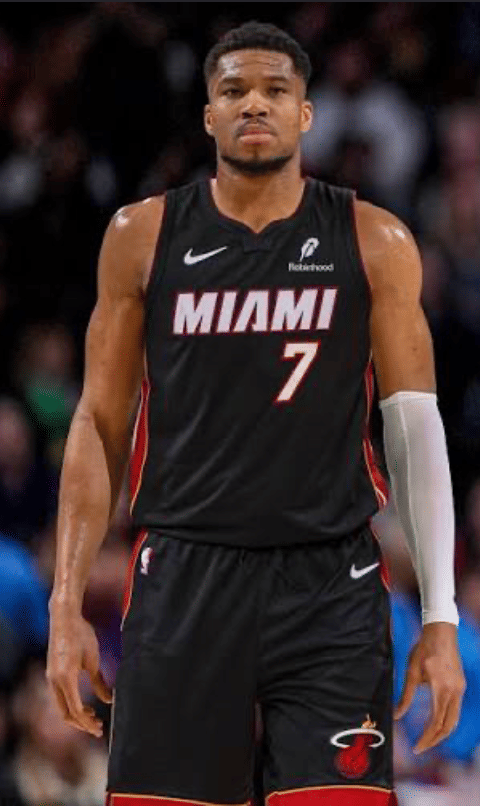
Miami Heat: 46.5 wins, we say 48
Miami went 43-39 last year and lost in the play-in, and Pat Riley responded the way he usually does: he went and got a superstar. The price for Giannis was Tyler Herro, Kel'el Ware, Jaime Jaquez Jr., Kasparas Jakucionis, the 13th pick, unprotected firsts in 2031 and 2033, and a pick swap in 2030. Bobby Portis, Klay Thompson and Tim Hardaway Jr. add shooting to the roster. Miami is now thin on tradable picks, which limits any follow-up move, though at 81 Riley is the person most likely to keep making calls anyway.
Giannis posted 27.6 points, 9.8 rebounds and 5.4 assists last year with 62.4% true shooting and a .597 free throw rate. Availability is the whole story. He played 73, 67 and 36 games over the last three seasons, and the most recent number is the problem. In a season with 65 or more games, he carried a 35.4% usage rate and a +12.3 net rating, which is MVP territory. He shoots 33% from three on 1.3 attempts a game, so he will not stretch the floor himself.
That puts pressure on everyone around him. Bam Adebayo has an 83-point game on his résumé and a field goal percentage that has dropped three straight years, from 52.1% to 48.5% to 44.2%, with true shooting following from 57.6% to 56.1% to 55.1%. He still produces 20 and 10 and made second-team All-Defense, but Miami needs more efficiency from him.
The shooters have to fill the gap. Andrew Wiggins hit 41.4% from three on five attempts, which completes a late-career turnaround. Portis shot 45% on 4.4 attempts and dropped 20 pounds in the offseason, and he could trade a few points of accuracy for volume at six attempts a game. Davion Mitchell is flirting with 40%, and Pelle Larsson is part of the same group. Thompson needs to get back to 40% to justify his place. Miami also has Erik Spoelstra, and we have never been in the business of betting against him.
The over needs Giannis and Bam both to play 65 or more games, with Giannis the larger risk of the two, and the shooters to hold their marks. The under arrives if his lower-leg injuries continue, if the depth lost in the trade shows up, or if defenses stop respecting the perimeter, which would shrink Giannis's free throw volume.
The call: 48 wins, over 46.5, and a four or five seed. We still think they need one more piece to be a real title threat, but a healthy Giannis in a playoff series changes how every opponent prepares.
Atlanta Hawks: 43.5 wins, we say 49
With Young shipped to Washington, Jalen Johnson is the offense. Quin Snyder spent years asking Young to play off the ball, and the trade settled that debate. Johnson played 72 games and averaged 22.5 points, 10.3 rebounds, 7.9 assists and 1.2 steals, shooting 48.9% from the field and 35.2% from three on nearly five attempts. His turnover rate of 14.9% needs to come down now that he runs the show. We project a jump to roughly 24 points and 10.5 rebounds, with the assists holding near eight.
Nickeil Alexander-Walker is the story nobody saw coming. He started 71 games and averaged 20.8 points, up from 9.4 the year before, with 3.4 rebounds, 3.0 assists and 1.3 steals. He shot 46% from the field, 39.9% from three on 8.1 attempts and 90% at the line, for 61% true shooting. In Minnesota he came off the bench behind Donte DiVincenzo. The closest parallel is Jermaine O'Neal, who couldn't crack the rotation in Portland and then blew up after a trade to Indiana. A scout told us the shooting is real, he moves well without the ball and needs few dribbles, but wants to see whether the threes hold near 40% once defenses run him off the line. That 39.9% was a career high, so regression is the biggest risk on the roster.
The defense is what makes Atlanta unusual. Dyson Daniels is a steals machine, Luguentz Dort arrived from Oklahoma City, and CJ McCollum gave 19 points and nearly four assists over 76 games across two teams. Put Alexander-Walker, Daniels and Dort on the court together and opposing guards and wings will have a miserable night.
The newcomers add more. Kingston Flemings, the eighth pick out of Houston, is 19, 6'2.5" and shot roughly 40% from three on 48% from the field with 1.6 steals. He plays the way Houston guards are taught to play: full-court pressure, deflections, chest on the ball. The comparison is early-career De'Aaron Fox, the Kentucky year and the first seasons in Sacramento. Zuby Ejiofor of St. John's is a 6'7.5" connector who defends and rebounds, with the three-point shot still unproven. Onyeka Okongwu is the small center who gave 15.2 points, a block and a steal a game, though his rebounding falls short for his role. The team also lost a stretch big it had planned around to a torn ACL on September 15.
The over comes from a full year of Johnson, a repeat from Alexander-Walker, another strong season from McCollum, and Flemings earning minutes as a floor leader. The under comes from the same place it comes from for everyone else: Johnson or Daniels missing time, Alexander-Walker cooling off, and an Eastern Conference that doesn't hand out wins.
The call: 49-33, well over 43.5. That puts Atlanta a slight margin ahead of Miami for the division title, and the winner likely hosts what shapes up as a four-five series. Even when the shots don't fall, this roster doesn't let opponents shoot well.
Where the division lands
The pattern across all five is that the division rides on games played, more than on talent. Davis needs sixty, Giannis sixty-five, Suggs at least sixty-eight, Miller somewhere near seventy-two, and Atlanta needs Johnson and Daniels upright for the whole run. Nobody here is short on ability. The question is who shows up in February.
The Atlantic Division is next on Friday, October 9. If you've missed the Central Division breakdown, it's the episode right before this one.
Send this one to the person in your group chat who still thinks the Southeast is a weak division. Follow us on X at @frontrunnerpc, on Instagram at @frontrunnerpc, on YouTube at @FRPCVince, and on TikTok. Thoughts over takes.
I'm Vince, this is Front Runner Podcast Collective, and we'll see you Friday.