By Vince Carter
Free agency doesn't move like a river. It moves like a heart monitor: drips and drabs, then a deluge, then you're standing in the rubble trying to figure out what just happened. Boston trading Jaylen Brown to Philadelphia is the flatline-to-spike moment that kicked the whole thing off. By the time the dust settled, two LA franchises had lost their franchise wings, Portland had somehow acquired even more point guards than it needed, and half the league went on a spending spree ranging from smart to genuinely baffling. Let's get into it.
The Trade That Doesn't Add Up
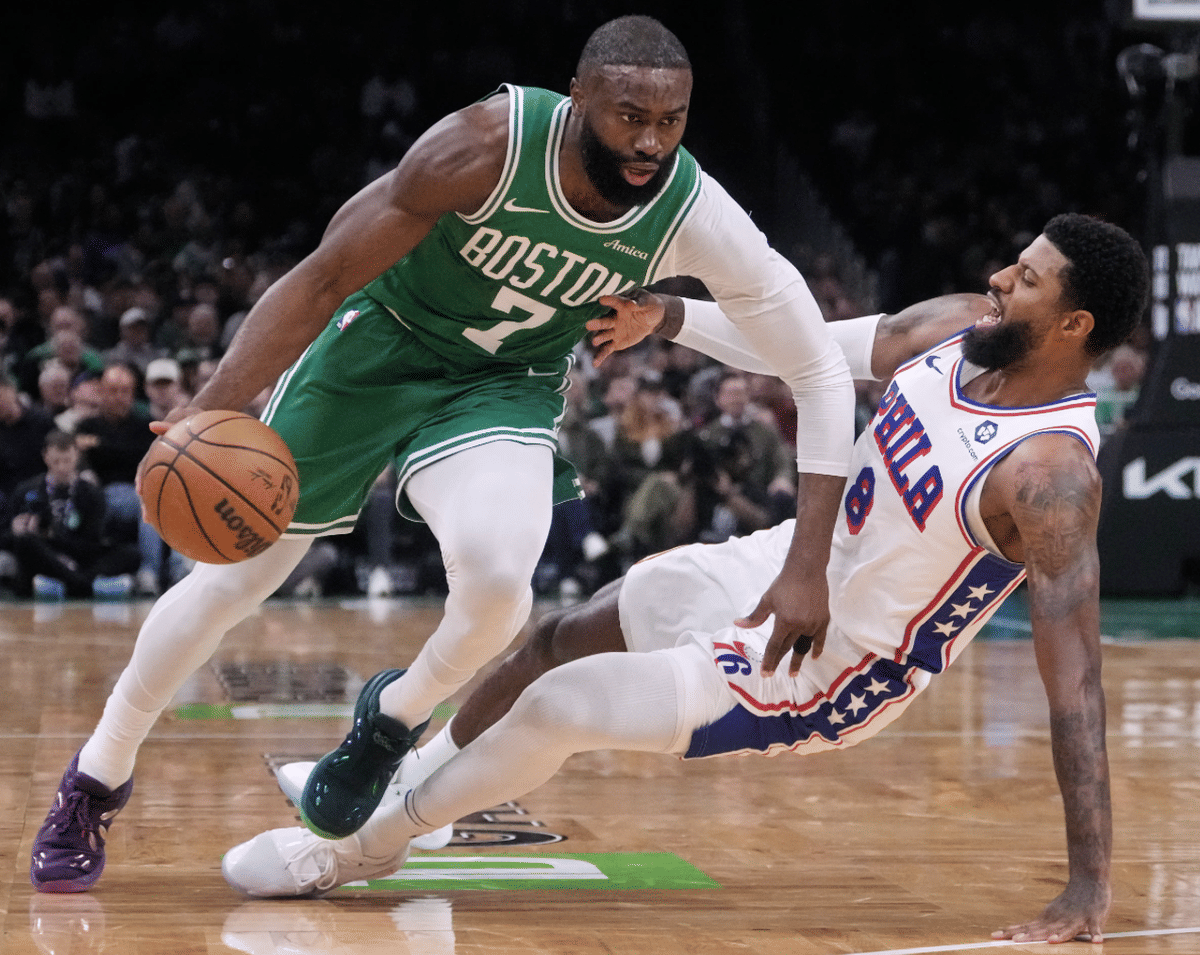
Let's get the numbers on the table first. Boston sends Jaylen Brown (28.7 points, nearly seven boards, five assists, All-NBA Second Team, arguably a First Team snub given he carried a Tatum-less Celtics team to 56 wins) to Philadelphia. In return, Boston gets Paul George, a 2028 first (converts to a Boston-favorable swap), a 2031 unprotected Philly first, a 2028 second (most favorable of Golden State, Oklahoma City, and Milwaukee), and a 2030 second (most favorable of Washington, Portland, and Phoenix).
Paul George's return line from his 37 games: 17.3 points, 5.3 rebounds, 3.6 assists, a 25-game PED suspension, and a knee that required surgery. He's 35.
"Put those two stat lines next to one another, and then you take into consideration Paul George's age. What doesn't add up?"
Here's the read: this trade only makes sense if Brad Stevens and the Celtics front office decided Brown's makeup was no longer manageable. Brown was shopped in Giannis talks back in June before Milwaukee sent Antetokounmpo to Miami. When that fell through, Boston didn't scrap the plan; they just found a new taker. This wasn't a reactive move born out of a single bad week; the front office had already made up its mind that Brown was gettable.
After a first-round elimination, Brown vented on Twitch about a league-wide agenda against him, and, more tellingly, called the Tatum-less season his favorite of his career. That's the line that mattered. Not the talent, not the production. The signal. Telling your organization, publicly, that the year your co-star was hurt and you got to do everything yourself was better than the year you won a championship is exactly the kind of red flag that shows up right before a front office moves on from a player it still values on the court.
Strip the character question away, though, and you're left with a front office that traded a 28-year-old coming off his best statistical season for an oft-injured 35-year-old, without ever fully shopping the deal to Portland, Atlanta, Phoenix, or a three-team package that could have brought back more actual assets. Boston is left with a suboptimal return. Full stop.
The bigger question hanging over Philadelphia: does Brown actually escape the co-star situation he just left, or walk into a shakier version of it? Joel Embiid's health record and Tyrese Maxey's need for touches as a ball-dominant lead guard mean Brown may end up playing the exact same role he played in Boston: carrying the operation when the higher-usage co-star is out, except now next to a center whose availability is even less certain than Tatum's recovery turned out to be.
Kawhi's Full-Circle Trip to Toronto
While Boston was blowing up its own timeline, the Clippers were quietly dismantling theirs. Kawhi Leonard is heading back to the Toronto Raptors, the team that drafted his championship pedigree in the first place, in a deal that sends Brandon Ingram, Grady Dick, two first-round picks, and two second-round picks back to Los Angeles. The headline basically writes itself: Kawhi returns to the six, and Drake gets new material.
It's the second star exit for the Clippers in as many years: Paul George left last summer, and now Kawhi is gone too. The Clippers have pivoted into a youth movement built around Ingram, Darius Garland, rookie Keaton Wagler, and a young core with real talent but zero proven chemistry.
Is it a downgrade going from Kawhi to Ingram? No shade intended, but yes. Ingram's biggest flaw has always been his reluctance to let threes fly, an issue that followed him from New Orleans to Toronto and never got fixed. Nobody's asking him to jack up eight a game; five would do it. Whether the infrastructure around him forces that adjustment, or he reverts to mid-range mastery in a crowded frontcourt, is the real story of the Clippers' season.
LA's Two Departures and One Very Different Response
LeBron James told the Lakers he's done, and at this point that's not breaking news so much as background noise while the league waits to see who wins the sweepstakes at 41 (soon 42). It's a little surreal that a player at this stage of his career is still moving the market the way he is; teams are going to be refreshing their phones for weeks waiting on a decision.
The Lakers' response to losing their franchise cornerstone was the loudest thing that happened all offseason, and it deserves its own deep dive.
The Walker Kessler Bet
Rob Pelinka had been chasing Walker Kessler for roughly two years, and finally got him via a sign-and-trade out of Utah: four years, $130 million. On paper, it's a strong rim-protecting bet: 12.2 rebounds and a 21.9 total rebound percentage in his last full season, an elite shot-blocking rate, and a lob threat who can catch anything Doncic throws up. The catch is a shoulder surgery that wiped out his following season, so this is a bet on his all-rookie-team ceiling, not recent injury history. Worth flagging for the scheme: Kessler is a drop-coverage center, not a big who chases wings on the perimeter.
Pelinka didn't stop there. Quentin Grimes signed for four years and $60 million on the mid-level exception: a capable, not great, three-point shooter (33-38% across stops) with Dallas chemistry with Doncic, but no track record as a point-of-attack stopper. Sandro Mamukelashvili came aboard on a four-year, $52 million deal as a stretch big who spaces the floor but offers little on defense. Colin Sexton signed for two years and $19 million off the room exception: instant scoring, minimal defensive upside.
Who Walked Out the Door
Here's where the roster construction gets uncomfortable. Marcus Smart declined his player option and signed with Houston to reunite with Ime Udoka, taking the Lakers' only real point-of-attack defender with him. A former Defensive Player of the Year who led the league in charges taken and served as the on-court captain of the defense, his box score (9.3 points, 2.8 rebounds, 3 assists) undersells his value completely: he was there to guard the other team's best perimeter scorer, and that job is now vacant.
Luke Kennard signed with Phoenix for two years and $13 million. Rui Hachimura, fun to watch in the clutch but a persistent liability guarding wings out of position, appears gone too, with reports pointing toward San Antonio or Brooklyn. Jackson Hayes, the connective piece who caught lobs and provided weak-side rim protection but was never an on-ball rim protector, signed with Utah.
"Nobody on this roster is a proven point-of-attack defender. That's the tension LeBron saw coming."
That leaves the Lakers without the draft capital to fix the gap via trade: they gave up unprotected firsts in 2031 and 2033, plus pick swaps in 2028 and 2030, just to land Kessler. DeAndre Ayton, their most movable piece at an expiring $8.1 million, can't be dealt without leaving the roster without a backup center. That's the bind Pelinka built for himself: he won the Kessler trade on paper and, in the same move, spent the currency he'd need to fix whatever else breaks.
The long shots to fill the defensive gap are second-round rookie Trevor Theero (six minutes a game across 25 appearances last season) and first-round pick Cameron Carr, a 24th-overall 3-and-D prospect who shot 37.5% from three but is entirely unproven defensively. Question marks, not answers.
There's a wider narrative here too. LeBron's exit reads less like a pure basketball decision and more like a verdict on trust eroding for years: back to LeBron offering to take less money so the front office could add talent (Harden, Klay Thompson, and Jonas Valančiūnas among the names floated), and the Russell Westbrook swing both LeBron and Anthony Davis pushed for. Both the front office's and the stars' judgment have been questioned by the fanbase, and this offseason doesn't fully settle it.
Portland's Backcourt Math Doesn't Work
Somewhere in the middle of all this, Ja Morant landed in Portland, a team that now also has Damian Lillard, Scoot Henderson, Drew Holiday, Shaedon Sharpe, Blake Wesley, and breakout two-way piece Caleb Love. That's not a backcourt, that's a depth chart with no chairs left. On pure value, Portland won the trade: no picks surrendered, no expiring salary attached, a former Rookie of the Year added. But stacking that many bodies at one position only makes sense as a bridge to something else.
The likeliest odd man out is Scoot Henderson, the former third overall pick who now risks getting buried behind veteran depth. Drew Holiday, Portland's most consistent player last season and reportedly not on the market, could still end up moved because the math doesn't work with this many guards on one roster. The Jaylen Brown trade only tightens that market, removing one of the few obvious guard-needy partners.
The Rest of the Board: Signings That Made Sense
Not everything this offseason was chaos. Austin Reeves agreed to a four-year, $185 million deal to stay in LA, with Draymond Green already putting the expectations on record: that kind of money means Reeves needs to prove he can be a 24-point-a-night guy consistently against the league's best defenses, not just the bottom of the standings.
Mitchell Robinson left New York for Boston's frontcourt on a three-year, $47 million deal: one of the league's best offensive rebounders, plus needed toughness, even if his free-throw shooting invites the Hack-a-Rob treatment nightly. Oklahoma City locked up Isaiah Hartenstein for three years and $75 million, keeping them out of the second apron. Miami retooled its spacing, adding Tim Hardaway Jr. on a one-year, $6.5 million deal (40.7% from three, Sixth Man of the Year finalist) and re-signing Andrew Wiggins.
San Antonio addressed a real need at the four, signing Tobias Harris for two years and $31 million. Coming off a season as Detroit's clear second option (18.1 points, 7.2 rebounds, 1.5 assists), Harris slides into a smaller role with zero long-term entanglement on the timeline. Houston added Bogdan Bogdanović. Indiana named wing depth a priority before free agency and delivered with Kelly Oubre Jr. on a two-year, $16.5 million guaranteed deal. New Orleans kept Jose Alvarado, and Charlotte re-signed Kobe White after trading LaMelo Ball to Minnesota.
The WTF Round
Every offseason has its head-scratchers. Trae Young's four-year, $212 million commitment from Washington leads the list, starting at $49.5 million and climbing to $56.9 million with player options in 2029 and 2030. It's hard to find another franchise that would have offered that number, and pairing a ball-dominant lead guard with a still-developing young core carries real risk if the fit doesn't click. Washington signaled its direction earlier than people realized, too: Jusuf Nurkić's modest two-year, $22 million deal was a quiet tell the roster was reshaping around a different timeline.
Philadelphia's Dean Wade signing raised eyebrows too: four years and $39 million for a 36.7% career three-point shooter who's never played more than 63 games in a season is a lot of term for a replacement-level defender with a streaky jumper. Keon Ellis, who lost his shooting touch entirely during the Cleveland playoffs, signed a two-year, $18 million deal with Brooklyn, a fresh start on a rebuilding roster.
None of these are franchise-crippling. But stacked together, they're the kind of decisions that make you wonder how much of free agency is real planning versus not wanting to be the team left standing when the music stops.
Where This Leaves the League
The dust hasn't settled. It rarely does in this window. Boston is betting its future on an aging star and a character-risk exit that could look shrewd or disastrous within a year. The Lakers spent nearly everything they had to solve one problem while creating another. Portland has a roster full of talent and no obvious blueprint for how it fits together. The shape of the league is already starting to show: who's building with a plan, and who's just reacting to the news cycle.
Got a take on the Brown trade? Think Pelinka won the summer or mortgaged it? Hit us up on X @frontrunnerpc or @Socially_FRPC, and subscribe wherever you get your pods so you don't miss the next breakdown.