By Vince Carter and FRPC Contributors
Baseline Buzz: Dallas Mavericks: Déjà Vu in Big D
Let’s go ahead and say it, the Cooper Flagg point guard experiment needs to die a swift, merciful death.
That’s not hate; that’s clarity. You don’t hand a 19-year-old the keys to a Tesla and expect him to drive through playoff traffic. This was never about potential, it’s about fit. Jason Kidd tried to turn Flagg into Giannis with a jump shot, but the problem is... he’s not Giannis, and the Mavs don’t have the spacing Milwaukee had.
What they do have is a fanbase living on borrowed optimism, waiting for the calf strain era to finally end and yet, here we are again.
Anthony Davis, the headline of our Baseline Buzz this week, is doubtful with a leg injury that’s listed as “day-to-day,” but everybody in Dallas knows that’s code for “nobody exhale yet.” Mavericks fans have seen this movie before, only now the main character switched jerseys.
When Nico Harrison pulled the trigger on the Luka Doncic-for-AD trade last season, it became the most infamous deal in NBA history, an experiment in risk tolerance that had fans lighting up every comment section from Reddit to TikTok. Luka’s name still echoes in the rafters, and every time Davis grabs his calf, you can hear the collective anxiety ripple across Texas.
Davis’ numbers are still elite, 20.8 points, 10.2 rebounds, 58.7% true shooting in just under 30 minutes per game, but that’s never been the problem. He plays great. Until he doesn’t play at all.
And now, the dominoes are lined up again. Dereck Lively II is out (knee). Kyrie Irving, recovering from that ACL tear he suffered late last season, is “ahead of schedule,” which is like saying “not dead yet” in Mavs language. Dante Exum is out too. Dallas isn’t just short-handed; they’re short on stability.
Jason Kidd keeps insisting on “getting reps” for Cooper Flagg as the primary initiator, which sounds nice in a developmental meeting but looks like chaos on film. The rookie is shooting 39.4% from the field, 29% from three, and while the rebounds (6.6) and assists (2.8) look fine in a vacuum, it’s empty calories. Dallas doesn’t need a teenage quarterback; they need a vertical finisher who makes defenses think twice about collapsing.
Meanwhile, Daniel Gafford, bless him, is doing what he can, 12 points, 5 boards, 75% from the field, but he’s a bridge, not a foundation. Dereck Lively’s rim protection (15.1 TRB%, 27.5 AST% in 17 minutes) is still missing, and without it, Dallas’ defense is Swiss cheese.
And the fans? Still smoldering from the Luka trade, still asking the same question: Was this worth it?
Because when your 32-year-old cornerstone comes into camp heavier, tweaks the same muscle he strained in L.A., and your franchise is already paper-thin at the rim, “wait and see” stops feeling patient and starts feeling naïve.
The tension in Dallas isn’t new, it’s just rebranded. One spark (another setback, a slow start, a quote from AD that hits wrong) and the venom from last year’s trade backlash is coming right back. The fan base is loyal but scarred, and this city remembers.
Dallas doesn’t need “healthy soon.” They need a plan that survives reality.
Stat Snapshot Dallas Key Core
Player | PTS | REB | FG% | 3P% | Status |
|---|---|---|---|---|---|
Anthony Davis | 20.8 | 10.2 | .520 | .273 | Doubtful (Leg) |
Cooper Flagg | 14.4 | 6.6 | .394 | .290 | Active |
Dereck Lively II | 5.3 | 5.0 | .778 | — | Out (Knee) |
Daniel Gafford | 12.0 | 5.3 | .750 | — | Healthy |
Kyrie Irving | — | — | — | Out (ACL rehab) |
Viral Line from the Pod:
“Dallas is reliving this nightmare over and over again, it’s like Groundhog Day, but without Bill Murray.”
Soraya’s Note: “Availability scales titles. Résumés sell jerseys.”
🎙️ Under the Radar, Over the Edge
Some guys make noise. These guys make tape.
Every year, there’s a handful of NBA names you can’t find on a jersey rack but you’ll hear whispered on League Pass Reddit threads, the ones who quietly flip the math on second units and turn throwaway possessions into film study fuel. Vince had eleven of them lined up in the Baseline Buzz: not the household names, but the rent-is-due crew.
The first name off the board is Ajay Mitchell in Oklahoma City, is already a Sam Presti fever dream. He’s the guard who moves like he’s late for class but never misses attendance. His left-hand drive is NASCAR-predictable and still unstoppable, like every defense has the scouting report but no one read it. Vince put it perfectly on air: “He’s gonna go left. He’s gonna keep going left. And when you think he’s done going left, he’s going left again.”
Mitchell’s game doesn’t hum; it glides. He’s the connective tissue in a Thunder team that already feels like a physics lab, all kinetic energy and zero waste.
Then there’s Ryan Rollins in Milwaukee, the quietest player in the loudest system. The Bucks have a way of finding these low-ego guards who do the dirty math: smart paint touches, low turnovers, never-rushed decisions. Vince called him “steady Eddie,” which in FRPC language means you’re the adult in a room full of splash plays. He’s not changing the skyline, but he’s keeping the lights on.
Colin Gillepsie, Phoenix. If the league had a “You’ve Earned This” award, he’d win it twice. Villanova blood, G-League grind, and finally the minutes to show he’s not a placeholder, he’s the guy you actually play when the rotation tightens. Forty-two assists to twelve turnovers, and the man barely blinks. He’s the unbothered barista of the Suns offense: no flair, no foam, just results.
Cam Spencer in Memphis? The antidote to all that empty highlight hunting. He doesn’t jump high, he doesn’t move fast, but he moves right. Vince’s phrase: “He’s a connector.” He’s what coaches mean when they mumble about “glue guys” with misty eyes. Soraya Note: Cam Spencer defends like he’s filing taxes, boring, consistent, and terrifyingly thorough.
Out in Utah, Keyonte George is the opposite energy. The Jazz are bad, the vibes are weird, but he’s dancing through it like a kid at prom. The comp is inevitable, “not Jalen Brunson, but with Brunson essence”, the kind of player who turns hesitations into scripture. He’s not here for moral victories; he’s here for buckets.
In Miami, Dru Smith is out here playing like the basketball gods finally sent him a clean MRI. More steals than fouls. More heart than fear. Every Heat player says they “embody Heat Culture.” Smith is Heat Culture, disruptive, unglamorous, entirely unafraid.
Then came the surprise name that made Vince grin mid-monologue: Mouhamed Gueye in Atlanta. A pogo stick with homework due. The man guarded Paolo Banchero like he had a vendetta, one of those moments where you realize raw athleticism plus film discipline equals chaos for opposing wings. If you blinked during that matchup, you missed a masterclass in vertical violence.
Jamal Shead in Toronto! He’s the floor general you’d draft if your franchise was allergic to turnovers. Forty-three assists, eight turnovers. He doesn’t do mixtapes. He does infrastructure.
In Orlando, Tristan da Silva has that IQ-of-a-coach’s-kid vibe. You watch him for five minutes and immediately know he’s seen every angle before you did. Forty-one percent from three, all off movement. He doesn’t hunt shots; he stumbles into them, then punishes you for overhelping.
Cleveland’s Jaylon Tyson, fresh legs, grown-man patience. He plays like a guy who’s already been cut once and didn’t like the feeling. Efficient, poised, quietly mean.
And finally, the sleeper headline: Jake LaRavia in Los Angeles, from Memphis to Sacramento to the Lakers, and finally home to relevance. Vince’s delivery was pure gold: “White dudes out here just yamming on people, it’s great theater.” That’s the LaRavia file. The league keeps underestimating how much value there is in knowing your lane and how fast you can sprint it.
If the stars make the posters, these are the guys who make the box score make sense.
Vince framed it perfectly as the segment wrapped: “Each loss teaches something. Each win hides a story. These guys, they’re the stories that leak through the cracks.”
This is the layer of the NBA casual fans miss, the everyday brilliance of dudes who will never trend, never headline, but who bend games quietly. They don’t change the highlight reels. They change what’s possible.
🏀 The Return of the Grown-Up: De’Aaron Fox and the Spurs’ Balancing Act
There are fixers in the NBA, veterans who don’t come to make headlines, they come to make sense. De’Aaron Fox might just be that for San Antonio.
He’s coming back Saturday against the Pelicans after a frustrating hamstring rehab. It’s not flashy timing. It’s not even a national TV game. But for the Spurs, this is a return that feels like oxygen.
Because let’s be honest, the guard room’s been a revolving door and a daycare center. Dylan Harper, the promising rookie who plays with the confidence of a guy twice his age, is out with a calf strain. Stephon Castle, bless his competitive heart, still thinks he’s a point guard. The numbers (and the turnovers) say otherwise.
“It was cute that he thought he was a point guard,” Vince said on the pod, his voice somewhere between empathy and exasperation. “We clearly see that’s not the ultimate position for him.”
Castle’s got tools. Size, defense, the kind of footwork that makes you forget he’s only 21. But when the lights hit and the game slows down, he’s playing catch-up, the reads are a beat late, the dribbles a touch too high, the turnovers too D’Angelo Russell for comfort.
He’s sitting on 19.4 points per game, shooting an impressive 51.8% from the floor. But it’s those six assists and five turnovers that tell the real story. The man can run a play, he just can’t yet run a team.
Enter Fox.
When the Spurs traded for De’Aaron Fox last season, it was a move that said: we’re tired of waiting for development to catch up to our talent. The goal wasn’t just speed or scoring, it was adulthood.
Fox isn’t just another shot creator. He’s a fourth-quarter adult. He’s seen playoff doubles, bad rotations, and crunch-time noise. He doesn’t flinch. That alone makes him the most valuable player in a Spurs lineup that’s been growing like a science experiment, a bit of brilliance, a lot of chaos, and occasional smoke.
“He’ll be the grown-up the Spurs need,"He’ll get the ball to Wemby, stabilize the guard room, and in the long term, the whole offense.”
That sounds tidy. But look closer. It’s not just about getting Wembanyama touches, it’s about where and how he gets them.
When Fox delivers an entry pass, it’s not the forced dump-off we saw from Sochan last season. That experiment was pure chaos, a 6’8 power forward trying to play air traffic controller in a storm. Every possession looked like a group project where no one did the reading. Soraya Note: The last time the Spurs asked Sochan to run the offense, the ball cried. Fox’s arrival should come with tissues and thank-you notes.
Now? Wemby’s getting the ball in rhythm, in motion, and within structure. His 25.6 points per game felt smoother, not the “give me the ball and move” diet from last year, but a steady diet of lobs, cuts, and mismatches Fox helps create.
Fox’s rim pressure is the real gift here. Defenses can’t load up on Wembanyama when there’s a guard sprinting downhill every possession. Fox drags the defense inward, and suddenly those double teams on Wemby have a cost.
And for Castle, Fox’s presence means breathing room. He doesn’t have to be the conductor anymore, he can be the soloist. A secondary ball handler, working off Fox’s tempo, playing in space instead of stress.
It’s a simple shift, but in basketball, simplicity is a superpower.
Then there’s Dylan Harper. The rookie with a linebacker’s frame and a college guard’s creativity. He’s been sidelined, but make no mistake, his absence hurts. Harper isn’t polished, but he’s the bridge to the Spurs’ future. His playmaking instincts are what let you imagine a world where Fox moves off-ball in two years and Harper becomes the engine.
“If Dylan Harper pops, if he’s who I think he is, he’s the one who could move Fox to the two.”
That’s the roadmap. In the short term, Fox is the stabilizer. In the long term, he’s the mentor. San Antonio hasn’t had that kind of guard clarity since Tony Parker, someone who knows when to go and when to guide.
And for a team that’s been rebuilding while pretending it isn’t, that’s worth more than any box score.
his is the version of San Antonio that might finally make sense. Not just highlight reels of Wemby blocking shots into orbit, but a real basketball organism, spacing, timing, order.
Fox’s presence won’t fix everything. But it will make the right things possible. Wemby gets easier looks. Castle learns structure without being crushed by responsibility. Harper’s rehab becomes a subplot, not a crisis.
🦅 The Trae Young Thriller: Atlanta’s High-Stakes Reality Show
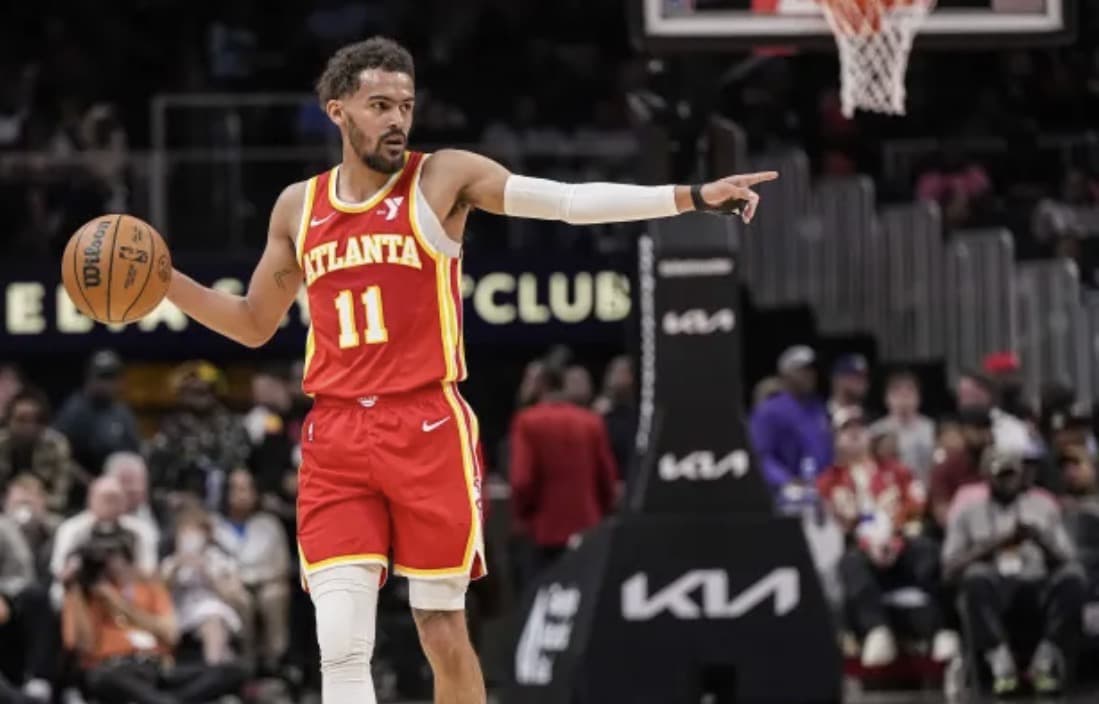
This isn’t basketball right now, it’s theater with a shot clock. Every Hawks game feels like a poker hand, and Trae Young’s sitting at the table with sunglasses on, trying to convince everyone he’s holding aces.
(Oh, too soon? We’ll skip the gambling metaphors, but you get the point.)
Because in Atlanta, every dribble, every heat check, every postgame shrug is a referendum on Trae Young’s future.
The extension talks? Pushed until the end of the year. The faith? Wobbling. The message from the front office is clear, show us something different.
🎭 The Tension: Trae and the Franchise That’s Tired of the Reruns
The Trae Young Era started like a movie, logo threes, All-Star flair, and one delirious Eastern Conference Finals run. But somewhere between the coaching carousel and the “this time it’s different” roster reboots, the Hawks’ script started to sound like reruns.
Now, the entire organization feels like it’s on the edge of an awkward breakup. The kind where both sides swear they’re “just focusing on themselves,” but everyone knows one of them already changed the Netflix password.
“Every game is a referendum on Trae Young’s tenure with the Hawks,” Vince said on the pod. “You can feel the tension. It’s not vibes anymore, it’s evaluation.”
The numbers tell you why the eyes are narrowing.
Trae’s averaging 17.0 points, 7.8 assists, and shooting just 37.1% from the field, a career-low efficiency for a player once feared as a heat-check machine. The shot diet? Still heavy on 28-footers. The turnovers? Still showing up like they pay rent.
Meanwhile, Jalen Johnson is out here looking like the adult in the room.
🔄 The Counterpoint: Jalen Johnson’s Calm in the Chaos
Every Quin Snyder offense needs a connector, someone who understands tempo, spacing, and sanity. Jalen Johnson, at 24, has suddenly become that guy.
He’s averaging 20.6 points, 8.6 rebounds, and shooting a silky 58% from the field. What’s more telling? He’s not hijacking possessions with early-clock threes or over-dribbling through traffic.
“Jalen doesn’t jack 35-footers with 19 seconds on the shot clock,” Vince quipped. “That’s a revolution in Atlanta.”
It’s not just a shot-selection joke, it’s cultural commentary. Johnson plays like someone who’s seen what not to do. There’s a maturity in his pacing, and you can see Snyder’s fingerprints all over it, fewer iso possessions, more second-side reads, more collective rhythm.
And that’s the threat to Trae’s throne: a functioning offense without him at the controls.
🧱 The Foundation: Defense and the Daniels Effect
Here’s the thing nobody saw coming, the Hawks’ defense has started to matter.
Not in a highlight-reel way, but in that subtle, “we don’t look like turnstiles anymore” kind of way.
Dyson Daniels deserves a statue (okay, a small plaque, maybe). The 22-year-old guard is averaging 10.1 points, 5.8 rebounds, 3.8 assists, and quietly playing like he’s allergic to dumb basketball. He’s their best defensive guard by a mile, and every lineup he’s in suddenly looks… organized.
He doesn’t gamble. He doesn’t overhelp. He just competes.
And that’s contagious, the kind of defensive tone the Hawks haven’t had since they were trying to convince themselves De’Andre Hunter was a stopper.
“If these young wings take care of the ball and run the offense,” Vince said, “the front office might just decide they can move forward without Trae.”
That’s not hot-take talk anymore. That’s internal reality.
⚖️ The Pressure: Extension on Ice
Let’s be clear, nobody’s saying Trae Young’s washed. He’s still one of the best offensive engines in the league when he’s locked in and a pick and roll maestro in the entire NBA! But the patience has worn thin.
The extension talks pushed to the offseason are the NBA’s version of “we’re just taking a break.” And breaks rarely end with both sides happier.
Every missed pull-up three, every sulky possession, every bad defensive angle feels like an audition for other GMs. And that’s a dangerous energy to have around a franchise that already feels like it’s done the “what if” tour for too many seasons.
“You can’t keep promising change and then show up with the same soundtrack,” Soraya said. “Fans want to see evolution, not remixes.” (source: observation)
🧩 The Supporting Cast: Okongwu and NAW Holding the Line
Here’s what keeps this from being a full implosion: the other guys are hooping.
Onyeka Okongwu is finally getting consistent minutes and turning them into production, 13.9 points, 8.4 rebounds, and a surprising 40.7% from deep on 3.4 attempts per game. His defensive metrics (.626 TS%, +0.3 BPM) show what he’s always been, a switchable, sturdy anchor who doesn’t need headlines.
And Nickeil Alexander-Walker, maybe the quietest comeback story in the East, has found the middle ground between chaos and control. 17.3 points per game, nearly 3 assists, and a knack for showing up in moments when Atlanta desperately needs an adult bucket.
They’re not stars. They’re structure. And for once, the Hawks have more of that than vibes.
The Hawks don’t need a savior. They need someone who can read the room and the defense.
🔥 The Punchline: Trae’s Mirror
Here’s the hardest truth, Trae Young is staring into his own reflection.
The things that made him special, creativity, defiance, volume, are the same things the Hawks now need less of.
That’s not hate; that’s evolution.
If the young wings keep running Quin Snyder’s system with pace, composure, and purpose, it’s going to force a choice. Keep building around the most volatile star in the East… or pivot to a style that actually breathes.
“Atlanta used to live off Trae’s chaos,” Host said. “Now they’re surviving without it. That’s the scary part.”
And that’s where this season becomes more than just a standings story. It’s a referendum, not just on Young’s extension, but on Atlanta’s identity.
Are they still the team that needs Trae’s magic to function?
Or are they quietly realizing that discipline might be their next superstar?
🔥 Miami Heat: Fire, Culture, and Real Flames
Every season in Miami starts like a lab experiment. Erik Spoelstra walks into the gym with that half-smile, clipboard in hand, and a brand-new basketball elixir he swears will fix what the rest of the league forgot to cure.
This time, the concoction is a motion offense that looks like a merry-go-round after three cups of Cuban coffee. Everyone’s cutting, screening, reversing, it’s a cardio symphony that only the 4% body fat club could execute.
Spoelstra’s latest design isn’t about stars; it’s about stamina. And if you’re not ready to share the sugar, you’re gonna be left staring at the ball as it whips past your head.
🚴♂️ The Motion Experiment
At 4–4, the Heat are running like their lives depend on it. Literally. Their pace (105.3) ranks first in the NBA, and they’re averaging a blistering 122.4 points per game, a fireworks show disguised as organized chaos.
What’s wild is how calm it all looks. This isn’t the frantic, scramble-heavy Heat we’ve seen in years past. There’s balance now, an offensive rating of 116.2 and a defensive rating of 111.7 paint the picture of a team learning to sprint without stumbling.
“The weirdest calm,” Vince said on the pod. “They’re one of the fastest teams in basketball, but it doesn’t feel panicky.”
Without Tyler Herro, who’s sidelined with an ankle injury (still 4 -8 weeks from return), Spoelstra has built a system where everyone eats, even if nobody’s feasting.
Herro’s absence has forced Miami to turn motion into its leading scorer. Every possession is a math problem: cut, pass, relocate, repeat.
And right now, Norman Powell has the answers.
🎯 Norm McBuckets: UCLA’s Revenge
Powell’s been the surprise constant, dropping 23.2 points per game on 46% shooting and an absurd 51.7% from deep.When Miami traded for him, the skeptics called him a bench gunner; Spoelstra turned him into a scalpel.
He’s not just filling Herro’s shot diet, he’s reshaping it. His off-ball timing is pristine, his spacing forces defenders to stay honest, and his rim pressure is giving Bam room to operate like the Bam of old.
“Boy, let me tell you,” Vince said, leaning into the mic. “Norm Powell out here, UCLA dude, just cooking. Twenty-three a night, efficient, confident, grown-man shots.”
It’s not just hot shooting. It’s intentional shooting, the kind of rhythm Miami hasn’t had since prime Duncan Robinson was hunting corner threes like bounties.
🧊 Bam Still Bam
Then there’s Bam Adebayo, Miami’s heartbeat, their defensive soul, and now, quietly, one of the best playmaking bigs in basketball.
He’s posting 19.9 points, 8.1 rebounds, and 2.9 assists per game, the usual sturdy production, but it’s how he’s doing it that matters. Bam’s become the stabilizer in the middle of Spoelstra’s merry-go-round offense.
He’s directing traffic, punishing mismatches, and reading defenses like he’s been sneaking film sessions with Jokic. And while the Heat’s offense feels new, Bam’s presence feels like gravity, everything orbits around his intelligence.
“He’s still Bam Adebayo,” Vince said. “Defensive captaincy, stability, still the one who makes the chaos make sense.”
And when Bam isn’t in the action, Andrew Wiggins has found his lane. Literally.
🛣️ The Wiggins Adjustment
It’s easy to forget that Wiggins, now 30, came into the league with LeBron-sized expectations and Minnesota-sized confusion. In Miami, he’s none of that. He’s a role player who finally looks comfortable.
17.0 points per game, 53.4% from the field, and a 60.2% eFG suggest a man who’s finally coloring inside the lines. He’s not forcing pull-ups, not freelancing, just fitting, and thriving, inside Spoelstra’s system.
“He knows exactly who he is right now,” Vince said. “He’s not an ancillary piece, he’s in a comfortable space.”
Wiggins doesn’t need to carry Miami. He just needs to balance it. Between Bam’s leadership, Powell’s firepower, and Jaquez Jr.’s glue energy, the Heat’s offense feels like a machine that Spoelstra assembled out of mismatched but perfectly complementary parts.
🧩 Jaime Jaquez Jr.: The Spoelstra Guy
If you asked Spoelstra to design a player from scratch, he’d probably come out looking like Jaime Jaquez Jr., scrappy, efficient, and always two steps ahead.
Jaquez Jr., is BACK! After a tough sophomore seasonJaime Jaques Jr. is hooping for real. He’s putting up 17.4 points per game, shooting 60.9% from the field, and has one of the highest effective field goal percentages (62.5%) among non-centers in the East.
Jaquez doesn’t care about touches; he cares about timing. He’s that one pickup player who scores quietly but always makes the right read.
And you can see why Spoelstra loves him, he’s connective tissue. In a lineup filled with volatility, he’s predictability in motion.
Spoelstra: The Survivor and the Human
Now, here’s where the Miami story takes a real turn, the kind of turn that reminds you these guys are people before they’re play-callers.
A couple days ago, Erik Spoelstra’s five-bedroom, six-bath home caught fire and went up in flames. No injuries were reported, but the house, the personal anchor of one of the NBA’s steadiest figures, I can’t even imagine what this man is trying to battle through.
You can talk all day about Heat culture and resilience, but this is real-life resilience.
“Money doesn’t solve everything,” Vince said on the pod. “Yeah, he’s made plenty, but losing your home, your memories, that’s tough. He’s been through divorce, family adjustments. You can coach through chaos, but this is different.”
For a coach who’s spent a career adapting to on-court adversity, this is his off-court version of the same. And you can bet his team will mirror his response, with empathy, and focus.
The man has spent 16 years redefining “resourceful.” Whether it was LeBron’s dynasty, Butler’s overachievers, or this motion-driven experiment, Spoelstra finds a way. He doesn’t just reinvent systems, he reinvents himself.
“He’s not just an NBA lifer,” Host said. “He’s an NBA survivor.”
🏁 The Meaning Behind the Motion
The Heat sit at .500, but records don’t scare this team. They’ve lived at the intersection of chaos and control for years. And this new system? It’s not about flash, it’s about faith.
Faith that conditioning outlasts talent. Faith that structure beats superstardom. Faith that Spoelstra, through fire, literal and figurative, will still find a way.
Because if there’s one truth about Miami Heat basketball, it’s this: they don’t rebuild, they reformulate.
⚡ Memphis / Ja Morant: Discipline vs. Chaos
If Atlanta is a referendum and Miami is a religion, then Memphis right now is a rehab program, for both body and brand.
And at the center of it all is Ja Morant, the NBA’s most explosive contradiction.
No one doubts the electricity. When he’s flying through the paint, limbs bending physics, Memphis looks like the loudest team in the room again. But when the jumpers start clanking and the frustration builds, that same energy turns combustible.
“There’s a point guard that’s much maligned in Memphis, Tennessee right now,” Vince said on the pod. “Would Ja Morant be a right landing spot… maybe Atlanta? Maybe Miami?”
The question isn’t if Memphis will eventually have to decide on Ja... it’s when.
🧪 Miami: The Wrong Kind of Chemistry
Let’s start with the one that sounds fun until you think about it: Miami.
It’s easy to picture, Ja in the open floor, Spoelstra designing blur actions around him, Pat Riley quietly watching from the rafters. It’s cinematic. It’s also completely unrealistic.
“I think Miami would be wonderful for Ja,” Vince said. “But I don’t know if Ja would be wonderful for Miami.”
"Miami would fix Ja. But Ja might break Miami."
That’s it. That’s the whole scouting report.
Miami is built on control, 4% body fat, conditioning drills from hell, a zero-tolerance policy for distractions. They’re an accountability lab. And right now, Ja Morant doesn’t fit in that ecosystem.
Forget the discipline for a second, the basketball fit isn’t there. Ja’s still shooting under 15% from three. Even if he climbs to the high-20s, that’s not enough spacing to function next to Bam Adebayo, Jaime Jaquez Jr., and whatever version of Tyler Herro comes back.
In Miami’s offense, if you can’t stretch the floor, you stretch the patience.
And off the court? Let’s be real.
“You’re gonna let Ja out on South Beach?” Vince laughed. “That sounds like a bad idea for everybody involved.”
Pat Riley’s Heat is not a place for self-discovery, it’s a place for self-discipline. And Ja’s story still needs the former.
🏀 Atlanta: Controlled Chaos
Now, Atlanta, that’s a different kind of possibility.
The Hawks have the infrastructure to hide him. Length on the wings with Jalen Johnson, Dyson Daniels, and Nickeil Alexander-Walker. They can cover up his defensive gaps. They’ve got shooters everywhere.
It’s a place where Ja doesn’t have to shoot threes, just create gravity.
Purposeful paint touches, drive-and-kick, rhythm over chaos.
“He’d be a better fit in Atlanta,” Vince said. “They’ve got size, they’ve got shooting, they can hide him on defense.”
It’s not perfect. Ja’s usage rate would drop, and his ego would have to follow. But the trade mechanics make sense.
If Atlanta decides the Trae Young experiment has run its course, Ja’s contract and timeline line up well.
And here’s the kicker, Memphis doesn’t have leverage anymore.
Morant’s value is perception, not production right now. That’s why Bobby Marks would tell you: “Distressed asset, high risk, potential reward.” The return won’t be superstar-level picks or blue-chip prospects. It’ll be the best of the worst-case scenarios.
You trade him for fit, not flash.
🪞 The Reality Check
Ja Morant’s problem isn’t talent, it’s translation. His game needs a system that amplifies his explosiveness without exposing his judgment.
In Memphis, the patience has worn thin. The front office has protected him, defended him, suspended him, and still found themselves stuck in neutral.
Miami would offer order, too much of it. Ja unleashed on South Beach, does anyone want to ponder the scenarios that could spark in your imagination?
Atlanta would offer cover, just enough to work.
Either way, it’s becoming clear: the version of Ja that once looked like the NBA’s future now looks like a test of whether culture can save the swirling chaos.
🏗️ Washington Wizards: The Pain of Progress
You gotta talk about the Wizards, man.
Yeah, I know, they’re 1–7. Washington Wizards fanbase must have known the deal went the organization pulled the trigger on the rebuild instead pretending, the defense is optional, and the box scores look like crime scenes. But every team’s important, damn it. Every loss teaches something. And Washington’s film right now won’t shut up.
It’s screaming lessons, some painful, some promising.
They run fast. They defend almost nothing. But they’ve got two kids, Alex Sarr and Kyshawn George, who make the pain worth sitting through. If anything comes of this season it is the improvement of these two second year youngsters and their first round pick from the 2025 NBA draft Tre Johnson.
🌱 The Sprouts in the Rubble
Let’s start with Sarr. The 7’1 French unicorn who was supposed to be all “potential” and no polish suddenly looks like a real basketball player.
He’s averaging 19.0 points, 8.4 rebounds, 3.9 assists, and shooting 45.5% from three, not “stretch-big hopeful” numbers, but stretch-big arriving numbers.
“Anytime you’re 7’1” and you can shoot it from outside, you got a chance in this league,” Host said.
He’s smooth, decisive, not scared of contact. The rim protection’s there. The rebounding is improving. The jumper’s clean enough that defenses actually close out. You can build with that.
He’s not the guy, not yet, but he’s one of the guys. Every rebuild needs one of those before it finds the one.
And then there’s Kyshawn George.
He’s that lanky, twitchy, 6’8 wing every modern GM hoards like crypto. He’s giving you 16.8 points, 6.8 boards, 4 assists, and knocking down half his threes, 50% from deep.
When he’s locked in, he’s a deflections machine. When he’s not, he looks like he left his defensive effort at TSA. But when the discipline hits, you see why the Wizards are betting on him.
“When the discipline is there, he can provide really good defense,” Host said. “He gets deflections, he’s got the length, he just has to lock in.”
🧨 The Growing Pains
Now, let’s not sugarcoat it, there’s pain everywhere.
Their net rating: -15.5. The defense? Leaks like a screen door in a hurricane. Their last loss was a 136–107 meltdown against Boston.
They’re learning by losing, and that’s the point.
This is what real rebuilds look like, ugly, honest, and educational.
And that brings us to Tre Johnson, their teenage scorer still trying to figure out which end of the court pays the bills.
He’s putting up 11.6 points per game, but let’s keep it real:
“He can’t defend a doghouse,” “I wouldn’t let him defend a trash can.”
The thing is, that’s okay. He’s 19. You didn’t draft him to lock up Jalen Brown, you drafted him because one day, he might become your shot-creating wing next to Sarr and George. This season is about reps, not results.
The Organizational Therapy
Years of mediocrity numbed D.C. basketball. The 38–44 treadmill, the “we’re close” delusion, the purgatory between lottery and playoffs, it’s over. Finally.
Trading Jordan Poole out of the building was a cleanse. Adding C.J. McCollum and Khris Middleton as stabilizers? That’s professionalism.
You’re not building around vets; you’re building through them. They’re here to show these kids what habits look like, not take their minutes, but model their work.
“Develop, keep the pick, preserve the flexibility,” “The vet minutes help with structure.”
That’s the mission. No shortcuts. No fake .500 runs.
You’ve got to sit in the mud until the foundation dries.
💬 The Reality Check
It’s going to hurt.
They’re going to lose a lot. The nights will be long, and the box scores will be mean. But that’s the cost of trying to build something real after years of pretending to.
Alex Sarr isn’t a mirage. Kyshawn George isn’t a fluke.
They’re foundation pieces, the kind that make the losing worth watching.
Washington’s not cursed; it’s just in therapy.
And sometimes, you’ve got to cry through the session to get better.
🐝 Charlotte Hornets: Talent Without Urgency
Another season, another rerun in Charlotte.
Buzz City’s got all the flavor, and none of the finish.
They’re sitting at 3–5, 12th in the East, and if you squint, the numbers almost look respectable. Offensive rating: 119.2 (5th in the league), that’s fireworks.
Defensive rating: 119.2 (26th in the league), that’s a fire hazard.
Put them together, and you get a net rating of 0.0, the perfect statistical representation of Charlotte basketball: balanced mediocrity with good taste in sneakers.
🎭 The LaMelo Paradox
Here’s the story, and it hasn’t changed in three seasons: LaMelo Ball is box office. He’s electric, improvisational, and completely unpredictable, the NBA’s equivalent of a stand-up comedian who won’t stick to the setlist.
23.3 points, 9.8 assists, 7.8 rebounds, the numbers scream franchise cornerstone.
But dig a little deeper and you start to hear the static: 43% shooting, 33% from three, 51.8% eFG. Those numbers whisper something else entirely, talent without timing.
“LaMelo is another Trae Young type,” “He’ll shoot a 35-footer for no apparent reason.”
And that’s the problem.
There’s a difference between fun basketball and winning basketball. LaMelo hasn’t made that leap yet, not because he doesn’t want to win, but because he doesn’t understand what winning habits look like.
You can’t be both the highlight and the hindrance.
🧨 The Leadership Question
The Hornets don’t need LaMelo to be perfect. They need him to be serious.
Because for all the flash and flair, what Charlotte’s missing is urgency, that willingness to do the boring things that make the exciting things matter.
“There are winning plays and there are losing plays,” “And anytime you shoot a 37-footer with 16 seconds on the shot clock, that’s a losing play.”
It’s not that LaMelo can’t make that shot. He can.
It’s that he shouldn’t have to.
He’s supposed to be the tone-setter, the one who controls the room, not tests its patience. Charles Lee came in to rewire the system, but even he can’t coach accountability into existence.
Until Ball trades a few of those logo threes for smart possessions, Charlotte can’t take that next step.
🌟 The Hope Spots
Now, it’s not all gloom and doom.
If the Hornets are a slow-building drama, Kon Knueppel is the breakout supporting actor.
At 20, he’s averaging 14.8 points, shooting 41% from deep on 7.6 attempts, and more importantly, he looks like he knows who he is. He’s a movement shooter, disciplined in his routes, and never in a rush.
“Kon Knueppel’s jumper is crispy clean,” “He’s doing exactly what he’s supposed to be doing.”
It’s rare for a rookie to feel professional this fast. Knueppel does.
He’s not hunting fame, he’s hunting open looks.
And then there’s Miles Bridges, quietly putting up 21.5 points and 6.6 boards a night. He’s been steady, physical, and committed to being the secondary scorer LaMelo needs.
Meanwhile, Collin Sexton, the wild card from Utah, has found his lane as a slasher and complementary guard. 16.1 points, 5.3 assists, efficient shooting across the board. He’s not flashy, but he’s functional and that alone is progress for a team that’s allergic to consistency. Trade deadline trade bait if I ever seen one!
🧱 The Building Blocks Beneath the Buzz
Don’t forget the new big man find, Ryan Kalkbrenner.
He’s shooting an absurd 82.9% from the field, albeit on low volume. He’s not your traditional Hornets center project (Mark Williams PTSD still lingers). Kalkbrenner is a vertical spacer who knows his role: screen, roll, block, repeat.
“You fell into Ryan Kalkbrenner,” “Real efficiency, off-the-charts rim protection, doing all the dirty work.”
This is what development looks like when you stop pretending you’re one move away
The Reality: Medicine Season
Buzz City doesn’t need another slogan.
They need a season of medicine, a dose, not despair.
“This is a medicine season,” “Dose dosage, not despair.”
You can’t rush leadership. You can’t fake maturity. And right now, the Hornets are in that awkward teenage phase of a rebuild where talent outpaces discipline.
They’ve got the raw material:
LaMelo’s playmaking genius. (Blockbuster?)
Bridges’ toughness. (Trade fodder)
Knueppel’s composure.
Sexton’s control. (Almost guaranteed traded)
Kalkbrenner’s verticality.
But until LaMelo Ball looks at the court like a chessboard instead of a TikTok reel, all that talent just hums in neutral.
🏁 The Verdict
Charlotte doesn’t need a miracle, just maturity.
There’s enough talent here to matter, but not enough urgency to scare anyone.
Until LaMelo trades stardom for stewardship, this franchise will stay where it’s been for years: entertaining, exhausting, and unfinished.
Buzz City deserves better.
But it’s on its star to make “fun” turn into “functional.”
🪄 Orlando Magic: “The Vanished Identity”
There was a time, not long ago, when the Orlando Magic were a headache you couldn’t shake. They didn’t just defend, they strangled the air right out of games. You had to work for every dribble, every screen, every inch. They were thatteam: young, physical, exhausting, and proud of it.
Last season, even as bodies fell and rotations evaporated, they finished second in the NBA in defensive rating. That wasn’t luck; that was culture. Jamahl Mosley built a system where defense wasn’t an option, it was oxygen. Every game looked like a 90s VHS tape, full of closeouts, chest bumps, and angry rebounding.
Fast-forward to now.
The Magic are 3–5, running a top-five pace (102.6), but somehow the defense has gone missing. Their offensive rating (113.3) ranks 24th; their defensive rating (114.6) sits in the middle of the pack. That’s not “bad,” but for Orlando, it’s a five-alarm fire. When your identity used to be grit, and now your film looks like a pickup game, something’s off.
Orlando didn’t just lose a few games, they lost their compass.
The Cost of Evolution
The big summer swing was Desmond Bane. Four first-rounders gone.
That’s not a developmental trade, that’s a “we’re here” move. You make that kind of deal when you believe you’re one shooter away from leveling up.
The plan sounded clean on paper: Bane’s gravity opens up lanes for Paolo Banchero and Franz Wagner, both young, versatile scorers who thrive when the floor isn’t crowded. The problem? The geometry hasn’t worked.
Bane’s been unrecognizable, 13.9 points per game, 28.6% from three, well below his career norm north of 40%. Maybe it’s rhythm, maybe it’s system shock. Maybe it’s just early. But without his shooting, Orlando’s “new” offense looks like the old one, only faster and less careful.
And in the process of modernizing, they’ve drifted from what made them dangerous in the first place.
The Paolo Problem
Let’s talk about Paolo.
He’s averaging 23.1 points, 9.5 rebounds, and 4.5 assists, numbers that sound like a franchise anchor. But the shot diet? Questionable at best, self-destructive at worst. He’s shooting 24.2% from three on four attempts a night. The misses aren’t just inefficient, they’re momentum killers.
When Paolo’s attacking downhill, Orlando’s offense looks functional. When he’s parked beyond the arc launching bricks, the whole operation bogs down. It’s not that he can’t shoot, it’s that he shouldn’t need to.
He’s 6’10”, 250 pounds of mismatch hell. His first job is to collapse the defense, not audition as a stretch-four. Every possession he starts with a jab-step three instead of a paint touch is another gift-wrapped transition chance for the opponent.
“If you’re shooting 24% from three,” I said on the pod, “stop negotiating with that line.”
Couldn’t agree more. Paolo’s jumper should be dessert, not dinner. Until the touch returns, it’s time to bully again, back to the elbows, the block, the free-throw line. Paint first, spacing later.
The Franz Equation
While Paolo figures out the rhythm, Franz Wagner has quietly been Orlando’s adult in the room.
He’s giving them 22 points per game on nearly 50% shooting, hitting almost 40% from deep, and maintaining an effective FG% of 54.8%. Those are “I know who I am” numbers.
Franz isn’t flashy, but he’s efficient. He gets to his mid-range spots, cuts on time, and plays like a man allergic to bad possessions. When Orlando’s offense hums, it’s because Franz is the connective tissue, making the next pass, hitting the short roll, or finishing calmly when the defense overplays Paolo.
But here’s the rub: Orlando can’t let Franz’s maturity become a crutch. He can’t be the stabilizer and the spark plug. If Paolo’s the engine and Franz is the steering, they need Bane to finally become the wheels that move this car forward.
Until then, Franz is holding the team together with tape, poise, and endless backdoor cuts.
Desmond Bane: The $100 Million Question
This is what happens when you trade picks for shooting, the spotlight gets real hot, real fast.
The Magic didn’t bring in Desmond Bane to fit in. They brought him to elevate.
So far, the returns are… underwhelming. His stroke looks rushed, his reads mechanical. He’s toggling between movement shooter and secondary ballhandler, and the spacing is off. But this is Desmond Bane, the man built like a linebacker who shoots like a surgeon. His shot will come back.
The trick for Mosley is giving him purpose-built actions: more off-ball pin-downs, more stagger screens, fewer straight isolations. Let him pull gravity, not create it. Because when Bane starts hitting, that floor will open wider than Orlando’s cap sheet.
And yes, that cap sheet is about to get spiky. The Bane deal means the Magic are choosing a timeline. The patience clock is officially ticking.
Defensive Drift
Now let’s get back to the heart of the issue, defense.
Orlando’s regression from 2nd to 14th in defensive rating isn’t about roster holes; it’s about focus.
Last year’s group suffocated because they moved as one. Early help. Late contests. Communication that felt telepathic. This year’s group? Silent on switches, late on tags, fouling after breakdowns.
That’s not schematic, that’s cultural erosion.
The frustrating part: it’s fixable. Defensive effort is the one lever every player controls. Mosley’s message used to be simple: “We guard, or we sit.” It might be time to reintroduce that sermon.
“Defense is 70% energy, 30% discipline,” Soraya said. “Orlando’s missing both.”
They need to rediscover the joy of suffocation, the art of making teams miserable again.
Numbers Never Lie (But They Sure Complain)
More pace + lower effective field goal = more transition opportunities for your opponent.
Paolo’s FTr (.623) says he can live at the line, he just needs to commit to it.
Bane’s TS% (.511) is an anomaly, not a death sentence.
Franz’s TS% (.600) proves he’s in rhythm.
The numbers tell the same story the film does: Orlando’s faster, but not smarter. Their possessions are quicker, not better. And when you miss long, you give up fast. That’s how you go from elite to ordinary.
Shot diet is defensive strategy.
Miss less. Run less. Win more. Orlando’s biggest fight isn’t on the court, it’s in the mirror.
The Magic’s strength last season was that every player accepted the “we.”
This season, everyone’s trying to prove they belong.
Paolo wants to be a star. Franz wants to ascend. Bane wants to validate the price tag. The sum isn’t bigger than the parts yet, and that’s what Mosley has to fix.
Identity isn’t branding; it’s behavior. Until Orlando defends with last year’s urgency and plays with this year’s spacing, they’ll just hover between promise and frustration.