By Vince Carter
OKC Thunder Lock Up Their Young Core and Might’ve Found a Cheat Code
It’s Friday. You know what time it is.
The Front Runner Podcast Collective is back on the air and back in your algorithm with a numbers spike that even Vince didn’t expect. From Germany to Bolivia, Japan to Australia, the download map lit up like playoff brackets. Turns out, the heartland of America has become an international case study in how to build a team from the ground up without bottoming out the culture.
And it starts in Oklahoma City.
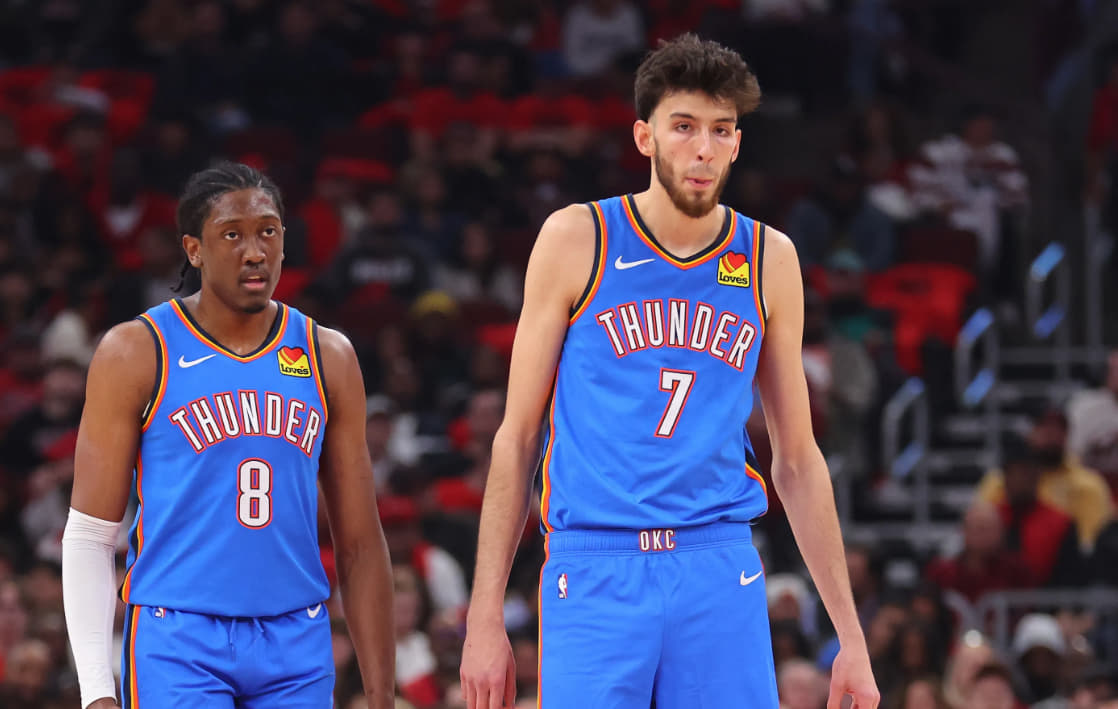
After their first championship parade, the Thunder didn’t hesitate. They secured the bag or more specifically, they handed bags to Chet Holmgren and Jalen Williams, adding their rookie extensions to the already inked Finals MVP, Shai Gilgeous-Alexander. All three are now locked in through 2029. All under 27. All capable of growing together.
“We got the first one out the way,” Vince said.
Soraya followed with a sharper edge: “This isn’t just roster construction. This is Presti playing 4D chess.”
The receipts check out. Chet recovered from hip injury and instantly became a rim-protecting, floor-spacing anomaly. Jalen evolved from a mid-major sleeper into a 23-point-a-game Finals X-factor. Shea? He’s the north star leading the league’s best point differential (12.87) while staying off the drama grid.
But this isn’t just about the players. It’s about the war chest.
Oklahoma City owns 15 first-round picks and 22 second-rounders through 2030. That includes pick swaps, trade fodder, and international stashes that only Presti’s front office has the patience to wait on. This all started with the now-legendary Paul George trade in 2019, when Presti flipped a frustrated star into a haul that included Shai, multiple picks, and the philosophical permission to slow-cook the future. It was not all shrewd trades... it was development. Lu Dort and Isaiah Joe are the tip of the spear when it comes to proactive swings in allowing development to take its shape.
Five years later? The slow cooker’s bubbling over.
And in Vegas Summer League, the ripple is felt. OKC players show up, not just to hoop but to represent a system. Fans are in the building wearing “Trust the Vision” shirts and talking like front office analysts.
The question now isn’t can they win again. It’s how many. With stars locked in, flexibility intact, and more picks than roster spots, the Thunder may have cracked the modern NBA code: win now, stockpile for later, and make it look intentional.
This isn’t small-market luck. It’s next-gen franchise building and the whole world’s watching.
Bag Secured. But What’s Next?
Apron Era? OKC Might Be the Only Team That Isn’t Sweating
Locking in a young core is impressive. Keeping that core intact while the NBA rewrites its rulebook on cap flexibility?That’s elite.
As teams across the league start to feel the squeeze from the first and second aprons of the new CBA, Sam Presti has already adjusted course. Where other GMs are sweating matching offers or ducking tax bills, OKC has built a war chest of tools not just in the form of picks, but with desirable, team-friendly contracts across the board.
Over the next three seasons, tough calls will come. They have to. That’s by design. But the Thunder have more off-ramps than most contenders have runway.
Take Luguentz Dort a defensive Swiss Army knife with a team-friendly deal at around $17M a year. He can guard positions 1 through 4, fights over screens like it’s a playoff game in December, and hits just enough threes to be playable deep in a series. But: he’s 6'3", and OKC now has younger, cheaper defenders in the wings, like Cason Wallace, a sophomore point-of-attack specialist who could slide into Dort’s role within a year.
As Soraya asked on the pod:
“Can you justify $17M for a tone-setter who shoots 33% from three?”
Thunder Twitter is already buzzing with proposed trade packages:
Lou Dort + a second-rounder to Toronto for a veteran wing and cap relief, while Wallace slides into a starting defensive role. That’s not panic that’s succession planning.
Then there’s Isaiah Hartenstein, recently signed, whose value may outpace his cost by 2026. If younger bigs like Thomas Sorber develop, you have a ready-made replacement. That’s how you dodge hard decisions: by preparing for them two years in advance. Presti’s presence of mind in these tumultuous seas of the first and second apron gives the OKC Thunder a great chance to compete longer than the average window of time.
And don’t forget what OKC did with Josh Giddey flipping a 6'8" ball-handler with defensive issues for Alex Caruso, a championship glue guy. It was a clean pivot that added maturity to the rotation without extending a flawed fit. That deal wasn’t a reaction it was a forecast.
Now Caruso himself is entering a contract year. If OKC chooses not to extend him? They won’t be scrambling. They’ll be negotiating from leverage again.
The scary part? The Thunder still have two firsts in the 2026 NBA Draft, and the flexibility to trade into nearly any pick tier they want. They’ve built not just a team, but a decision-making machine.
In the apron era, most teams are bracing for impact. OKC? They’re out here finessing the crash landing before they even lift off again.
Because if anyone can untangle the NBA’s financial knots, it’s Sam Presti with 48 hours and a whiteboard.
Restricted, Resisted, Reassessed
The Kuminga Dilemma and the Price of Potential in a Veteran System
In a league obsessed with youth and upside, Jonathan Kuminga might be the most frustratingly unrealized talent in the restricted free agent pool. The athleticism is off the charts. The frame is elite. The flashes real. But four years in, we’re still talking about potential instead of production.
Why?
The easy take is: he’s not ready. The honest one? He’s never been given the space to become ready.
As we said on the pod:
“Kuminga’s development, unlike the Lu Dort’s of the world, was stymied by the constraints of cap strategy and the shadow of proven champions.”
This is what happens when you drop a 19-year-old physical phenom into a championship-pressure incubator. Steph Curry is still the system. Draymond Green still runs the huddle. Klay may be gone, but now Jimmy Butler’s arrivalbecomes yet another roadblock to offensive touches and defensive slack.
Kuminga has made his frustrations known before. Publicly questioned the coaching staff. Subtweeted his own box scores. And when the press ran with his quotes, Steve Kerr didn’t flinch.
“If he rebounds and understands our offense, he’ll play,” Kerr said flatly.
Translation: this is not a learning environment. This is a results business.
Kuminga’s tools scream two-way terror. He can finish at the rim, defend 1-through-4, and create for himself in space. But the numbers tell a messier story: inconsistent shooting splits, shaky playmaking, too many turnovers. He wants $28–30M/year. Golden State’s internal ceiling is closer to $20–22M.
As Soraya framed it:
“Would you pay nearly $30M for a guy who can’t shoot threes consistently, has below-average passing, and hasn’t bent defenses with the ball yet?”
The comp some execs toss around: Aaron Gordon’s less-polished cousin. Kuminga value has been deeply depreciated by the stop/start of yanking him in and out of the lineup and rotations, whether due to what head coach Steve Kerr wanted out of the young wing or the necessity of putting Kuminga back in to the rotations because of injuries! So what will the Warriors fetch for Jonathan Kuminga if they do decide to sign and trade him? It is clear they pulled the trigger two years too late!
The whispers are growing: sign-and-trade season. The Warriors want assets. Kuminga wants autonomy. And with the rising cap, his ask isn’t insane just premature.
From our POV, this is the downside of the “two timelines” myth. You can’t develop a kid and chase banners unless you’re willing to burn wins. Golden State never was. OKC let Lu Dort grow into his role. Kuminga never had that chance.
He may not be a bust. But he’s definitely boxed in.
And the clock is ticking.
Giddey in the Windy City, More Like Blowing In The Wind!
High Feel, Low Force And Chicago’s Risky Rebuild Math
At 6’8” with buttery passing and feel for days, Josh Giddey looks like a dream puzzle piece — until you try to build a real playoff rotation around him. That’s the dilemma now facing the Chicago Bulls, who took him on in a trade that’s already telling us more about OKC’s foresight than Chicago’s vision.
As Vince noted on the pod:
“You gotta give Presti credit he extracted Alex Caruso, a championship glue guy, for a player they were ready to move off of anyway. That’s how you sneak-proof a playoff core.”
Caruso was exactly what OKC needed: defense-first, ego-light, playoff-tested. Giddey, meanwhile, walks into a Bulls system still fighting ghosts of past inertia DeRozan’s walkaway, LaVine’s nosediving trade value that the Bulls finally pulled the rip cord on, and Patrick Williams’ $90M development stall-out.
Chicago now holds a player who’s as puzzling as he is promising.
Giddey’s strengths are real:
94th percentile in assist creation
Elite transition vision
Floater touch that lives in the mid-range
But his flaws are equally glaring:
23rd percentile in finishing efficiency
Defensively targeted in every switch
Three-point creation: D-minus by most tracking models
Soraya dropped it cold:
“How much do you pay a contact-averse Hedo Turkoglu with no iso defense?”
Giddey isn’t doomed. He’s context-sensitive. He needs structure, shooting, and a defensive infrastructure that hides his lateral limits. Chicago? They’ve rarely built that way. And now the whispers are surfacing four years, $82 million with incentives based on defense and shooting benchmarks.
The FRPC lens is skeptical:
This feels like Zach LaVine 2.0 a team betting on improvement while ignoring how mismatched the roster around that improvement actually is.
Could Giddey be flipped again? Sure. Pairing him with Patrick Williams might net future picks or a versatile wing. But the question is less about what they’ll do and more about what they’ll delay. Chicago has been caught in the “play-in purgatory” loop for half a decade.
Meanwhile, OKC solved three problems in one deal:
Cleared a questionable fit
Added a playoff-viable vet
Avoided paying Giddey before the apron pain kicks in
That’s future-proofing. That’s cap warrioring.
That’s what the Bulls haven’t done yet.
Josh Giddey might still prove the doubters wrong. But the Bulls? They’re running out of rebuild retries.
Buckets or Bust
Cam Thomas and the Cost of Unapologetic Scoring
There’s microwave scoring, and then there’s Cam Thomas — a walking flame emoji with zero conscience and a shot diet straight out of a video game. He’s not just fearless; he’s defiant. The man pulls up from 28 like it's mandatory. And for much of his early career in Brooklyn, that audacity kept him on highlight reels even if it kept the team off balance.
The stats paint the contradiction:
98th percentile in pull-up threes
1st percentile in shot quality
A defensive rating that might get him benched in pickup
Soraya asked the room:
“Do you overpay a 6'3" guard who doesn’t pass, doesn’t defend, but drops 24 a night with no help?”
And that’s the Cam dilemma. He produces points. But what kind of points?
Is he your sixth man? Your closer against second units? Or is he a $28M-a-year gamble in an era where teams are overcorrecting toward defense and size?
Enter Michael Porter Jr., recently acquired by Brooklyn.
The contrast couldn’t be clearer. MPJ is 6’10", shoots 42% from deep, and plays a position of scarcity in the NBA. If Brooklyn sees MPJ as a high-usage, low-maintenance floor spacer and is paying him roughly $33M AAV what does that do to Cam’s number?
“If I already have 6'10" scoring insurance,” Vince said,
“Why would I overextend on 6'3” guard that provides little value past his expert tough shot making ability???
And that’s the leverage shift. Front offices around the league are reportedly comfortable with three years, $60M for Cam a healthy mid-tier deal that pays for points without rewarding his worst instincts. But Cam’s camp wants more. Maybe a lot more.
That’s where the Bradley Beal cautionary tale comes in. Washington kept maxing Beal in hopes he'd grow into leadership. He didn’t. And by the time they moved him, they got pennies on the dollar. Brooklyn won’t make that mistake twice.
Still, there’s no doubt Cam’s shot-making warps defensive schemes. He’ll always find a roster. The question is: is he a system, or a freelance artist with a green light?
As Soraya dropped in her notes:
“Cam will wave off your number one option and call his own number that’s just who he is.”
Buckets? Always.
But building around him? That’s a much tougher shot to hit. Steph Curry is the only guard that has successfully been b built around that stature! So ask yourself is Cam Thomas hefty pay day worth it to keep the asset until something better comes around?
Beringer’s Blueprint
The French Big Who Outgrew Soccer and May Have Outgrown the Draft Model Too
Every draft cycle has its mystery big. This year, that honor might belong to Joan Beringer, the 18-year-old French center who went from unknown prospect to first-round darling and all of it started because his feet got too big for soccer cleats. A credit ti the entire Minnesota international scouting department and the relationships they have built overseas! Tim Connelly made the bold move of trading for Rudy Gobert and. may have not work to the extent of a championship, the Timberwolves have not tasted success like this even in their glory days of Kevin Garnett! Connelly saw the vision and made Beringer a priority! Another front office that is forward thinking... this is what I want to see out of the Lakers front office! DO YOU HEAR ME ROB PELINKA???
Literally.
“When your shoe size hits 19 at 14 years old,” Vince joked on the pod,
“your football dreams die and your rim protection dreams begin.”
That’s exactly what happened. Beringer had to walk away from soccer at age 14 not for lack of talent, but for lack of equipment. No boots, no future. A few growth spurts later, and the kid’s 6’11" with a 7'7" wingspan, a soft shooting touch, and mobility that belies his frame. Suddenly, he’s drawing eyes in every Summer League scouting suite.
And on night one in Vegas? He showed why.
Beringer logged just 14 minutes but flashed elite timing, altered six shots, hit a top-of-the-key three, and dove on the floor in transition like it was a Final Four game. He looked raw of course. But also ready enough.
“He reminds me of young Alonzo Mourning at Georgetown,” Vince said.
“Before the chest bumping and muscle-flexing. Just hard hats and instincts.”
That comp might be lofty, but the logic tracks. Beringer’s feel for angles, rebounding on the move, and positional IQ give him a mature toolkit for someone still too young to order wine at a team dinner.
He’s not flashy. Not viral. But every front office wants one of these guys a low-usage, high-ceiling big who can defend, rim-run, and eventually space the floor. The modern NBA doesn’t need dominant centers as much as connective ones, and Beringer’s checking boxes fast.
The question now is whether a team can slow-play his development without rushing expectations. That’s the Presti formula identify early, invest slowly, and never overpay for mystery.
If Joan Beringer lands in a system like OKC, Toronto, or Indiana, we’ll be talking about this Summer League debut like it was the start of something massive. If he doesn’t? The league still better keep a scout on him because this late-bloomer big just might bloom faster than projected.
From size 19 cleats to center stage in Vegas.
This is the kind of blueprint you don’t teach you just recognize it early.