By Vince Carter
Imagine this: you win 68 games, you’re led by a first-team All-NBA talent, your team carries a top-three net rating in league history, and you’ve built a roster so promising that fans and media alike start whispering “finals run.” And yet—you’re in a Game 7 dogfight.
That’s where the Oklahoma City Thunder stand.
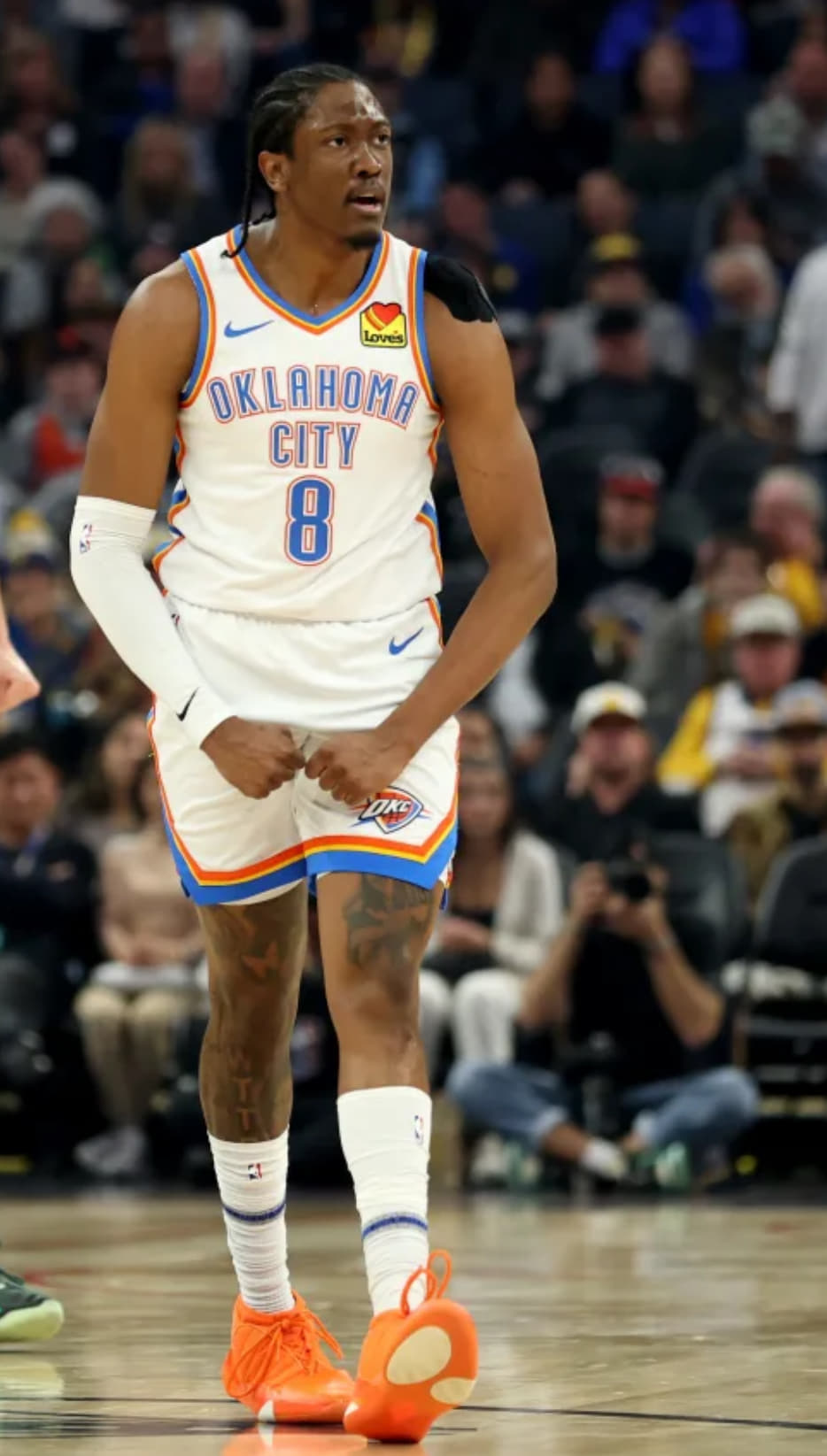
They’ve been electric all season. Shai Gilgeous-Alexander continues to assert himself as one of the game’s most layered guards. Jalen Williams has been the perfect Swiss Army knife wing, and Chet Holmgren brought rim protection and modern floor spacing to a team that was already schematically sound.
But the playoffs don’t care about potential.
They care about pain.
As Vince put it on the pod: "It wasn’t about talent, it wasn’t even about coaching. It was about trauma. It was about scars." That’s the question OKC has danced around all year. Not whether they were good, but whether they were ready. Ready for the bruises, the tight whistles, the split-second decisions that define postseason success.
The regular season was a breeze. Most nights, they blew teams off the floor—no clutch time, no adversity, no reps under duress. Their statistical résumé was pristine, even historic. But playoff basketball is built on muscle memory, not net rating.
And that memory? OKC doesn’t have it.
Not yet.
This is not hate. It’s not disrespect. It’s exactly the respect this stage demands. And it’s not the first time this story has been written. The 2012 Warriors had to take their lumps before they leveled up. The 2015 Spurs had to lose to become legends. This might just be OKC’s year of bruises—their emotional blueprint moment.
Because as the pod asked: “What happens when you don’t get the call? When your second-best player goes 3-for-16 and you still have to win anyway?”
That’s the gap between dominance and durability.
🧠 The Systems That Survive May
The NBA playoffs don’t reward vibes. They reward systems.
And no team proved that more than the Denver Nuggets in their takedown of OKC’s chaos-resistant idealism.
Where the Thunder offered spacing, flow, and paper-deep potential, Denver came to Game 6 with something far less poetic but far more useful: a memory of how to win.
Let’s talk receipts.
Rebounds? Denver +12.
Free throws? Denver doubled OKC at the line.
Second-chance points? 23 to 9.
Halfcourt offense? OKC scored just 0.79 points per possession.
That’s not a shooting slump. That’s a system failure.
And the key piece? Zone defense.
Denver doubled their zone looks from Game 4 to Game 6. Instead of just slowing pace, they disassembled OKC’s identity. The Thunder—built on drive-and-kick rhythm, off-ball cuts, and one of the league’s best shot profiles—looked like they had never seen a 2–3 in their lives.
Quote of the episode:
“Zone’s not supposed to win you a playoff game. It’s a change-of-pace tool. Denver used it like a wrecking ball.”
And the wreckage was everywhere:
Open threes passed up.
Panic decisions from Cason Wallace and Dort.
Stagnant possessions ending in rushed shots.
Meanwhile, Denver didn’t just survive. They trusted Christian Braun, Julian Strawther, and a system that’s been tested in the Finals.
Jokic doesn’t just create offense—he is offense.
Gordon found space in mid-post zones.
Jamal Murray operated as a pressure valve with surgical reads.
It wasn’t elegant. It wasn’t perfect.
It was playoff basketball at its most precise and repetitive.
Because that’s what systems do when they’ve been under playoff fire: they don’t panic. They execute.
And that’s what separates the contenders from the contenders-in-waiting.
One knows how to win a closeout game.
The other is still Googling how to respond to a zone defense in May.
📄 Paper Doesn’t Rebound — Pretty Doesn’t Win in May
There’s regular-season dominance, and then there’s postseason truth. And in Game 6, OKC finally met the latter.
The viral quote from the pod hit like a playoff elbow:
“Paper doesn’t rebound. Paper doesn’t throw a body into Aaron Gordon. Paper doesn’t shoot down six with two minutes left.”
Translation: it doesn’t matter how pretty your stats look if your system folds when the lights get hot.
And that’s exactly what happened.
OKC’s roster is gorgeous on paper.
SGA is a surgical scorer. Chet is a unicorn. Jalen Williams is a plug-and-play wing with vision. Their lineup data is elite. Their analytics sparkle.
But in Game 6, the Nuggets didn’t care about aesthetics. They dragged OKC into a fistfight—and the Thunder brought spreadsheets to a street brawl.
Let’s be real:
Chet still weighs 209 pounds.
Jalen Williams looked rattled for the first time all season.
The bench rotation shrunk to a whisper.
The game slowed down, the physicality ramped up, and suddenly, OKC’s clean offense turned static.
SGA was asked to be the scorer, the initiator, the spiritual leader, and the only adult in the room.
You could almost hear it: “Can he shoot the t-shirt cannon too?”
That’s not a knock on Shea—it’s an indictment of what happens when your supporting cast tightens up and your team identity is still in beta mode.
The pod didn’t frame this as failure. It framed it as franchise pain—the kind you need before you evolve. Denver didn’t win because they were better on paper. They won because they were better in chaos.
Because playoff basketball isn’t about your net rating.
It’s about your bruises. Your scars. Your second-effort rebounds.
And right now, OKC’s still learning how to take a punch.
🧩 Role Players Win Games, Not Just Stars
Stars sell tickets. Role players win Game 6s.
Let’s not pretend this series was just Jokic vs. SGA. Game 6 wasn’t decided by MVPs—it swung on the backs of players making $2.8M and under.
Christian Braun, with his relentless energy, flipped possessions Denver’s way with charges, putbacks, and chaos.
Julian Strawther, the rookie Malone didn’t trust for most of the season, stepped in and ripped the soul out of OKC’s rhythm with back-breaking threes and hard closeouts.
13 points, 6 boards, 2 steals doesn’t tell the full story—Braun changed vibes, not just numbers.
“This is the playoff tax,” Vince said. “It’s the test every team has to take. Not just if your stars can cook, but if your 7th–9th guys can survive in the fire.”
Meanwhile, OKC’s depth—one of their regular-season strengths—disappeared in the pressure fog.
Isaiah Joe had one good shooting game… early.
Cason Wallace showed flashes, but the nerves crept in.
Aaron Wiggins, a steady hand all season, looked like he wasn’t sure if he was allowed to take shots.
This is the part casual fans don’t always get: playoff rotations shrink not out of ego, but out of necessity.
You learn quickly who can play through chaos, who can adjust mid-possession, and who panics when the game slows to a crawl.
This is where culture shows up. This is where teams like Boston, Denver, and even Minnesota weaponize guys like:
Sam Hauser (42% from 3 in the playoffs)
NAW T-Wolves (spacing glue)
Mitchell Robinson (destroying possessions in the paint)
These aren’t luxury pieces. They’re survival gear.
The Thunder? They’re not there yet. They don’t know who their “chaos-proof” guys are outside of SGA.
That’s not slander. That’s data. That’s tape.
And for Presti and Dagnault, that means the conversation this summer isn’t just about growth—it might be about conversion.
All those picks. All those young prospects. At some point, you cash the chips and get someone who doesn’t blink in May.
🌀 Giannis Watch + The Summer of 2025
Every few years, an offseason freezes over—not because of a lockout, but because one man holds the league in his hands.
Welcome to the Summer of 2025.
And Giannis Antetokounmpo is holding the rose like it’s the finale of The Bachelor.
Milwaukee is on borrowed time. Their cap sheet is broken, their picks are gone, and their best path forward may be… backward. Dame’s contract is a financial anchor. Middleton is aging. The margins have disappeared. So if Giannis is even thinking about other zip codes, you can feel the tension ripple through front offices coast to coast.
The pod put it plainly:
“Don’t hand Giannis a rebuild dressed as a contender. He sees right through that.”
So who’s in play?
Houston has picks, cap flexibility, and confidence—but their refusal to part with Amen Thompson could be a sticking point.
San Antonio holds the No. 2 overall pick and Wemby’s gravitational pull—but Milwaukee may want vets over teens.
Toronto is lurking with mid-tier stars, tradable salaries, and a belief that they can build something real around Giannis.
Brooklyn? Always thirsty for a headliner, but their holistic plan remains… elusive.
And then there’s Los Angeles, dreaming up Rui-for-Giannis fantasy trades with one pick and vibes.
But here’s the twist: Giannis doesn’t just want out. He wants certainty. A system. A partner. A runway. A chance to win.
That means whatever team wants him must offer more than hype. It’s not about the biggest haul. It’s about the clearest vision.
Meanwhile, Kevin Durant is still floating in purgatory, and the draft is forming the league’s next generation:
Cooper Flagg is a lock for No. 1 — a playoff-ready defender who can anchor and initiate.
Dylan Harper is spicy at No. 2, but…
Pod shoutouts went to Thomas Sorber and Rashir Fleming — IQ-forward role guys who aren’t headlining mixtapes but will win playoff minutes before some lottery picks ever see a floor.
This is a landscape in flux. The league is lining up on the tarmac—but no one can take off until Giannis decides where he wants to land.
And don’t mistake the silence for stasis.
“The NBA’s next era is unfolding quietly—built by teams who aren’t waiting on a superstar, but building a system a superstar would choose.”
💔 Closing Thoughts – What Hurts Before It Breaks
Every playoff run tells a story. Sometimes it’s a coronation. Sometimes it’s a crash. And sometimes, it’s a lesson dressed up like a loss.
For the Oklahoma City Thunder, Game 6 wasn’t just a stumble — it was an exposure. But not in the way fans fear. This wasn’t a “blow it up” moment. This was a “what do we have, and what do we need?” gut check.
The verdict? They’re close. But they’re not there yet.
This is where the franchise therapy begins.
Do you run it back, betting on internal growth from Jalen Williams, Chet, and the rest of the young core?
Or do you cash in some of those 15+ first-round picks and get SGA the co-star he clearly deserves?
The pod didn’t flinch:
“This was not a free trial year. Expectations were real. The pain is earned.”
And that’s the theme. You don’t skip steps.
Not the Thunder. Not the Warriors before them. Not the Spurs in ‘12. Not the Celtics who got bounced twice before finally getting over the hump.
Pain precedes poise.
That’s why this isn’t a teardown moment — it’s a tension point. The front office has to decide whether they believe this group just needs time, or whether they’ve already hit their ceiling as currently constructed.
And here’s the thing: it wasn’t just Game 6 that exposed OKC’s cracks. It was the zone panic. The zero fast-break points in the fourth. The hesitation on open threes. The bench vanishing. These weren’t isolated errors — they were symptoms of a young team that hadn’t yet bled together.
So, what’s next?
If they win Game 7: it’s a storybook chapter in the rise of a contender.
If they lose: it’s scar tissue. And scar tissue is how you build muscle.
Because playoff greatness isn’t built with net rating spreadsheets.
It’s built with bruises, blown leads, and a second-half collapse you replay in your head for months.
Pretty doesn’t win in May. Poised does.
The Thunder aren’t broken.
They’re just feeling their first fracture. And what they decide to do with that pain will define whether they’re just exciting, or eventually… elite.
🏁 Final Whistle – This Is What Becoming Looks Like
The Thunder didn’t collapse.
They got introduced to the final boss called Playoff Basketball.
This isn’t a referendum. It’s a reality check.
OKC is legit. But they’re also learning — painfully — that there are levels to this.
And maybe, just maybe… there is something to these so-called “playoff scars.”
What we witnessed in Game 6 wasn’t failure — it was friction.
The kind that turns potential into purpose.
The kind that shows you what your system really is when the plays break down, the crowd smells blood, and your role players freeze.
Playoff basketball doesn’t reward vibes.
It rewards scars. Sweat. Systems. And stars who don’t blink.
For OKC, Game 6 was the bruise.
Game 7 will be the mirror.
Because if you want to win in this league — really win —
you don’t wait for it.
You snatch it.
BE A FRIEND (To Podcast) TELL A FRIEND (About Podcast)
Social Media and Handles:
X - Twitter Handles
Blue Sky Handles
YouTube
https://www.youtube.com/@FRPCVince