By Vince Carter
Minnesota’s Blueprint: Can You Have It All?
The Western Conference is obsessed with either/or, but the Minnesota Timberwolves, thanks to smart drafting and fearless front office moves, are pushing toward both/and. What does that mean in practice? It means building a team that can punish you with rim protection and floor spacing at the same time, on every trip. The Wolves aren’t just theoretical: they’ve got Anthony Edwards, who just led the entire NBA in three-pointers made last season 320 makes on 811 attempts, hitting at a .395 clip, and he did it at just 23 years old, starting every game, logging 2,871 minutes, and scoring over 2,100 points. You want superstar building blocks? This is what it looks like.
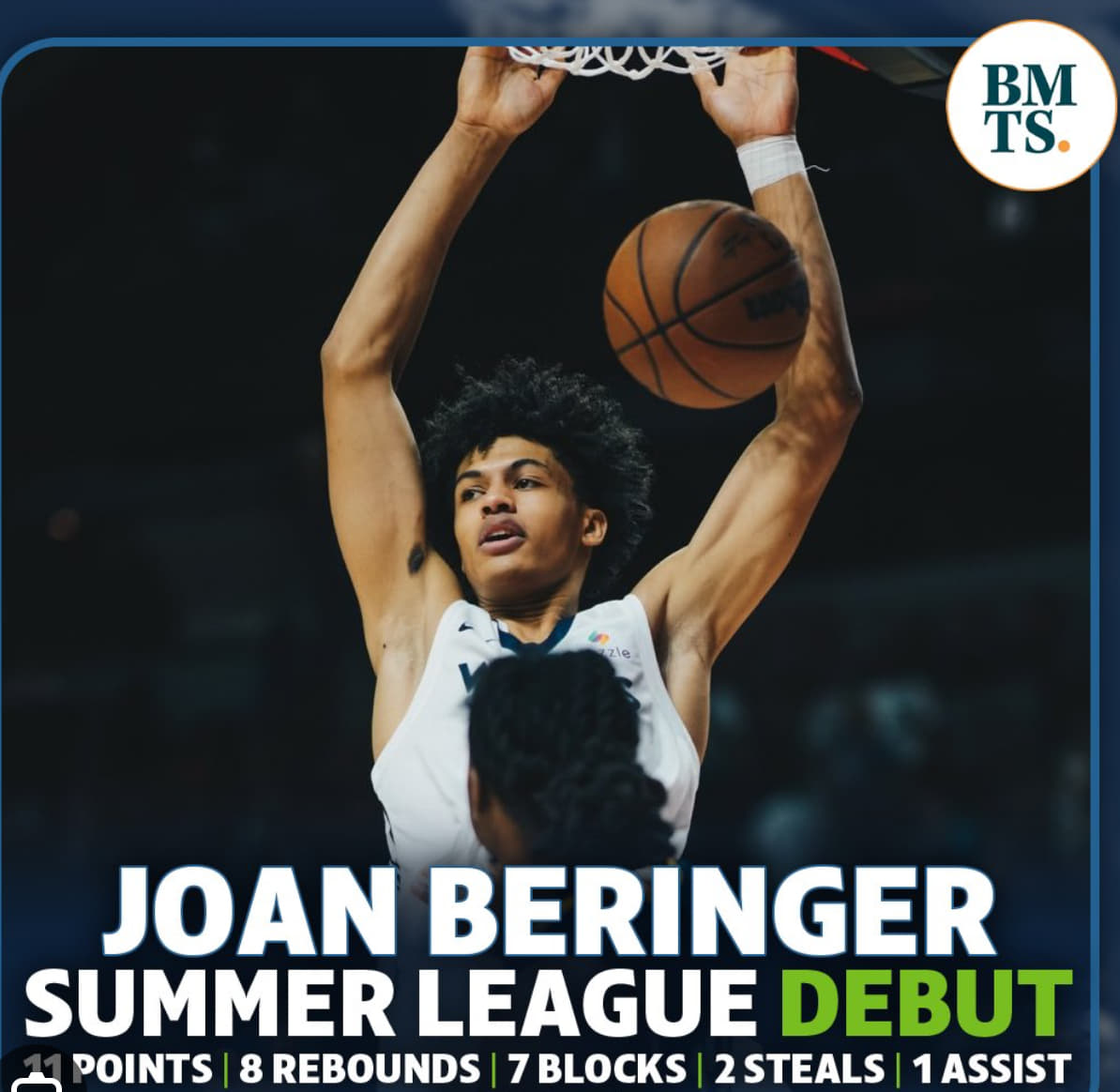
While the rest of the league is still arguing whether you can win with a true center, Minnesota is zigging and zagging. Rudy Gobert is still a Defensive Player of the Year candidate, putting up a 4.1% block rate and cleaning the glass at an 18.2% rebound rate. Naz Reid is a unicorn off the bench, launching 50% of his shots from three and still protecting the rim with a 3.0% block rate. But here’s where it gets really interesting: Joan Beringer, the 19-year-old project with a 7-foot plus wingspan and real two-way potential. The Wolves didn’t just roll the dice they trusted Tim Connelly, a president who once bet on an unproven, pudgy kid from the Baltic states named Nikola Jokic. Now, Connelly is at it again, betting on Beringer who, if he hits his ceiling, could be the French Alonzo Mourning.
Minnesota has made two straight Western Conference Finals, and if Beringer develops (with no rush he doesn’t even turn 20 until November), he could be the heir apparent to Gobert and keep the Wolves’ train rolling. The beauty of the Wolves’ blueprint is its layers: Edwards is still 23, already an All-NBA force, yet still years away from his prime. Gobert anchors the defense. Naz provides instant offense and spacing. And Beringer? He’s a “project” with the upside to become the next foundational big, a defender who can change geometry and erase mistakes just like Jokic changed everything for Denver.
So, can Minnesota have it all? In a league of specialists, the Wolves are building a lineup with no obvious weak link lineup flexibility, superstar shooting, veteran defense, and a teenage wildcard who could be the next big thing. They aren’t just challenging the West; they’re challenging the idea that you have to choose. With Edwards bombing threes, Gobert and Beringer erasing shots, and Naz Reid popping out for corner triples, Minnesota’s blueprint is more than just a plan it’s a warning shot to the rest of the NBA. And they’re just getting started.
The Now and the Next In Joan Beringer, Terrence Shannon Jr., and the Wolves’ Evolution
Not every NBA story begins in a dusty gym. For Joan Beringer, it started on a soccer pitch—until he outgrew the sport, literally. At age 14, Beringer couldn’t find cleats big enough for his size, so he pivoted to basketball out of necessity. The result? A 6-foot-11 pogo stick who learned the game late but now erases shots and grabs lobs like a seasoned pro. Forget the secret pre-draft workout in Chicago Beringer is the future for the Wolves, a French prospect with a 7-foot wingspan and a motor that’s impossible to coach.
But what about the “now” in Minnesota? The Timberwolves have a rotation hole to fill after Nickeil Alexander-Walker’s exit—a slot that Terrence Shannon Jr. is trying to claim, loudly and emphatically. At 25, Shannon is actually a year older than franchise cornerstone Anthony Edwards, and he’s no longer content to be a bench footnote. Last season, he saw the floor in 32 regular season games but rarely got real run. When the lights brightened in the playoffs, he seized his moments enough to make you wonder if Summer League was even necessary.
Turns out, Shannon played like he had something to prove anyway. Averaging 22.7 points, 6 rebounds, and 5 assists per game, while knocking down 38.5% from three, he brought energy and production in every Vegas appearance. In three games, all wins for Minnesota’s summer squad, Shannon’s style was unmistakable: relentless attacks in transition, never shying away from contact, and a willingness to make plays in chaos that most rookies shy from. He looked like a guy fighting for a real role and that’s exactly what the Wolves needed to see.
Minnesota’s coaching staff didn’t gift him minutes, but Shannon earned attention by playing with a refreshing edge, a bit of “good trouble” that’s sorely needed off the bench. He approached Summer League with a hunger that made it clear: nothing is guaranteed, and the rotation spot vacated by Alexander-Walker is open for the taking. The Wolves are banking on Beringer’s raw upside in the long term, but in the short term, they need Shannon’s no-fear approach, downhill energy, and ability to spark runs.
As this season unfolds, Minnesota’s bet is clear: mix the future (Beringer’s sky-high ceiling) with the urgency of now (Shannon’s ready-for-war mentality), and you get a team that’s both planning for tomorrow and refusing to wait for success. In a Western Conference full of finished products and microwave stars, the Wolves’ willingness to blend project and plug-and-play could be the difference in another deep playoff push.
Rebuilding a Champion: Denver’s Tactical Depth Reset
Championship windows in the NBA can vanish in a heartbeat. For the Denver Nuggets, the pressure of defending a title collided head-on with the reality of roster bloat and salary cap gravity. Last season, the story was simple: Nikola Jokic is the sun, but even he can’t play 48 minutes a night. Every time he sat, Denver’s defense cratered and the bench was exposed, often surrendering hard-won leads in mere minutes. The front office saw the cracks and executed a multi-pronged, tactical reset that was equal parts risk and necessity.
The centerpiece: trading away Michael Porter Jr. Shedding his $40+ million contract wasn’t just about payroll it was the move that enabled Denver to reconstruct a true championship rotation. In Porter’s place, the Nuggets brought in Cameron Johnson, a wing whose shooting and length offer schematic flexibility. Johnson’s ability to stretch the floor and defend multiple spots fits perfectly next to Jokic and Jamal Murray, allowing Denver to stay modern and unpredictable in crunch time.
But that was just the start. The Porter Jr. trade reopened the door for Bruce Brown, a glue guy and playoff X-factor who was so vital to Denver’s championship run two seasons ago. Brown’s return signals a renewed emphasis on defensive versatility and hustle qualities that defined the Nuggets at their peak. Add to that Tim Hardaway Jr., a movement shooter who thrives off the chaos Jokic creates; his knack for finding open pockets will let Jokic rack up assists and keep defenses honest, especially when the Nuggets go to their secondary units.
Perhaps most importantly, Denver added Jonas Valančiūnas as Jokic’s new backup finally giving the MVP a bruising, playoff-tested big who can soak up minutes, absorb fouls, and let Jokic actually rest. In years past, the drop-off when Jokic sat was so steep it felt like the Nuggets were playing with one hand tied behind their back. Now, with Valančiūnas anchoring the bench, Denver can weather foul trouble and survive the wars of attrition that define the Western Conference playoffs.
The sum of these moves is a front office masterclass. Michael Porter Jr. was a luxury, but his massive contract locked Denver into a rigid, shallow rotation. By flipping that salary for a trio of playable, versatile contributors, the Nuggets now boast real depth and adaptability. It’s the kind of tactical adjustment that would have brought a proud nod from former coach Michael Malone, who knew better than anyone that you don’t win with just five stars you win with eight or nine reliable soldiers. The Nuggets may not have gotten younger, but they got smarter, tougher, and deeper retooling around Jokic’s prime for one more serious run at glory.
The Dallas Puzzle Small Guards and Big Questions (With Numbers)
Ryan Nembhard steps into Dallas with the best number on his résumé: a 4:1 assist-to-turnover ratio during his last college season, leading the WCC with 181 assists. In Summer League, he averaged 11.3 points and nearly 7 assists per game, proving he’s more than just a safe passer—he’s an orchestrator who rarely looks rushed. Dallas desperately needs that composure, especially with Kyrie Irving set to miss half the season and D’Angelo Russell starting at the one.
Coaches don’t need a hero ball rookie; they need someone who will “fight through screens, avoid cheap fouls, and not get picked on in switches.” Nembhard’s ticket to minutes is defensive neutrality, offensive steadiness, and the ability to run the show without turnovers. If he can hit an open three, keep the ball moving, and play within himself, Kidd might give him 12–14 minutes a night. In a conference where backup point guard play often swings playoff games, those numbers could be the difference between staying afloat and sinking fast.
Calculated Gambles: The Lakers, Deandre Ayton, and the Power of “Option Value”
Say what you want about Deandre Ayton there’s no shortage of adjectives when “Domi-Ayton” is the topic. Is he enigmatic? Frustrating? Underachieving? Maybe, depending on the night and the narrative. But strip away the headlines and you’ll find a 26-year-old center, drafted the same year as Luka Doncic, who was at his best when playing alongside an elite orchestrator like Chris Paul. Ayton’s prime years in Phoenix weren’t an accident: with a true floor general spoon-feeding him easy looks, he delivered double-doubles and held his own as a rim protector.
Now Ayton lands in Los Angeles on what amounts to a “prove it” deal, and the stakes could not be clearer. The Lakers are betting that the change of scenery and the pressure of LA lights might be just the jolt Ayton needs to reclaim some of the value he’s let slip away in recent seasons. If he’s motivated, Ayton is still a legit 15 points and 10 rebounds per game guy numbers he’s averaged even on off nights, and a standard that still commands respect around the league.
But here’s the real genius from Rob Pelinka and the Lakers’ front office: this is a classic low-risk, high-upside signing. If Ayton rediscovers his spark, the Lakers get a starting-caliber big who can anchor the paint, rebound, and score efficiently, all without surrendering a pick or core rotation player. If he doesn’t? The contract is an expiring $8.6 million easy to move at the deadline or simply let fall off the books with no future pain. Either way, LA preserves its “optionality,” keeping the cap clean and every major asset still in hand for a bigger swing down the road.
In podcast debate, it was clear: even an unmotivated Ayton playing with minimum effort still brings size, rebounding, and a nightly double-double threat, especially when paired with the Lakers’ shot creators. This is why LA’s offseason has been hailed by insiders as one of the shrewdest of any contender. Ayton is the poster child for calculated risk; if he clicks, the Lakers just stole a playoff piece for pennies on the dollar. If not, they lose nothing but time. Sometimes, front offices get stuck chasing perfect. Rob Pelinka just grabbed “pretty good” for a bargain, and in the arms race of the West, that’s sometimes all you need.
The Wild West: Where Paths Diverge and Giants Collide
Let’s make one thing crystal clear: Oklahoma City enters the season as the reigning, defending NBA champions and with all due respect to the great Paul Heyman, they’ve earned every bit of that bravado. The Thunder are still at the mountaintop, carrying the crown until someone finally pries it away. But don’t blink: the rest of the Western Conference is loading up for a run at their throne.
The Houston Rockets made the kind of offseason splash that shakes the foundation bringing in Kevin Durant to a squad that finished second in the West just a year ago. Suddenly, Houston isn’t just a feel-good story; they’re a full-on juggernaut, armed with a nuclear option on the wing. Yet for all the hype, nobody should sleep on Minnesota, Denver, or the Lakers. These aren’t just playoff teams they’re organizations that have taken radically different, creative approaches to building out a roster that can actually go the distance in this gauntlet of a conference.
The West is STACKED! Top to bottom, with no easy nights. We haven’t even touched on the Golden State Warriors, simply because their offseason is stuck in neutral until Jonathan Kuminga’s restricted free agency is resolved. That’s a saga for another pod. The Clippers and the Memphis Grizzlies? Both deserve their own full FRPC breakdown, and with the way this league moves, you can be sure we’ll get there before opening night.
But here’s the real thread: every team we’ve highlighted Minnesota’s hybrid frontcourt and emerging stars, Denver’s tactical depth reset, the Lakers’ asset jiu-jitsu has forged a completely distinct path. There’s no copycat formula, no one-size-fits-all blueprint. Some have doubled down on youth and homegrown stars; others have gambled on trades, cap space, or calculated risk signings. It’s a testament to how wide open, unpredictable, and competitive this side of the bracket has become.
This series isn’t just a preview it’s a snapshot of the wild diversity of team-building strategies in the modern NBA. Whether you’re betting on culture, chemistry, stars, or just sheer talent accumulation, the West is a rolling battlefield. By the time the playoffs hit, don’t be surprised if it’s a brand new set of “other guys” making all the difference. That’s the beauty and the madness of the Western Conference, and we’re just getting started.