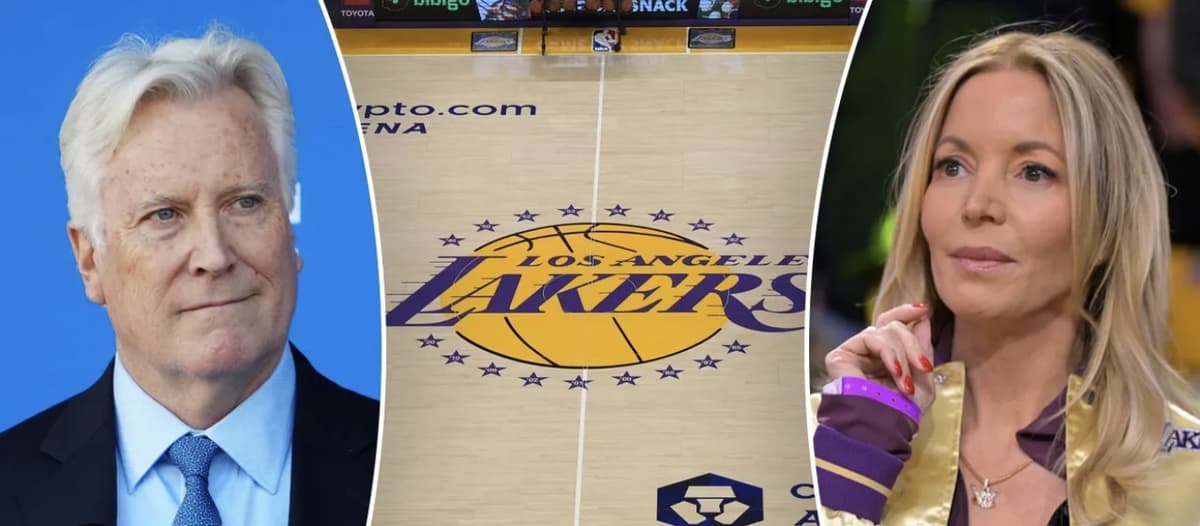
By Vince Carter
The Promise: Jerry’s Succession Plan That Never Happened
When people talk about the Lakers, they usually skip straight to the banners. Showtime, Kobe, LeBron, the parades on Figueroa. But before we get to the $10 billion sale and the “enemy” exit, you have to understand the promise that was made inside that family and how far the franchise has drifted from it.
Dr. Jerry Buss didn’t just leave a team; he left a blueprint. The way Jesse tells it, the marching orders were simple: Jeanie runs the business. Joey and Jesse grow into running basketball operations. The Buss kids would share ownership, split the money, and different siblings would hold different parts of the kingdom. Not a one-woman monarchy. Not an outside billionaire. A family-run empire with defined lanes: front-facing governor, behind-the-scenes basketball heirs, everybody eating off the same purple-and-gold tree.
Dr. Jerry Buss imagined a Buss family empire. What Jeanie got instead was betrayal, siblings protecting their own checks, and a vision slowly ignored.
Here’s where the romance falls apart and the math kicks in. That Lakers money? It wasn’t just “the Buss fortune.” It was Lakers revenue getting chopped into six. Six kids, six checks, six different levels of “How much do I actually care about winning vs. how much do I care about my lifestyle?” If you’re a fan, you saw it as “Why are the Lakers being cheap?” Inside the trust documents, it’s closer to: How much of my inheritance do I really want to put back into luxury tax, extra scouts, and an analytics department that doesn’t live in a broom closet? Some siblings were in; some were out. And every time someone flinched at a check, the team on the floor got a little bit smaller.
Meanwhile, Jesse and Joey were actually doing the job their father imagined for them. They weren’t just sitting on the group text; they were in the gym, in the tape, in the margins, the scouting and development arm of the family business. The implicit promise was that if they found players, grew players, and helped hang banners, their voices would always be heard and respected.
Look at the receipts. The 2020 bubble title doesn’t happen the same way without Alex Caruso, an undrafted guard who turned into a winning-time weapon. That’s Buss family infrastructure finding value before the rest of the league fully caught up. The front office rolled the dice on Austin Reaves, and he’s now an integral piece of the current core. Max Christie didn’t turn into a star in Los Angeles, but his development mattered too, he became an essential part of the package that brought Luka Dončić to the Lakers before the 2025 trade deadline. Scouting isn’t always about who becomes a Laker legend; sometimes it’s about who becomes the piece that moves the next chessboard.
That’s how you end up with decisions that feel way out of character for a franchise that used to operate like a big-market bully. The Caruso situation is still the cleanest symbol. He wanted to stay. He brought the offer back. He even reportedly asked the Lakers to just come close. They didn’t. Fans aimed the anger at Jeanie like she personally slammed the door. But when you zoom out and look at the six-way split, the uneven appetite for reinvestment, and the fact that the “basketball kids” were the ones finding undervalued pieces, it starts to look less like “Jeanie won’t pay” and more like a fractured family trying to protect its cash flow while leaning on Jesse and Joey to keep bailing water.
And while all of that was playing out, the next chapter was quietly being set up in the background. In 2021, Mark Walter and Todd Boehly bought a 27% stake in the Lakers from Philip Anschutz, a deal that valued the franchise at roughly $5.5 billion. On paper, it was “just” a minority stake. In reality, that was the moment an outside billionaire with a proven sports track record walked into the room and sat down at the Buss family table. The seeds of the current partnership and eventually the $10 billion takeover were planted right there in 2021.
And that’s the twist a lot of people are going to have to sit with as this new era unfolds: the more we learn, the more Jeanie starts to feel less like the cartoon villain in everyone’s mentions and more like the last Buss actually trying to honor Jerry’s vision, while navigating a trust, a board, siblings who didn’t all love basketball the way he did, and a billionaire partner who was already in the building years before he owned the throne.
“The plan was a family empire. What we got was a family dividend and a billionaire waiting in the wings.”
Palace Uprisings: When the Buss Kids Went to War
If Jerry’s promise was the opening chapter, the next part of the story reads a lot more like a family rebellion than a basketball plan.
Before the $10 billion sale, before “enemy” quotes and think-tank dreams, the Lakers went through a Buss-on-Buss power grab. Jim and Johnny Buss didn’t just disagree with their sister; they tried to move against her. They pushed to change the board structure, “bust the trust,” and force a different future for the franchise. Janie Buss, one of the other sisters, has described it as exactly that: an attempt to crack open the trust and cash out.
This is the moment the Lakers stopped feeling like Jerry’s clean succession plan and started feeling like a drama about inheritance. On paper, it was still “family-run.” In reality, the family was divided between the sibling who was supposed to run the business and brothers who didn’t like that she had the face, the title, and the power.
The coup failed. Jeanie held onto the presidency. Eventually she brought in Magic Johnson and Rob Pelinka and reset the org chart. But the important part isn’t just the names; it’s the scar tissue. Once your own brothers try to remove you from power, every future personnel move hits different. Every promotion, every firing, every “who gets to be in the room” decision now has an extra layer: “Are you with me, or are you with them?”
From there, you can see how the organization slides into this weird in-between space. From the outside: Lakers mystique, star power, national TV games, a ring in 2020. From the inside: a mom-and-pop structure trying to manage a global brand, a governor who’s already survived one attempted ouster, and a family trying to decide whether the franchise is a business, a legacy, or just a very lucrative annuity.
By the time Mark Walter shows up as a minority owner in 2021, he’s not walking into a clean, united Buss empire. He’s walking into a throne room that’s already seen one civil war and a governor who’s learned the hard way that keeping the Buss name on the door and keeping Buss voices in the room are not the same thing.
Jeanie went full Daenerys Targaryen, Mother of Dragons energy , just to survive the Jim and Johnny Buss coup in 2017. Say whatever you want about her record as an owner; she’s been fighting an internal war with her own siblings the entire time.
Enter the Billionaire: The Dodgers Blueprint Meets the Lakers’ Fragmented Chain of Command
If the Buss family story is succession drama, Mark Walter walks in like a completely different genre: corporate thriller with a spreadsheet budget and no patience for mom-and-pop vibes.
Before he ever touched the Lakers, Walter had already run the Dodgers like a test case in what happens when you pour serious money into people, process, and data. In 2012, he buys the Dodgers for around $2.15 billion. At the time, they’re mid-tier in attendance, haven’t made the playoffs in three straight years, and they haven’t sniffed a top-five payroll in about a decade. Under Walter, the payroll doubles in year one. Then comes the run: 13 straight playoff appearances, three World Series in six years, and eventually MLB’s first billion-dollar revenue franchise. That’s not just “we signed some stars.” That’s what it looks like when ownership commits to human capital, analytics, infrastructure, and a clear chain of command.
Now put that next to what the Lakers were doing in the same window: still massive as a brand, still the league’s glamour franchise, but internally running off a tangled Buss family tree, a governor with coup scar tissue, and an org chart where loyalty and last names sometimes mattered as much as org fit. From the outside, both the Dodgers and Lakers felt like “blue blood L.A. institutions.” Under the hood, one was operating like a think tank, the other like a legacy shop trying to modernize while fighting over the will.
The bridge between those worlds shows up in 2021. That’s when Mark Walter and Todd Boehly buy a 27% stake in the Lakers from Philip Anschutz, in a deal that values the franchise at about $5.5 billion. On the transaction sheet, it’s a minority investment. In reality, that’s your billionaire operator pulling a chair up to the Buss family table. The “billionaire in the wings” is no longer hypothetical; he’s literally in the cap calls and boardrooms, watching how this family actually runs its crown jewel.
Fast-forward to earlier this year: Walter moves from minority stake to majority control with a $10 billion purchase of the Lakers. NBA owners unanimously approve it. The Buss family retains roughly 15% as a minority slice. Jeanie remains governor for at least the next five years. On paper, it sounds like a soft landing: the Buss name stays on the door, Jeanie keeps the governor title, and Walter brings the Dodgers model to a franchise that desperately needs a modern backbone.
But this is where the Dodgers blueprint crashes into the Lakers/Buss fragmented chain of command. On the Dodgers side, you’ve got Andrew Friedman at the top of baseball ops, surrounded by layers of former GMs, elite scouts, and people who “eat data for breakfast.” It’s a hierarchy: lots of smart voices, but a clear line of who decides what. On the Lakers side, as this sale finalizes, you’ve got Jeanie with her history, Rob Pelinka as GM, and Joey and Jesse Buss embedded as the scouting and development arm, the very sons Jerry reportedly said would one day help run basketball operations.
So what does a Walter-style operator see when he looks at that structure? He sees a global luxury brand with a family still entangled in the decision tree. He sees brilliant hits, Caruso, Reaves, Christie as a Luka trade piece, Rui via Kuzma, coming from Jesse and Joey’s lane. He also sees the long shadow of the 2017 coup, the six-way inheritance politics, and an org where internal loyalty has historically blurred the line between “family” and “front office.”
You even had a little preview of this dynamic in Boston. Wyc Grousbeck says he’s going to “hang around” and help guide the new guard; once the fresh money settles in and gets its people in place, he’s eased out of the paint. That’s not shade, that’s a pattern: legacy stewardship on the way in, cleaner control on the other side. The names change, the sport changes; the logic doesn’t.
So when Walter’s full takeover finally hits, the optimistic reading writes itself:
“This is the moment the Lakers become the NBA’s Dodgers — money, data, collaboration, a deep front office, no more mom-and-pop decision-making on a global brand.”
But from inside the Buss ecosystem, it reads a little colder. The billionaire who started as a silent partner is now king. The family stake is diluted. The woman who survived the coup is still governor, but the Buss male heirs in basketball ops, the very ones Jerry once envisioned in that role are about to find out what happens when a think-tank owner looks at a throne room crowded with relatives and decides it’s time to simplify the org chart.
The Enemy Exit: Joey & Jesse Buss and the Cleared Throne Room
If Jerry’s promise was that his kids would one day help run basketball operations, Joey and Jesse Buss are the closest thing we ever saw to that vision actually walking around the practice facility.
They weren’t just “around the team.” They had real jobs. Joey Buss was an alternate governor, deep in research, development, and the G League pipeline. Jesse Buss was assistant GM, director of scouting, and the draft/gem hunter. For most fans, you only hear their names when something goes really right or really wrong. Inside the building, they were the ones living in gyms, film rooms, and scouting reports, trying to turn a family inheritance into a modern player-development arm.
And the receipts are real. The 2020 bubble title doesn’t look the same without Alex Caruso, a G League and undrafted story who became a championship rotation piece. That’s development. The Lakers rolled the dice on Austin Reaves, and he turned into a core guard in real playoff minutes. Rui Hachimura is a Laker because the front office first hit on Kyle Kuzma, then flipped him; Rui’s current shooting splits are the payoff of that chain. Even Max Christie, who never quite broke through in L.A., mattered, he became a crucial piece in the package that brought Luka Dončić to the Lakers before the 2025 trade deadline. You don’t get that trade done if you haven’t already identified, drafted, and developed Christie to the point where another team cares.
That’s what Joey and Jesse thought they were building: a lane where you find value, grow value, then either win with it or use it to go star-hunting.
Then Jesse starts talking, and the story shifts from “heir apparent” to “treated like the ops.”
He’s on the record saying he felt siloed going back to before the 2023 draft. Communication with Jeanie and the organization fades while he’s battling serious health issues and going through immunotherapy. He says he’s learning about team moves through the media instead of the front office. On his relationship with Jeanie and Rob Pelinka, he says he hasn’t spoken to either of them in five months. Rob’s communication, per Jesse, had boiled down to being informed who they drafted instead of being asked what he thought they should do.
Inside any org, disagreements happen. Where it really breaks is when people stop talking. The Jalen Hood-Schifino vs. Cam Whitmore split is the perfect snapshot. Jesse reportedly believed Hood-Schifino was the guy the Lakers should take. Others in the building pushed for Whitmore. That’s not unusual, scouting departments argue all the time. What matters is what happens afterward. According to Jesse, that’s where the communication frayed, where trust started to leak, where he stopped feeling like “part of the future” and started feeling like he was being quietly moved to the edge of the map.
Layer in his health. While he’s trying to get right physically, the Lakers are off to one of their better starts in years, and the players he helped identify are central to the rotation. He can’t travel as much. He can’t be in the office as much. Instead of feeling supported, he says he felt shut out — and uses the exact phrase “like an enemy.”
Meanwhile, other Buss siblings are making their positions clear in a different way. John wants to get paid and cash out. Jane, by your own description, has checks and very little day-to-day interest in the product on the floor. The people most invested in the basketball side are the ones whose roles are now the most vulnerable in a post–$10 billion world.
Then comes the hammer:
The Lakers terminate Joey and Jesse Buss and members of the scouting staff.
There’s no detailed public explanation. No long statement. No real attempt to walk fans through it.
Jesse says he isn’t surprised. He points back to the breakdowns, the silence, the feeling that the writing was on the wall. He also says out loud what a lot of Lakers fans feel but don’t always articulate: that the vision of the last 10 years, the mom-and-pop, family-heavy structure, wasn’t going to produce the kind of sustained success people got used to under Dr. Jerry Buss. And yet, the timing matters. The Joey/Jesse era doesn’t just end after a random bad season. It ends in the same window that:
The franchise is sold for $10 billion
The Buss stake is reduced to roughly 15%
And Mark Walter is expected to bring his Dodgers-style think tank to El Segundo
From a pure Walter standpoint, it tracks. You want a clear chain of command, no more trust-document politics in your basketball ops, and the flexibility to bring in as many smart people as you can hire former GMs, analytics heads, cap specialists, player-development savants. From a Buss-family standpoint, it’s brutal. The very sons Jerry once pointed to as future basketball leaders are out. The remaining Buss voices with real operational power are all on the business/governor side and that basically means Jeanie.
The throne room is quieter now. Fewer Busses in the front office. More room for Walter to build a Dodgers-style org where the analytics department is no longer a broom closet and scouting, video, and data are all fused into one machine. Depending on how you feel about the family and the brand, that either looks like necessary modernization or the final step in turning Jerry’s succession plan into a story about an heir getting walked out the door feeling like an enemy.
Welcome to the Lakers Think Tank
In the optimistic read, this is the moment the Lakers finally catch up to what franchises like the Dodgers, Astros, and a handful of NBA teams did years ago.
Walter’s track record in baseball says: when he takes control, he spends on everything, not just stars, but people, process, and infrastructure. Payroll, scouting, development, analytics, sports science, all of it. Apply that to the Lakers and the next few years start to look like this:
The analytics department moves from “broom closet” to full floor in the building.
Scouting, video, and data are fully integrated instead of siloed.
Pelinka gets real support from multiple high-level basketball minds, ex-GMs, cap geniuses, player-development heads who have actually built something before.
Sports science becomes part of the brand: diet, recovery, biomechanics, all tied to what you’re seeing on the floor, not just a buzzword in pressers.
If there’s a big star who actually fits, ownership has both the cash and the conviction to go get him, the way the Dodgers did with Mookie, Freddie, and Shohei.
Just like the finale of Game of Thrones, the “win” in this version doesn’t come from one ruler sitting on the Iron Throne it comes from collaboration and a council of minds reshaping what power looks like. Daenerys never actually sits the throne; the story ends with a group trying to govern smarter instead of louder. In that light, Jeanie isn’t the doomed queen. She’s the one who keeps choosing the Lakers over her own ego.
Whatever you think of her record, Jeanie has always put the Lakers and the Lakers brand first. That shows up in how she treated the late, great Kobe Bryant, paying him like a superstar at the end, knowing it sent a message about how the franchise takes care of its icons. It shows up again when she forms a partnership with LeBron James, bets big on Anthony Davis, and gets her first ring as governor in 2020. While her name and image have taken a beating in the media, on social, in every “Jeanie is cheap” thread, she’s stood firm through coups, criticism, and money-grabbing siblings who didn’t always share her obsession with purple and gold.
The 2026 NBA Draft: From Big Three to Fantastic Four
For most of this cycle, the 2026 NBA Draft has been framed as a classic “Big Three” situation.
Front offices, scouts, and sickos on draft Twitter have been circling the same names at the top of every board:
Darryn Peterson
AJ Dybantsa
Cameron Boozer
Three prospects good enough to make owners comfortable losing on purpose. Three different ways to talk yourself into “franchise cornerstone on a rookie deal.”
But now there’s a new question floating around war rooms and text chains:
Did Caleb Wilson just turn this class from a Big Three into a Fantastic Four?
The Original Big Three
Darryn Peterson – The Guard Engine
Peterson is still the name you hear most often at the very top. A 6’6 guard with a reported 6’10+ wingspan and an 8’7 standing reach, he checks just about every modern creator box. He scores on all three levels, lives at the free-throw line, and has the frame to absorb contact and still make plays. Coaches are already talking about him like a freshman who can handle a 26-5 stat line from day one. In a league starving for big guards who can run your entire offense, Darryn Peterson is the prototype.
AJ Dybantsa – The Nuclear Wing
Dybantsa is the wing version of a cheat code. The size, the bend, the explosion, the way he bends a defense just by attacking the rim, it all pops immediately. You saw it in that UConn game: ugly first half with turnovers and over-eager drives, followed by 21 points in the second half once the spacing adjusted and he started reading the help better. The shot and playmaking are the swing skills, but if those progress, you’re looking at a wing who can live in the paint, live at the line, and live in scouting reports for a decade.
Cameron Boozer – The Boring Monster
Boozer might be the least “viral” of the three, and that’s part of the appeal. His game is quiet, efficient, and relentless Tim Duncan without the marketing department. He’s fundamentally sound, can operate from multiple spots on the floor, and already plays with a veteran understanding of spacing and timing. He runs inverted actions, works off talented teammates, and gives you Kevin Love–adjacent offense with a better handle this early. Analytics people see him as a high-floor star: even if he never feels like a human mixtape, he’s the kind of big you expect to be in the middle of winning basketball for a long time.
Caleb Wilson: The Party Crasher
Then there’s the reason this conversation even exists: Caleb Wilson out of North Carolina.
Wilson is the kind of prospect who makes front offices recalibrate their risk tolerance:
Measurements & Movement: Around 6’10, 215 pounds, with a frame that still has room to add good weight. He moves like a modern forward, fluid, coordinated, and comfortable in space.
Two-Way Versatility: He can switch across positions, protect the rim, rotate, and guard in space when he’s locked in. The box scores start filling up with blocks, steals, and deflections when the motor’s running.
On-Ball Skill: This isn’t a stand-in-the-corner big. Wilson can put it on the floor, create his own shot, attack mismatches, and flash scoring at all three levels. The drive–pull-up game is already real, and the putbacks are nasty.
Shooting Upside: The mid-range fade, the pull-up, and the emerging three-point range are the swing factors. If the jumper holds over volume and time, you’re talking about a 6’10+ shot-maker who can anchor your defense and survive every switch-heavy scheme you want to run.
That’s why you’re starting to hear the same thing from people who actually work in front offices:
“If the Caleb Wilson film keeps looking like this, we’re not talking about a Big Three anymore. We’re talking about a Fantastic Four.”
If all of this holds through the cycle, the shooting, the engagement, the defensive versatility, the 2026 NBA Draft doesn’t just have three “tank-worthy” prospects at the top. It has four.
Tanking Economics of 2026: When One Draft Class Becomes a Business Plan
The 2026 NBA Draft isn’t just a scouting conversation; it’s a business model.
When owners look at Darryn Peterson, AJ Dybantsa, Cameron Boozer, and Caleb Wilson and see four legitimate franchise-changers on rookie contracts, they don’t just ask “How good are they?” They ask a different question:
“How much losing can we justify for a shot at one of these guys?”
One franchise-changing rookie? You tank.
Three? You throw a season into the shredder.
Four? You get a full-on tank-a-palooza.
You can already see the outlines in the standings and in the way teams are talking.
We knew Washington was going to be bad.
Brooklyn basically told us what this season was going to look like.
Utah has been comfortable signaling a long timeline.
Charlotte is living under a constant cloud of LaMelo Ball rumors.
But then there are the teams we didn’t necessarily expect to be in the mess:
Indiana looking shakier than advertised.
Sacramento falling further than anyone in that building would admit in August.
Even scenarios where Dallas starts to spiral and people yell “Nico terrible!” while quietly doing the math on how a reset might play out.
Add another layer: early reads on the 2027 draft are lukewarm at the top. If 2026 is the last truly deep franchise-swing class before a softer year, you’re going to see more teams than usual talking themselves into the long game.
That’s how you get GMs and governors staring at the standings asking:
“Do we really need that 35th win… or do we want a real shot at Peterson, Dybantsa, Boozer, or Wilson?”
And hovering over all of this is the Cooper Flagg factor. If you’re a franchise stuck in the middle, the nightmare scenario for everyone else is obvious:
A bad enough season to land Cooper Flagg in 2025,
Followed by the right lottery breaks or the right trade package to make a run at a 2026 blue-chipper on top of that.
That’s not just a rebuild. That’s a decade-long content plan.
So when you see:
Indiana looking worse than expected,
Sacramento collapsing,
Utah flirting with the idea of shutting down Lauri Markkanen,
Charlotte stuck in perpetual “What are we?” mode,
Or even a team like Dallas drifting toward the edge of the play-in and beyond
You almost have to revisit the question you floated on the pod:
Is it really that bad… if the end of the pain is Cooper Flagg plus one of Peterson, Dybantsa, Boozer, or Wilson?
That’s the tanking economy of 2026 in plain terms:
Every ugly loss is a lottery ticket.
Every boring February game is really an assets play.
Every “strategic reset” is just a front office trying to buy its way into a draft that might be the last true franchise-swing class for a while.
Risers & Wildcards: Mikel Brown Jr., Karim Lopez, and Dash Daniels
The top of the 2026 board is dominating the conversation, but if you’ve been paying attention early, you know this class runs deeper than just the headline four. There’s a second tier of names already heating up group chats and early intel calls — and a couple of them live far outside the traditional college route.
Mikel Brown Jr.: FRPC’s Favorite Guard and Disruptor
If you’ve been riding with FRPC, you already know the name: Mikel Brown Jr.
He’s not in that “blow up your season for this guy” tier yet, but he’s trending as the kind of guard who can climb boards all year.
Guard toolkit: Craft off the dribble, pull-up shooting, and the confidence to go hunt shots in big moments.
Feel & pace: Plays like someone who’s watched a lot of high-level NBA guard play, he understands tempo, when to probe, when to keep dribbles alive, and when to just rise and fire.
Path to rising: For Mikel, it’s all about stacking consistency. If he can put together a sustained stretch where the decision-making, defense, and efficiency all line up, he’s got a clear path from “FRPC crush” to legitimate top-10 consideration.
He’s exactly the type of prospect casual fans “discover” late, while draft nerds say, “We’ve been here for a while.”
Karim Lopez: The Nasty, No-Excuses Combo Forward
Karim Lopez is one of those international prospects who makes coaches and execs nod before he even scores 20.
Frame & movement: About 6’8, broad shoulders, already looks like he belongs physically. More about balance and economy than showmanship.
Offense: He can attack off the dribble, work as a spot-up floor spacer, and operate comfortably from the mid-range. There’s touch from deep that suggests real shooting upside. He cuts, finishes, and doesn’t need the ball to impact the game.
Defense: This is where he really pops. He uses his length to guard multiple spots, rotates, contests, and does the little stuff that tilts games, fighting through screens, mirroring guards, blowing up actions instead of just surviving them.
The questions are about fluidity and volume shooting. At times, the jumper can look a bit mechanical, and he’s still living in that “combo forward vs. wing” gray area. But if the shot volume and comfort come around, you’re looking at exactly the kind of top-10 two-way forward that playoff teams covet.
If you’re picking in the back half of the lottery or the teens and Karim Lopez is still on the board, that’s the name that makes everybody in the room sit forward.
Dash Daniels: Dyson’s Little Brother, With Extra Pick-and-Roll Sauce
Then there’s Dash Daniels, younger brother of Dyson, already grinding in a pro environment in Melbourne.
Defensive DNA:
Dash is Dyson-coded on that end: size, length, deflections, contests, and real anticipation. He guards multiple positions and plays with that “I care about this stop” energy coaches fall in love with.Offensive upside:
The surprise is how far along he is compared to Dyson at the same age. Dash flashes scoring at all three levels in spurts, has more pick-and-roll savvy, and can create separation with craft instead of just straight-line speed. He’s a developing shooter, reliable with his feet set, still growing as a movement and off-dribble shooter, but the foundation is there.Context & concerns:
He’s 18, playing in a real pro league against grown men with families, not just teenagers. That explains some of the deference and tentativeness late in games. The burst and vertical pop aren’t elite, which limits some finishing upside, and he still has to find the right balance between facilitator and scorer. Right now, he leans unselfish.
That’s fine. You can coach aggressiveness into a guy who already understands team defense, reads the game, and competes. We’ve seen this arc before: defense-first wing with feel who adds enough offense over a couple of years to become a playoff starter. Dash has that kind of trajectory in his range of outcomes.
Tyrese Maxey Didn’t Just Take the Keys, He Changed the Locks
If you’ve been listening to FRPC twice a week, Thursday night in Milwaukee didn’t feel like a surprise. It felt like a receipt.
On Tuesday’s pod, we said it out loud: this is already Tyrese Maxey’s franchise.
Not eventually. Not “once Joel Embiid’s knees calm down.” Not “after Paul George gets fully ramped.”
Now.
We framed it pretty simply:
Treat Maxey as the long-term certainty.
Treat Paul George as an evaluation asset, not a co-anchor.
Make every decision about the Maxey window, not the hypothetical “healthy Embiid plus peak PG” fantasy run.
Forty-eight hours later, no Embiid, no Kelly Oubre, national TV vibes on the road in Milwaukee… and Tyrese Maxey walks into Fiserv Forum and drops 54 points, 9 assists, 5 rebounds in 46:38 of court time in an overtime win over the Milwaukee Bucks.
That’s not a cute breakout. That’s your front office getting publicly called to the board.
Exhibit A: 54-9-5 in a Hostile Building
Let’s live in the box score for a second:
54 points on 18-of-30 from the field
6-of-15 from three
12-of-14 from the line
9 assists, only 3 turnovers
+18 in a 123–114 overtime win
Sixers move to 9–6 in a game with no Embiid, no Oubre
Milwaukee, as a team, shoots well enough to win most nights, they’re sitting at 51% from the field, 45% from three, 73% at the line and it still doesn’t matter because one dude in a red “0” jersey turns the game into his personal referendum.
And it wasn’t empty scoring. It was apex predator stuff from the jump:
1st quarter: 12 quick points, downhill attacks, a three, and constant paint pressure. Philly goes up 33–20 after one. You could feel who was driving.
2nd quarter: Bucks punch back, win the frame 37–22. Maxey still drops 11, including a pull-up three with 32.3 seconds left to send a message that he’s not going anywhere.
3rd quarter: Ugly basketball, the kind of stretch where past Sixers teams would fold without Embiid. Maxey still finds 9, keeps them attached as Milwaukee edges ahead 81–77.
4th quarter: Cape time. Sixteen points. From the 12:00 mark down to about 9:26, he scores 9 of Philly’s first 11, including a 31-footer to take the lead. Down 106–104 with seven seconds left? He calmly walks to the line and hits both to force OT. No flinch, no hesitation, no “But what about Paul?”, just a guard who knows it’s his team.
Overtime: Six more points, including a blow-by layup with 3:43 left to put the Sixers up 111–106. Multiple trips to the line to ice it. Maxey takes all the big possessions. Everyone else orbits.
Three-level scoring? Check.
Stepbacks at the elbow? Check.
Layups and floaters? Check.
Transition finishes, hunting mismatches, running pick-and-rolls at whoever they could pull into the action? Check, check, check.
You don’t hang 54-9-5 on the road in that environment by accident. You do it because the team already plays like it’s your show.
This Episode Isn’t “Can Maxey Be a #1?” It’s “What Do You Do Now That He Is?”
The funniest part of all this is that people are still asking the wrong question.
Thursday night wasn’t about “Can Tyrese Maxey be a number one option?”
Thursday night was about “What do you do organizationally once the evidence says he already is?”
You’re paying him like a star.
He’s playing beyond that number.
So the cap sheet question flips from:
“Can Maxey scale next to other stars?”
to
“Can everyone else scale to Maxey?”
Once you accept that, everything shifts:
Paul George stops being “co-headliner” and becomes high-salary optionality and a supporting investment.
Minutes and role are no longer about what PG has been; they’re about what helps 0 in May.
Young guards and wings: VJ Edgecombe, Jared McCain, Quentin Grimes, Ricky Council, whoever else you bring in the building, become long-term bets on making Maxey’s life easier, not guards auditioning to someday replace him.
George was solid in Milwaukee: 21 points, 7-of-12 from the field, 4-of-7 from deep, 3 assists. That’s exactly what he should be at this point, a spacing, secondary-creation, switchable forward who makes life easier for the guy with the ball.
But did anyone on the floor or on the bench treat him like the offensive center of gravity?
No. Every high-leverage possession still ran through Maxey.
The George Question: Fit Piece or Main Character?
This is where it gets cold, and where smart franchises live.
Can Paul George help Tyrese Maxey? Absolutely.
He can buy Maxey rest from 40+ minute nights.
He can run second-unit offense.
He can get better looks for Edgecombe, McCain, and the rest of the young perimeter group.
He can guard 3s and 4s, use that 6’8, 220-pound frame, and occasionally offer a little rim protection when the legs cooperate.
But what he can’t be anymore is the guy the franchise is emotionally built around.
The nightmare version of this season for Philly isn’t “George doesn’t play well enough.” It’s “George is good enough that the organization slowly slides back into thinking his minutes and touches have to look like 30–35 prime-usage nights.” There’s no need for that.
You said it on the mic and it holds on the page:
Paul, you’ve had a great career. Respectfully, it’s not about you anymore.
It’s about:
Tyrese Maxey, supernova guard with elite speed, growing foul-drawing, and real playmaking.
VJ Edgecombe and Jared McCain, whose developmental runway (drink) defines how high this group’s ceiling goes.
The rest of the roster being constructed around covering Maxey’s weaknesses, not trying to drag him back into some outdated archetype fear about “you can’t win with guards like this.”
We’ve already seen this league build around smaller-ish offensive engines, Trae Young in Atlanta is the obvious comp. You cover with plus wings, defensive infrastructure, and role players who live to do the dirty work. Philly is already assembling some of those pieces. The job now is to be ruthless about honoring what Thursday just proved.
Front Office Time: Every Move Has to Answer One Question
Daryl Morey looks like a genius today because of Tyrese Maxey.
Josh Harris knows exactly what “one superstar changing your franchise trajectory” feels like, he just watched Jayden Daniels do it in Washington.
Maxey has done the basketball version of that in Philadelphia: quietly, relentlessly, then all at once in a 54-point explosion on the road.
So from here on out, the job for everyone upstairs is simple:
Every move has to answer one question:
Does this help zero in May?
If the answer is no, you don’t do it.
Not a rotation tweak.
Not a trade.
Not a buyout signing.
Not a “vibes” move to make a veteran comfortable.
You don’t ignore a guard who can drop 54 and 9 in a playoff-style environment just because you grew up scared of a certain archetype. You build the roster so the archetype works.
If Paul George is 80% of his peak and fully on-board with being a high-level support piece? That’s massive value. If he’s not? There’s always a team like Memphis who’ll talk themselves into needing that version of PG more than Philly does.
Because here’s the real bottom line:
Tyrese Maxey didn’t just justify having the keys. He changed the locks on the entire franchise while we all watched.
On Tuesday, FRPC told you the offense should be Maxey-first and George should be treated as a fit piece, not a main character.
On Thursday, Maxey walked into Milwaukee and made that the only logical way to see this team.
So if you’re a Sixers fan, you’ve got a decision to make too:
Are you already emotionally locked into the Maxey era, or are you still holding onto a pipe dream version of “maybe if we coax Embiid along and get peak Paul George by April…”?
One of those paths ends with “We should’ve been a contender” yelled at a TV.
The other ends with zero being the sun everything in Philly orbits around for the next decade.
Choose accordingly.