By Vince Carter + FRPC Contributors
🏀 Oklahoma City Thunder: “The Habit Merchants”
In the pre-production room, there was no talk of regression, no whispers of “slippage.” The question on the whiteboard was simpler, more dangerous: how high can they take this?
The Oklahoma City Thunder enter the 2025–26 season as the youngest defending champions in decades, and somehow, the most composed. Last year’s run wasn’t lightning in a bottle; it was lightning learning choreography. They lost bodies, bent lineups, and still raised the franchise’s first banner. Now, the champagne’s dry, the banner’s hanging, and the conversation has shifted from arrival to ascent. Oklahoma City, has the precision and calm of a assassin that regulates their collective heartbeats to stay on task!
They’ll open the year without Jalen Williams, nursing a wrist surgery recovery. For most teams, that’s turbulence. For the Thunder, it’s barely a breeze. This roster was built to absorb, talent, stress, expectation, like a system immune to panic. Cason Wallace will see more minutes, Alex Caruso adds the veteran friction every young contender secretly needs, Aaron Wiggins that gave heavy production during the regular season last season, and Mark Daigneault has a roster that behaves like a hive mind. It’s terrifyingly intentional.
The Presti Algorithm
Every dynasty has a mythmaker, and Sam Presti has become the league’s quiet novelist. What he’s built here isn’t loud; it’s layered. No shortcuts, no splurges, no desperate signings. Just years of draft precision, roster calibration, and cultural clarity. Scholars will dissect this team’s architecture the way film nerds break down The Godfather, frame by frame, move by move, every decision cascading into inevitability.
Oklahoma City finished last season with a +12.8 net rating, the kind of differential reserved for historical heavyweights. They were efficient, methodical, and cruelly balanced, the NBA’s version of a minimalist assassin. Shai Gilgeous-Alexander, the reigning MVP, didn’t just dominate; he dictated rhythm. Every dribble was a thesis, every possession a demonstration in control. Around him, Chet Holmgren evolved from unicorn promise to two-way anchor, while Williams became the connective tissue, the basketball conscience of the operation.
Even with Jalen out, OKC’s system doesn’t creak. Daigneault’s team doesn’t rely on magic nights; they run on process. Movement, spacing, read-react flow, it’s all principle, no panic.
Dynasty in Practice
Dynasties don’t announce themselves, they show up early to work and act like the parade’s already over. The Thunder don’t need the bravado of a repeat campaign. They walk with the posture of inevitability. Their real opponent isn’t Denver, or Minnesota, or whoever’s next in the West. It’s boredom.
This season is about resisting complacency, keeping edge without arrogance. The rotation runs ten deep, every player knows the vocabulary, and the goal isn’t reinvention. It’s refinement. Think of it like a jazz band that’s mastered the setlist, now they’re exploring tone.
“They don’t talk dynasty,” Vince quips on-air. “They act like it’s old news.”
That’s the FRPC truth serum: Oklahoma City’s secret isn’t flash; it’s fidelity. Habits that outlast hype.
The Numbers Behind the Noise
OKC’s half-court offense ranked top-five against elite defenses. Their clutch net rating was absurd (+18.1). They turned the ball over less than any team in the playoffs. That’s not excitement, that’s engineering. The Thunder play with the discipline of a veteran unit and the legs of a G-League highlight reel.
Jalen Williams’ absence will test their second-side creation, but the spacing remains pristine. Holmgren’s short-roll reads have matured. Cason Wallace’s catch-and-shoot rhythm adds dimension. And Caruso, the ultimate connective pest, ensures this team never flatlines emotionally.
There’s no crisis to cover here, no existential “what if.” Just a group too young to know fear and too structured to need luck.
Beyond the Banner
Inside the walls of FRPC, the consensus was blunt: the Thunder are the standard now. They’ve earned the quiet arrogance that comes with discipline. There’s no chest-thumping, no TikTok-era antics, just precision basketball from a front office that plays chess while everyone else scrolls trades.
Mark Daigneault’s only real challenge is psychological. How do you keep a locker room of 25-year-olds from believing the parade ended the story? The answer: you don’t. You convince them the parade was just the prologue.
Why It Matters:
Dynasty energy isn’t about hardware, it’s about repetition that feels inevitable. The Thunder don’t chase moments; they manufacture them.
Watch List:
Half-court offensive rating vs. top-10 defenses.
Cason Wallace’s playmaking stretch in Jalen’s absence.
The “complacency meter”, how often OKC coasts before Daigneault reminds them boredom is the enemy.
Soraya puts it cleanly in the closing confessional:
“Receipts say dynasty energy isn’t about rings, it’s about habits that outlast hype.”
And right now, Oklahoma City owns the habit market.
🐺 Minnesota Timberwolves: “Paisley Pressure: Ant’s Coronation vs. Half-Court Geometry”
In the pre-production meeting, Producer Soraya and contributor Maya were straight-up flummoxed by the national amnesia. The Timberwolves, two straight trips to the Western Conference Finals, led by a 24-year-old megastar somehow slipped off the tip-of-the-tongue hype list.
Everyone’s talking Nuggets’ reloads, Houston’s star power, the Lakers’ cardio, even the Spurs’ science project. But Minnesota? Quiet corner. That’s cute.
Anthony Edwards doesn’t do quiet.
This man walks like a headliner and stares like a debt collector. The league can hand bouquets to Denver, L.A. Clippers, and Houston all it wants, Ant’s not reading Hallmark. He’s reading hit lists. You don’t “take a step back” from the conference finals when your best player’s still leveling up. You don’t rebuild when your star has zero chill about the word patience.
Ant’s in superhero form, the kind that doesn’t need capes, just conviction. The only geometry problem in Minnesota is making sure he’s got the right angles.
The Blueprint: Coronation Needs Choreography
Here’s the truth: a cape can’t fix spacing. Minnesota’s half-court offense still feels like a Renaissance painting, layered, detailed, and sometimes too crowded to breathe. Rudy Gobert guards the paint like a toll booth operator; Mike Conley manages possessions like a Swiss watch; and the corner three still feels more theory than rhythm.
But help has arrived last season and we got a glimpse of what is to come in the playoffs against the Lakers. Julius Randle brings blunt-force creation, the kind that leaves bruises and buys shooters real estate. Donte DiVincenzo is the chaos agent who turns “stagnant” into “spontaneous.” And rookie Terrence Shannon Jr. gives the Wolves an early-offense runway built for violence.
Coach Chris Finch has made one quiet shift: speed before spectacle. Every touch Ant gets now is a decision point, not a performance. The faster the read, the fewer the turnovers, the more time for him to cook late. Reacher rules apply no speeches, just efficiency.
Soraya, off-camera: “Scorched earth is smarter when it’s paved.”
Ant’s Evolution: Swagger With Footnotes
The jump is mental now. Less jab-step opera, more first-dribble murder. Ant doesn’t need new tricks; he needs new sequencing. Fewer forced pull-ups, more paint touches. Less improvisation, more tempo.
He’s getting there. His usage rate over 32%, true shooting near 60%, those are MVP metrics, not “next step” teasers. But what separates Ant from other young killers is that he doesn’t crave validation; he craves accountability. He wants the burden, the cameras, the noise. Minnesota, for once, found a player who wants pressure. For Ant, there is no mountain is too steep to climb!
And while the national talk is still about Luka, Jokic, and Wemby, Edwards is quietly morphing into the league’s most watchable control freak.
The Supporting Cast: Structure, Not Scenery
Mike Conley is still the metronome, his steadiness lets chaos exist in safe doses. If he misses a stretch, the Wolves lose tempo. That’s why his minutes will be protected like heirlooms.
Julius Randle? He’s the downhill sledgehammer this team never had. Two dribbles, straight ribs. He doesn’t monologue; he mauls. Pair him with Naz Reid’s pick-and-pop flair, and the Wolves can finally unstack the lane for Ant’s slashes.
Donte DiVincenzo brings the swing math, his off-ball relocations and screen-the-screener movement keep the floor alive. Jaden McDaniels remains the quiet chaos: elite defense, brutal closeouts, mean cuts. And Jaylen Clark? Soraya calls him “the adult defender”, the kind of point-of-attack pest who makes stars breathe easier.
Soraya punch-up: “If you can’t shoot better, steal more.”
The Geometry Problem (and Solution)
Finch’s offensive mandate this year: ten corner threes a night, minimum. The Wolves’ spacing has long been their haunted house, flickering lights, mysterious cold spots. This year, it has to be architecture. Empty corners for Ant. Spain actions into flare screens. Fewer “what was that” possessions and more “yep, that’s the read.”
If they hit those benchmarks, the defense, already elite becomes lethal. McDaniels, Clark, and Gobert can smother, then sprint. Ant can roam like a hammer, not a helper. The Wolves’ best offense might just be their ability to turn stops into sprints.
Stakes: Pressure Is the Privilege
The Wolves’ ceiling is a top-three seed if the offense holds its shape. The floor? Somewhere in the play-in muck if spacing ghosts return. But nobody in the FRPC war room is betting on regression. The tape says they’re better. The vibe says they’re pissed.
Ant doesn’t want to “develop.” He wants to dethrone.
Why It Matters: Coronations require choreography. Minnesota’s can’t rely on brute force; it has to be designed.
Watch List: Corner-3 volume, Ant’s 0.5 decisions, Gobert-with-shooters net rating.
In the closing segment, Soraya smiles, looks at the camera, and drops the line that sums up the whole Wolves thesis:
“Reacher doesn’t monologue; he finishes the scene. Do that in May, and the coronation writes itself no confetti debt, no geometry lies.”
The disrespect was fuel. The math is motive. And Anthony Edwards? He’s still looking for someone brave enough to take it from him.
🏀 Denver Nuggets: “The Gravity Keepers”
The Denver Nuggets... Welcome back to the grown-man table!
Nikola Jokić, basketball’s most polite tyrant, still bends logic and geometry into submission. The league’s ultimate algorithm breaker, he dictates every possession with the patience of a librarian and the menace of a hitman. There’s no gimmick here, no mystery. The Nuggets’ entire playbook still runs through his gravitational pull. Every cut, every rotation, every box score quirk starts with him. But even Jokic needs more moments than he received last season to recharge the batteries, When Jokic was on the court last season, his stand alone Net Rating was +10.2!
If you’re a Nuggets fan, you already know: boredom is elite basketball’s final form.
A Reset, Not a Reinvention
Last season’s humbling still lingers. The Nuggets pushed the eventual champions OKC Thunder to seven in the conference semis, a war that looked less like failure and more like fatigue. The Nuggets didn’t collapse; they ran out of people. Michael Malone, visibly tired of asking seven players to do the work of ten, finally ownership stepped in and passed the clipboard to David Adelman.
That change matters more than it’s being discussed. Adelman inherits a title-caliber system with a new sense of inventory control. The front office did its job, too: Michael Porter Jr. shipped to Brooklyn in a calculated move that opened flexibility. In came Cam Johnson, a cleaner fit, a shooter who knows his role, and the freed-up space let Denver re-sign Bruce Brown Jr., the heartbeat of their 2023 run. Add Jonas Valančiūnas for dependable backup size and Tim Hardaway Jr. for veteran marksmanship, and suddenly this rotation looks… adult again.
It’s the type of offseason that doesn’t headline First Take but wins you playoff rounds.
Raya punch-up: Still allergic to panic, still allergic to losing two straight.
Jamal Murray’s Annual Slow Burn
Every season starts the same way: Jamal Murray in slow motion. Maybe he’s playing his way into shape, maybe he’s nursing a ghost injury, maybe he just doesn’t like Halloween basketball. But then Christmas hits, and boom, 27 points, clutch fadeaways, swagger unlocked.
Murray’s early-season rhythm is an ongoing subplot, but with this new bench depth, Denver can finally afford patience. His 2024-25 numbers, 21.4 points, 6 assists, 39% from deep, remind everyone that, healthy or not, he’s one of the league’s most dangerous co-stars. The difference this season? He doesn’t need to be Superman in November.
Soraya’s aside: “Sometimes maturity means taking your time, even when the league won’t shut up about speed.”
The chemistry between Jokić and Murray remains basketball’s best two-man telepathy act. Every backdoor cut is a wink, every pocket pass a love language. You can’t teach that, you can only protect it.
Braun, Brown, and the Backbone
If you’re looking for the quiet storm on this roster, it’s Christian Braun. He’s not flashy; he’s function. Last year, he averaged 15.4 points, 5.2 rebounds, 2.6 assists, on 58% from the field and 39% from three. But numbers don’t really capture it. Braun plays like every minute is an audition for playoff trust.
He doesn’t dribble to feel important. He cuts, defends, and punishes neglect. His .665 true shooting ranked among the league’s best for non-stars, and he’s turned into the bridge between the starters and the bench.
Bruce Brown Jr. complements that perfectly, toughness, mobility, chaos you can count on. Together, they form the energy band that keeps Denver from drifting into Jokić dependency.
The Gravity Equation
Denver’s identity has always been about gravitational pull, the way Jokić’s presence alters the court like a black hole that eats bad decisions. Opponents know it’s coming; they just can’t escape it.
Adelman’s tweak is subtle but surgical: increase off-ball movement from wings, use Valančiūnas’ bulk to stabilize second-unit possessions, and give Gordon freedom to toggle between post bruiser and short-roll playmaker.
If it sounds simple, that’s the point. Denver’s philosophy is repetition until rhythm becomes religion.
The Veteran Re-Up
Aaron Gordon remains the unsung glue. He’s still the defense’s spine, the transition freight train, and the guy who quietly guards the best forward every night without complaint. And now, finally, the bench behind him won’t turn every rest into a crisis.
FRPC lookahead: Opponent eFG% when Aaron Gordon sits, the number that will tell you if Denver’s depth fixes what cost them a repeat.
The addition of veterans like Hardaway and Valančiūnas means Jokic can, for once, sit down for more than three minutes without needing a defibrillator on the sideline.
Boredom as Dominance
This is the paradox of greatness, when you’re this good, excitement becomes inefficiency. The Nuggets don’t need a redemption arc; they just need mileage management. Adelman’s task is reestablishing the machine, that is one of the best on ball initiators in the NBA. Jokic authored a triple double season, serving 10.2 tasty dimes. Ryen Russillo says it best, "no one I trust more with getting a good look more consistently than Jokic.” All you have to do as a teammate is stay alert and keep your hands up! Bruce Brown Jr., had his best season when playing with Jokic during the Nuggets championship run a couple of seasons ago!
Why It Matters: Sustained excellence isn’t about new tricks, it’s about perfecting old ones until everyone else quits watching.
Watch List: Murray’s early-season consistency, Braun’s role expansion, opponent eFG% with Gordon off, and Jokić’s minutes curve.
This season, the tight rope act of counting the seconds of when Adelman can bring in Jokic. That is a welcome piece of news for the 3X MVP!
🗽 New York Knicks 2025-26 Preview: “Timbs on the Hardwood”
The New York Knicks are no longer fighting for respect. They’re managing expectations, a rarer, heavier task.
For years, the Knicks chased legitimacy through effort. Every regular season win felt like a referendum, every playoff loss a therapy session. Now? The bar’s higher. After back-to-back top-four finishes and a roster that finally blends star power with depth, the question isn’t “Are the Knicks good?” It’s “How far can structure take them?”
Tom Thibodeau’s exit closed a necessary chapter. Mike Brown’s arrival opens a new one and one that’s less about surviving 82 games and more about optimizing them. Brown brings modernity: expanded rotations, smarter minute management, and an offense that values flow over fatigue. His Sacramento tenure proved he could balance analytics with accountability, and New York’s roster is built to test that philosophy at scale.
A New Kind of Offense
The Knicks’ identity shift starts with Jalen Brunson. He’s still the engine, but under Brown, his role evolves from isolation killer to system quarterback. Expect more high-screen actions, dribble handoffs, and split cuts that generate rhythm shots. The Brunson–Karl-Anthony Towns two-man game will be the spine of the offense, Brown’s version of spacing through trust.
Towns, often miscast in Minnesota, finally has a role that suits his game: a high-volume stretch big who initiates from the elbows, not the low post. If he maintains last season’s efficiency (.630 true shooting, 27% usage), the Knicks could crack the top-10 in offensive rating for the first time since 2013.
The pace will quicken too. New York ranked 26th in pace last year; Brown’s teams play faster, not just in transition but in decision-making. “0.5 basketball”, shoot, pass, or drive within half a second, is the new mandate. That tempo should unlock role players like Mikal Bridges and Josh Hart, who thrive in organized chaos.
As one front-office source put it during camp, “We’re done grinding possessions. We’re orchestrating them.”
Defense: Still Personal, Now Smarter
The defense remains the franchise’s pride. OG Anunoby and Bridges form one of the best wing tandems in the league, interchangeable, disciplined, and allergic to space. Mitchell Robinson’s rim protection is still the safety net; the team’s defensive rating dropped nearly eight points per 100 possessions when he was out.
Brown’s tweak isn’t philosophical, it’s structural. Expect more switching across the 2–4 spots and selective trapping against high-usage guards. He’ll protect Towns through scram switches and backline zoning, masking weaknesses without breaking flow.
The KPI here is simple: Opponent three-point attempt rate. When New York runs shooters off the line and forces contested mid-range looks, their defense travels.
Depth: The Real Upgrade
Thibodeau’s greatest strength was intensity; his weakness was overuse. Brown intends to extend the rotation to ten players, which means consistent roles for Jordan Clarkson (instant offense), Guerschon Yabusele (stretch-four insurance), and rookie Baylor Scheierman (movement shooting specialist).
The goal: keep the non-Brunson minutes afloat. If the second unit maintains a Net Rating of +1.5 or higher, the Knicks can survive any schedule stretch.
Mitchell Robinson’s health is the variable that changes everything. If he gives them 60+ games, the defense has a top-five ceiling. If not, small-ball spacing with Towns at the five becomes a necessary compromise.
Coaching and Culture
Mike Brown’s tone resonates, confident but measured. His message is clear: “We’re not chasing validation; we’re chasing consistency.” It’s a culture pivot from “prove it” to “maintain it.”
The locker room dynamic fits that tone. Brunson leads by example, Bridges brings professionalism, and Hart holds everyone accountable, the connective tissue you can’t quantify but always feel. Towns’ fit, both on-court and culturally, is the swing factor. Brown’s system gives him structure; it’s up to him to bring the urgency.
Prediction and Perspective
Projected Wins: 54–56
Playoff Outlook: Top-two seed in the East; Conference Finals contender.
KPIs: Assist-to-usage ratio; non-Brunson net rating; corner three frequency; opponent 3PA rate.
This version of the Knicks doesn’t need luck, it needs habits. The difference between a feel-good story and a Finals run will come down to small things: defensive communication, late-game poise, and trust in the bench.
They’ve got the depth to rest smart, the structure to scale, and a city that’s hungry for something real.
So yeah, the lights are brighter, the pressure’s louder, and the schedule’s tougher, but this time, the Knicks aren’t flinching. They’re built for it.
We’ll unpack the full Mike Brown–Brunson dynamic and the East’s power shuffle on the next episode of the Front Runner Podcast Collective. Bring your notes. The Garden’s got expectations now.
🏀 Golden State Warriors 2025–26 Preview:“The Geriatric Assassins”
The Golden State Warriors are back for what feels like the “Final Symphony Tour.”
They’re older, wiser, and maybe a little slower, but still one of the smartest basketball collectives on Earth. Every possession feels like a veteran poker hand: no tells, no panic, just poise.
The core remains intact, Steph Curry, Draymond Green, Jimmy Butler, and Al Horford, a quartet that’s played more playoff minutes than most franchises. Their average age hovers around 36, and yet, when they share the floor, the game still bends around them. The Warriors’ 28–5 record last season with all four active wasn’t nostalgia; it was precision. The problem wasn’t skill, it was sustainability.
This season, Golden State isn’t fighting time, they’re negotiating with it.
Offensive Identity: Patience Over Pace
At 37, Curry is still the engine. He remains the best mover without the ball in the league, the rare player who commands a defense’s full attention even when he’s running around and weaving in and out if the lane just looking for Draymond or the Horford to pick off his man for a split second. That is all it takes, still to this day, one momentary lapse and Curry is raining threes! His release hasn’t slowed, his touch hasn’t dulled, and his leadership has evolved into something quieter, almost meditative.
Enter Jimmy Butler, the counterweight. Butler brings a deliberate tempo, slowing the game into half-court trench warfare. He doesn’t need screens or rhythm, he manufactures points through precision and pressure. Expect Kerr to lean on Butler-heavy lineups when Curry sits, allowing the offense to run through post touches, short rolls, and patient isolations. Butler’s leadership also frees Curry from having to be both maestro and motivator every night.
Al Horford stretches the floor, orchestrates from the elbows, and provides one of the smartest defensive minds in the sport. Draymond Green remains the emotional thermostat, volatile but essential. Together, they form what Kerr affectionately calls “the professor lineup”, a group that values reads over reactions.
KPI to watch: Net Rating in non-Curry minutes. If Butler can hold those steady, this team becomes much more than nostalgia.
Jonathan Kuminga: The Bridge
After a contentious offseason of rhetoric, Kuminga is back in the fold, with his pockets fuller. Remember how last season ended with Kuminga playing in the playoff games, but only when Kerr had no choice and had no other appealing options but to put Kuminga in the lineup. Before Steph got hurt, there were a lot of nights of DNP’s coach’s decision, If there’s a swing piece in the Warriors’ story, it’s Jonathan Kuminga. The 23-year-old forward has all the tools to make this veteran roster functional. Kerr’s challenge to him is simple, defend, rebound, and run.
With Draymond and Butler handling initiation duties, Kuminga’s job isn’t to dominate the ball; it’s to convert energy into efficiency. If he becomes a consistent two-way weapon, 12 to 15 points a night on 55% shooting, steady defense, and rebounding focus, the Warriors’ floor rises dramatically.
It’s no longer about potential with Kuminga; it’s about reliability. As one team source told FRPC: “He doesn’t need to be the next star. He just needs to be the next answer.”
Bench Blueprint: Heild Heat + Rookie Rhythm
For the first time in a while, the Warriors’ bench feels like it has definition.
Buddy Hield arrived as the trigger-happy veteran every contender needs, the kind of shooter who can swing quarters in three possessions. His quick release and floor spacing make him an ideal fit next to both Curry and Butler.
Then there’s Will Richard, the rookie guard out of Florida who’s already earned Steve Kerr’s trust. Richard isn’t hunting highlights, he’s playing within structure, cutting on time, hitting open looks, and understanding spacing principles that take most rookies a season to absorb. Kerr called him “a connector,” and on a roster full of stars, that’s the highest praise possible.
De’Anthony Melton adds defensive stability and ball pressure, while Brandin Podziemski brings youthful composure and vision off the bench. Expect Kerr to toggle between small-ball and hybrid looks depending on matchups.
KPI to monitor: Bench True Shooting % + Assist Rate. When the second unit moves the ball and hits shots, the system hums like 2016 again.
Kerr’s Rotation Philosophy: Managing the Marathon
Steve Kerr knows the math. His veterans can’t play 82 games at peak intensity, and they don’t need to. This year’s emphasis is balance: more scheduled rest, less panic substitution, and more developmental minutes for Kuminga, Richard, and Podziemski.
The target is sustainability, not flash. Kerr wants this group peaking in April, not grinding through December. Expect the Warriors to hover between the 45–50 win mark, experimenting early before tightening rotations post-All-Star break.
The organization believes their continuity, and collective basketball IQ, can offset what they’ve lost in athleticism.
Defense: Craft, Communication, and Calculation
Golden State’s defense isn’t built on raw speed anymore. It’s built on understanding.
When Draymond, Butler, and Horford share the floor, rotations feel telepathic. Butler guards wings, Draymond quarterbacks the interior, and Horford acts as the backline professor, always in position, always talking.
Gary Payton II remains the chaos agent, a defensive microwave who changes energy the second he checks in. The Warriors won’t lead the league in steals, but they’ll finish top-five in “deflections that matter.”
KPI: Opponent FG% at the rim. If they can stay under 60%, they’re in business.
Prediction and Perspective
Projected Wins: 48–51
Playoff Outlook: Top-6 seed, with a veteran edge no one wants to see in a seven-game series.
Key Indicators: Non-Curry net rating, Kuminga’s nightly consistency, Butler’s FTA rate, bench efficiency.
This season isn’t about reclaiming dominance, it’s about rewriting longevity.
The Warriors are self-aware enough to laugh at their own age but proud enough to still chase banners. They move like a dynasty in its twilight, not desperate, just deliberate.
Marshawn Lynch once said, “You know why I’m here.” That’s this team’s whole ethos.
No noise, no gimmicks, just vets who still believe in the purity of execution.
🦅 FRPC: Atlanta Hawks 2025–26 Preview: “Porziņģis, Patience, and Proof”
Atlanta finally stopped rearranging chairs and changed the table. The front office went all-in on fit: Kristaps Porziņģis at the five to stretch the floor for Trae Young, plus real guard/wing insulation so the offense doesn’t nosedive when Trae sits. The mood around State Farm isn’t chest-thumping; it’s audit-ready. This season is about grown decisions—health management for KP, habits for the bench, and Year-2 truth for Zaccharie Risacher. Or as T.I. might put it: it’s time to show receipts, not vibes.
Offense: Geometry Over Heroics
Trae still drives the bus, but the route’s smarter. A true stretch-5 changes Atlanta’s math. With KP popping above the break and living in delay actions, the lane widens, cleaner angles for pocket passes, easier weak-side skips, and deeper pull-ups when teams ice high PnR. The expectation isn’t 82 from Porziņģis; it’s 50–60 high-impact games that raise everyone’s shot quality. When he sits, Onyeka Okongwu toggles 4/5, bringing short-roll playmaking and better rebounding (career .665 TS; last season 13.4 PPG on .567 FG with a sneaky emerging corner three).
The non-Trae minutes have been Atlanta’s yearly cliff. That’s why the perimeter mix matters. Dyson Daniels arrived as a point-of-attack adult with connective passing; his ATL breakout (14.0 PPG in bigger minutes last year, All-Def caliber activity) gave Quin Snyder a guard who can initiate second-side actions without hijacking possessions. Pair him with a mover like Luke Kennard and you get rotation offense instead of stalled isolations. The internal KPI is simple: bench assist rate and turnover economy. If that unit plays on time, catch, swing, shoot, the Hawks avoid the familiar November spiral.
Trae + KP: The Chapter That Was Missing
Young’s production has never been the question; context has. With KP’s pop gravity, Trae doesn’t have to thread needles into crowds. Expect more double-drag into KP pop, Spain looks with ghost screens to punish top-locks, and step-up ball screens to beat ice. The goal: bump team eFG% back north of .520 and cut late-clock bailouts. If Trae’s rim attempts tick up and KP’s 3PA rate holds, Atlanta’s offense looks like a plan, not a promise.
Jalen Johnson, Engine of the Middle
Before last year’s injury, Jalen Johnson looked like the franchise’s north-south pressure valve (18.9/10.0/5.0 in 35.7 MPG; .569 TS). He’s back carving lanes, pushing in transition, and forcing small defenders to make choices they hate. The clean version of this team has Jalen toggling between mismatch slasher and secondary creator, with KP spacing and Trae relocating. If his decision rate stays sharp (five assists per game in 2024–25) and the turnovers stay manageable, Atlanta’s “middle” possessions, where seasons are won and become a strength.
Risacher’s Year-2: From Prospect to Profession
The scouting report remains steady: clean mechanics, real relocation feel, and team defense that travels. The ask isn’t stardom; it’s reliability. Hit 35–37% from three on volume, guard your yard, and punish sloppy closeouts. The leap to watch is strength: when Risacher turns shoulder contact into free throws instead of floaters, you’ll see his value spike. If he becomes a trustworthy two-way wing by spring, Atlanta’s ceiling shifts from “solid playoff team” to “tough out with home-court noise.”
Defense: Adults on the Perimeter, Choice at the Rim
Snyder finally has levers. Daniels chases ones and twos, Jaden Johnson (and the wings) fill lanes, and KP’s length deters pull-ups even when he’s not swatting shots. The coverage mix should be matchup-based: drop vs. non-shooting guards, switch at the 2–4 with Jalen, scram KAT-style when KP’s dragged into space, then let Okongwu shift the tone with more aggressive show-and-recover. KPIs: opponent corner-3 rate and defensive rebound percentage. If they finish possessions and keep corners clean, that travels to May.
Rotation & Roles: Routine Beats “Leap”
Snyder’s message this camp was Wos-energy blunt: execution is a personality. Nickeil Alexander-Walker stabilizes second units with defense and connective passing; Kennard supplies the movement shooting Trae’s always deserved. The mandate for the bench is boring, in the best way. Share it, shoot it, sit if you don’t. Atlanta doesn’t need a new identity so much as a reliable non-Trae offensive rating near league average. Hit that mark and the nightly floor rises by five points.
Cap & Calendar: Bobby Marks Lens
Zooming out: the ledger matters. Porziņģis is on the short clock (health + number), Daniels is extension-eligible, and Trae holds a 2026–27 player option. There’s a clean, pay-everybody path if KP’s number is sane and Risacher’s growth defers big money a year. But the room for error is slim. Deadline noise disappears if the team banks wins early; it amplifies if KP’s availability dips. The front office picked a lane, fit around Trae, and now has to ride it without flinching.
What Success Looks Like
You’ll know it when Atlanta’s offense feels inevitable, not improvisational. Trae manipulates coverage, KP stretches the map, Jalen wins the middle, Daniels calms the edges, and Risacher colors inside the lines. The record follows from the routine.
Projection: 46–49 wins, top-6 seed with home-court sniff if KP hits the 60-game mark and the bench breaks even.
KPIs to track: Non-Trae ORtg ≈ league average; KP 3PA rate + availability; bench turnover rate; opponent corner-3 attempts.
🚨 FRPC — LA Clippers 2025–26 Preview: “The Probe and the Promise”
The Clippers didn’t just open their season; they opened discovery. A 20-point faceplant to a Utah group clearly prioritizing tomorrow over today isn’t a catastrophe by itself, but paired with a league probe into salary circumvention, it reads like subtext in bold. As Van would say: the vibes are under review. Wos would add: and so are the habits. And Gil? He’d remind you the clock doesn’t stop so you can get your story straight.
What’s Real, What’s Rumor, What’s Basketball
The investigation is oxygen in every room they enter. It’s not that Kawhi Leonard and James Harden can’t compartmentalize, Kawhi’s basically a noise-canceling headphone with a jump shot—but everybody else has to take questions too. This team is expensive, older at the top, and loaded with names who used to headline July 1. That’s a lot of baggage to carry up NBA stairs every night.
The basketball fix is simpler than the headline: win the fourth quarter. Our KPI here is fourth-quarter usage vs. efficiency (Harden/Kawhi split). If late-game plans look like a relay, they’re fine. If it devolves into “your turn, my turn,” they’ll leak points and patience.
Offense: The Math of Two Alphas
Harden’s encore last year wasn’t just real; it was instructive. When he’s orchestrating, empty corner, snaking to the nail, pocket passes on time, the Clippers access a top-5 half-court ceiling. The question, now at 36: can he keep the paint touches without the turnovers that come when legs get heavy? Kawhi’s portfolio remains elite in the middle of the floor; he bends defenses with quiet violence. The clean version of this offense staggers them: Harden drives tempo with bench shooters, Kawhi closes in calm.
Expect more Harden–Lopez pick-and-pop to punish drops, Kawhi at the elbows with split cuts, and a steady diet of strong-side refusals that force single coverage. The test is when defenses load and dare the other guys to shoot. If the Clippers’ spacer corps (John Collins in the corners, wings screening to slip) doesn’t hit at volume, you’ll see that Utah script again: heavy legs, heavy possessions, light scoreboard.
Defense: Protection vs. Transition
Brook Lopez and Ivica Zubac finally give this team credible 48-minute rim protection. That alone raises their floor. But the film note from night one, and last year’s trend and is the transition defense. Long shots, long rebounds, slow legs, welcome to four-on-three drills the wrong direction. Our KPIs: opponent rim attempts and transition points allowed per 100. If those two metrics live in the red, the rim protection doesn’t matter; you can’t protect what you never get set for.
Kawhi still erases matchups 1-on-1, and when the game slows, this group can string multiple smart rotations. The problem is getting the game to slow in the first place. That’s a buy-in stat more than a scheme stat. “In other news, the Clippers would love to contest shots before they go in.”)
Depth: Blessing, Burden, or Both
On paper, this is the deepest five-through-ten they’ve had in the Ballmer era. In practice, too many playable guys often means too many unsettled roles. John Collins needs clear usage—quick decisions, early seals, rim runs. Bradley Beal (if he’s your third creator) has to scale without defaulting to midrange drifts that stall the second unit. The “names” look great in a press release; the rotation has to look great in six-minute chunks.
This is where Harden’s second-unit stewardship matters. If he wins his bench stints by driving assist rate and keeping turnovers under control, Ty Lue can keep Kawhi’s minutes in the sweet spot and still pocket wins. Our bench KPIs: assist-to-turnover ratio and corner 3 volume created. If the second unit generates clean corners, the machine hums.
Pressure Index: Probe × Media × Mileage
Let’s be grown: the investigation is a stamina problem as much as it is a headline. Questions before shootaround, speculation after losses, and every national game turning into a legal panel is draining. T.I. voice: you can’t trap out the season on layaway, payment due weekly. The organization has to do two things simultaneously: keep communications tight and keep the game plan tighter. If the messaging gets sloppy, the locker room gets louder.
Coaching Questions That Decide April
Ty Lue’s a top-tier tactician, but even elite coaches can over-solve. Watch for three things:
Stagger discipline — Do Harden and Kawhi overlap too much early, starving the bench of creation later?
Defensive matchups — Do they hide weaker defenders or enable them with help rules that actually protect the rim?
Two-big minutes — Lopez + Zubac should be rare, opponent-dependent, and glass-dominant when used. Anything else is charity.
If Lue rides what works and resists the urge to equal-opportunity the rotation, 50 wins is still reachable.
What Success Looks Like (Without PR Spin)
Fourth-quarter ORtg top-10 and the Harden/Kawhi clutch split above league average.
Opponent transition frequency down, rim attempts allowed down, free throws against down.
A defined eight-man core by Thanksgiving; the rest play matchup minutes, not hope minutes.
Health management that doesn’t forfeit seeds. There’s a line between rest and rust.
Projection & Stakes
Call it 48–51 wins with wide variance. The ceiling is West top-4 if the half-court offense stays precise and the transition defense grows up. The floor is play-in drama if the noise gets inside the building and the bench becomes a minutes-distribution argument.
Wos would say the Clippers finally have enough adults to win routine nights. Van would counter that routines crack under bright lights. And Gil? “All that money don’t buy fourth-quarter buckets, you still gotta get two feet in the paint.” If the investigation lingers but the habits harden, this team can keep its season about basketball. If the habits wobble, the headlines will finish the job.
🪄 FRPC — Orlando Magic 2025–26 Preview: “Abracadabruh: Do You Believe in Magic?”
Last year’s .500 finish wasn’t regression, it was reality of two offensive engines for the Magic missed significant time with oblique injuries. Paolo Banchero and Franz Wagner missed overlapping stretches, the floor shrunk to the size of a phone booth, and every game felt like an uphill run in ankle weights. The Magic didn’t panic; they got surgical. Desmond Bane arrived via trade, Tyus Jones joined on a prove-it deal, and suddenly, Orlando’s half-court offense looks like something you’d actually want to watch in HD.
This isn’t fairytale talk. The East feels open, and this roster looks purpose-built. It’s not “maybe next year.” It’s show me this year.
Offense: The Glow-Up
Paolo and Franz have been dragging spacing-challenged lineups uphill for two seasons. Now, for the first time, the court will actually breathe with them.
Desmond Bane is the new math teacher, 39% from deep, high-volume, low-turnover, surgical in motion. He’s a system in sneakers. Expect Orlando to feature more double-drags, wide pin-downs, and Spain PnR looks where Bane’s gravity stretches help defenses too thin. The payoff: Paolo seeing fewer bodies in the lane, Franz driving into daylight instead of traffic.
Tyus Jones doesn’t make highlight reels, but he might make Orlando efficient. His turnover rate is elite, his pace is intentional, and he brings structure to a roster that’s thrived on chaos. Together, Bane and Jones act like oxygen tanks, the kind of players who don’t win you headlines but win you games you used to lose by five.
KPI to watch: Assisted 3-point makes per game. If Orlando’s creating catch-and-shoot looks instead of contested heaves, the growth’s real.
Paolo & Franz: No More Mud Runs
Paolo Banchero averaged 25.9 a night last year despite every defense loading up like he owed them money. The talent was never in question, but the efficiency (.551 TS%) reflected a clogged runway. Now, with Bane and Jones in orbit, Paolo’s creation will come with actual geometry. Expect more empty-corner pick-and-rolls, Spain actions with Bane, and delay sets that let him seal early mismatches.
Franz Wagner, meanwhile, is overdue for a shooting bump (career 29.5% from three). He’s too polished, too methodical, to live under 34%. If that shot lands, he’s an All-Star, simple as that. The two-wing hierarchy is clear: Paolo drives pressure, Franz drives patience. With real shooters, they finally complement instead of overlap.
This is what grown spacing looks like, your stars don’t need to reinvent themselves, they just need room to breathe.
KPI: Franz 3P% above 34%; Paolo FT rate rise. Those are your indicators of comfort and control.
The Bane & Tyus Effect: Adult Basketball
This front office finally stopped pretending youth equals progress.
Desmond Bane brings volume shooting and decision-making; Tyus Jones brings poise and tempo, plus quality offensive possessions for your second unit. They’re the bridge between the raw and the ready.
When one of them is on the floor, expect Orlando to run like a playoff team, structured early actions, fewer empty possessions, smarter tempo control. The secondary benefit? Anthony Black move off-ball, guarding the toughest matchups while hitting open threes instead of forcing tough ones.
In short: creation by committee, finishing by Paolo.
Defense: Still the Religion
Orlando’s defense already lives in the elite neighborhood. Suggs, Isaac, and Wendell Carter Jr. make you earn every layup. The challenge is balance, staying elite on defense without suffocating their own offense.
Suggs’ 3-point regression (.314) can’t stick. When he hits 36% on catch-and-shoots, he stays on the floor deep into May. Isaac remains the ultimate disruptor, the kind of player who blocks your shot, then your confidence. Wendell Carter Jr. just needs to rediscover the stretch he flashed two years ago to keep the paint clear.
Defense travels. But shooting wins plane tickets.
KPI: Opponent corner-3 rate and rim attempts. If those stay low, it means Orlando’s rotations and communication haven’t slipped while the offense modernized.
Depth: The Quiet Advantage
The Magic’s bench is quietly deep and functional now.
Moe Wagner adds energy scoring, Tristan da Silva brings Euro spacing discipline, and rookie Jase Richardson might already be a legit shooter (7-for-10 from deep in preseason). Anthony Black continues to flash POA defense, and if his catch-and-shoot jumper stabilizes, he becomes a two-way staple.
For coach Jamahl Mosley, the theme is simple: if you can’t shoot, you sit.
KPI: Bench ORtg when Bane is staggered. If they maintain efficiency without Paolo or Franz, they’re a problem.
Front Office Math: Bobby Marks’ Reality Check
This version of the Magic is expensive and about to get pricier. The Bane deal cost them future flexibility: ‘26, ‘28, and ‘30 first-round picks plus a swap. The gamble only pays off if they’re good now. By 2027, Paolo, Franz, Bane, and Suggs will all be north of $30 million.
That’s fine if you’re contending. It’s a cap nightmare if you’re mid-tier.
But, as Jeff Teague might say, “That’s a good problem, means you got real players.”
Prediction & Perspective
This feels like the year Orlando graduates from “cute young core” to “serious team.” The defense is established, the offense is balanced, and the vibe is mature.
Win Projection: 47–50 wins.
Playoff Range: 2nd-round baseline; ECF if Franz’s jumper catches fire.
Key Indicators: 3PA rate at league average, wide-open 3s above 36%, Paolo TS% over .580.
“It ain’t magic, it’s mechanics, believe that.” As the Tribal Chief would say, throw your ones to the sky!!!
The Magic didn’t just trade for a shooter, they got Bane and it is Glorious.
And that’s what separates youth movements from playoff movements.
FRPC Blog Side-Car | “Cleveland Cavaliers — The Land Between Belief and Doubt”
What We Saw
The Cleveland Cavaliers are a team living between what they are and what they keep promising to be. On the surface, they check every modern contender box, a dynamic scorer in Donovan Mitchell, an elite defensive shell built around Jarrett Allen, and a front office that keeps finding glue pieces who can shoot, switch, and survive playoff pace.
But year after year, the same movie plays out: Cleveland can win 50-plus games, post a top-five defense, and still walk into the postseason looking like they just realized the difficulty setting changed. The problem isn’t the roster’s talent, it’s the absence of tone-setters when the temperature spikes.
The Cavs dominate February, then vanish in May. Their offense without Mitchell becomes predictable, slower, almost polite. When Garland’s rhythm fades or he’s managing yet another soft-tissue injury, the Cavs lose their perimeter flow. That’s when you start to see the gap, the emotional gap between a regular-season team and one built for the postseason.
Kenny Atkinson’s arrival brought order and a smarter tempo. He’s cleaned up the sets, sharpened Mobley’s role, and given this team a grown-up structure. But the same question hangs over Cleveland like a humid Ohio sky: Does this team have a killer?
Because that’s what every Finals team needs. Not just a scorer, a closer, a tone that says, “We’re not blinking.” Mitchell can be that guy in spurts, but even he’s admitted the emotional load is exhausting. The rest of the locker room? Too quiet. Too deferential. Too nice.
What We Felt
Let’s talk Jarrett Allen, because he’s the emotional litmus test for this team. He’s efficient, smart, technically elite, but too often he disappears when the lights turn cruel. You watch him in those tight fourth quarters, and you want to yell, “Man, you’re seven feet tall, be terrifying!”
Allen doesn’t have to become a different player; he has to become a different presence. His defense is solid, but playoff basketball demands intimidation. There are too many possessions where he contests instead of finishes, rebounds instead of resets the tone. The Cavs don’t need him to talk trash, they need him to make opponents flinch. Until Allen becomes more than the polite guardian of the paint, Cleveland’s ceiling stays capped at “interesting.”
Now, let’s pivot to the bright spot, Evan Mobley. Atkinson has finally unlocked his potential as a two-way pillar. He’s starting to take up offensive space, demanding touches, and punishing switches. Mobley’s emergence isn’t just a developmental win, it’s a philosophical shift. The Cavs have spent two years asking him to fit in. Now he’s starting to take over. And when he does, everything changes: Mitchell gets freer looks, Garland’s usage stays healthy, and Allen can focus on doing the dirty work instead of chasing mismatches.
What It Means
So again... Does Cleveland have a killer?
Right now, it’s Mitchell and no one else. He’s wired for the moment, but he’s also been asked to carry a New York–sized weight without the insulation stars usually get. Garland’s injuries, Allen’s passivity, and the team’s occasional identity crisis all make Mitchell’s load heavier.
If Cleveland wants to get out of the East, it won’t be because Mitchell averages 35 in April. It’ll be because the rest of the team starts acting like the moment belongs to them too.
To reach the NBA Finals, three things must happen:
Mobley must fully bloom, become a 24 and-10 presence every night and command the offense when Mitchell rests. Mobley’s game requires for him to reach this watermark!
Jarrett Allen must get meaner. No more quiet double-doubles that blend into the box score. The Cavs need playoff violence, controlled, emotional, visible.
Garland must stay healthy and decisive. The Cavs are unstoppable when his tempo dictates the flow.
Do those three things, and suddenly 55 wins feels real instead of theoretical.
What Comes Next
Win Total Prediction: 54-28. A top-four seed in the East. Efficient, fun, but still chasing that postseason edge.
To make the Finals, they’ll need more than execution, they’ll need a switch-flip moment. Something that shifts this group from good to dangerous. Every championship team eventually finds its moment of refusal, that game, that stretch, that possession where they stop hoping and start taking.
Cleveland’s had enough of almosts.
One Last Thing
Belief in Cleveland isn’t blind anymore, it’s earned through exhaustion. The fans have lived through heartbreak, rebuilds, and déjà vu. They don’t want another “maybe next year.” They want a team that makes the league uncomfortable.
The Land has the map, it’s time they stop following it and start redrawing it.
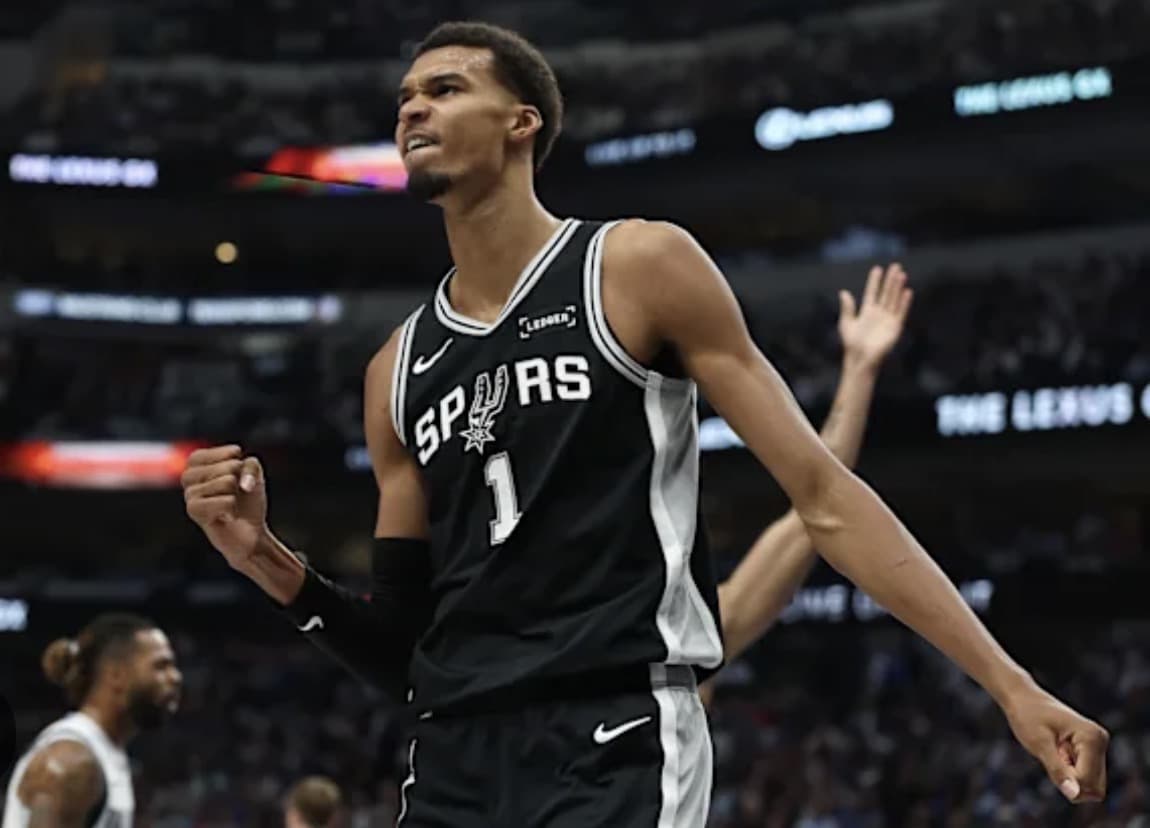
Spurs, Accelerated: Wemby’s Return, Fox’s Pace, and the Math on a Top-3 West Push.
What We Saw
San Antonio just went from “fun rebuild” to “legit math problem.” The second Victor Wembanyama stepped back onto the court, fully cleared from his clot scare, the energy flipped. It wasn’t relief; it was intent. Add De’Aaron Fox, who now dictates the tempo like a one-man metronome, and suddenly the Spurs are playing with a grown-up heartbeat. The pairing works because their strengths rhyme: Fox bends the defense until it creaks, and Wemby punishes every rotation mistake with reach physics that shouldn’t exist.
But the real difference is what’s around them. Stephon Castle, reigning Rookie of the Year, guards like he’s offended you even tried to dribble. Dylan Harper, the No. 2 pick, adds a second-side decision-maker who can trigger chaos without hijacking rhythm. What was once a roster of intriguing projects now reads like an organized attack plan.
The question isn’t talent, it’s sustainability at playoff speed. The regular season will be full of highlights, but can San Antonio stay connected when the tempo drops and spacing shrinks? Because the Spurs’ ceiling, third in the West, isn’t a fantasy. It’s a formula: if the defense holds when Wemby sits and Fox controls pace, the numbers start lining up.
That’s what makes this version of San Antonio dangerous: it’s not about vibes anymore. It’s about math that travels.
What We Felt
There’s a new tone in the room. It’s confidence without the condescension, a sense that San Antonio finally knows how good it can be. Wembanyama’s 40-point opener wasn’t a message; it was a warning. The NBA’s youngest genius has adults in the backcourt now, and every possession feels like a clinic in controlled chaos.
Fox changes the culture immediately. His pace gives Wemby a co-star who can feed him rhythm instead of static. It’s not just that he’s fast, it’s that he’s decisive. That tempo infects everyone else. Castle’s poise looks even sharper next to Fox’s downhill pressure, and Harper’s developing feel makes the bench lineups less brittle.
Still, there’s one glaring variable that keeps popping up in analytics meetings: non-Wemby minutes. When he sits, San Antonio’s defense tends to deflate like a beach ball in November. Fox’s rim pressure can cover some of that gap, but at some point, the team needs to defend with the same edge they show on the highlight reels. That’s the difference between a third seed and another “fun League Pass team.”
And here’s the quiet truth: San Antonio might already be the most balanced young roster in the league. The top-end star power is clear, the developmental curve is ahead of schedule, and Atkinson’s offense finally gives Wemby room to breathe.
But balance doesn’t get you through May, edge does.
What It Means
San Antonio’s big rotation is deep and solidified their backup big behind Wemby. You need someone who that just protects the rim. That’s why the on/off defensive rating during Wemby’s rest will be this season’s most telling metric. Kornet’s minutes are big! Having Fox as a release valve during “crunch time”, is huge for the Spurs. Not many teams will have an answer for Victor Wembanyama, but there will be a coach with an exotic defensive or two and that is where Fox and Vassell’s scoring will come in handy!
Castle is the hinge of that scenario. His defensive versatility makes everything make sense. He guards 1 through 3, absorbs pace, and still manages to organize half-court possessions without ego. That’s rare for a sophomore guard. Harper, meanwhile, adds juice to the bench units, a burst of creation that keeps the rhythm alive. Together, they make San Antonio’s rebuild look accelerated by intent, not luck.
So what has to happen for the Spurs to reach the NBA Finals?
Health holds. Wemby and Fox must play 65+ games together, their synergy builds repetition, and repetition builds fear.
The defense defends without Wemby. Simple math: you can’t outscore everyone in May.
Castle grows into the third voice. Not a passenger, not a rookie guard, but the connective tissue between superstars.
If those three align, the rest of the West suddenly feels reachable.
What Comes Next
Win Total Prediction: 52–30. Third in the West if Wembanyama stays healthy. The time is now for the Spurs graduate from “promising” to “dangerous.”
The playoff test will come down to endurance, can they win the slow games? Every contender eventually faces the same question: when the game turns ugly, who cleans up the mess? Fox gives them urgency. Wemby gives them inevitability. Now they need everyone else to give them resistance.
Because if the defense stabilizes, the ball moves, and the math keeps checking out, San Antonio won’t just be ahead of schedule, they’ll be setting it.
One Last Thing
This isn’t a science project anymore, it’s production on deep post possessions. Wemby’s cleared and ready to dominate! Fox is committed. The rookie (Harper) is real. If the defense won’t drown when Wemby sits with the free agent acquisition of Luke Kornet, home-court advantage is the floor, not the dream. (source: observation)
So yeah, plant the flag. Dare the West to dislodge it. Because this version of the Spurs? They’re not waiting for the future, they’re making everyone else catch up to it.
Purple Pulse Check: Luka’s Show, LeBron’s Clock, and the 42-Minute Gas Tank
What We Saw
Luka Dončić lost 30 pounds and Luka feels he has something to prove to the entire NBA, and it showed Opening Night, where Dončić dropped 43 points on Golden State. Luka Dončić is now the Lakers’ gravitational offensive hub, and the franchise looks more like a European art project than a Hollywood sequel.
That first game told the truth: Luka was brilliant, Austin Reaves was fearless, and everyone else was still learning where to stand. The Mavericks got the win, but the message from Crypto.com Arena was louder than the scoreboard, this is Luka’s team now, and it’s already complicated.
LeBron James is still around, but he’s transitioned into something rare: a living legacy coexisting with the next superstar. At 40, he’s become the Lakers’ pace regulator, resting when necessary, mentoring when possible, and managing minutes like a man playing chess with his body clock. The challenge is real: how do you integrate the league’s boldest young creator with its most seasoned mind without stepping on rhythm or ego?
The early film says it’s possible. Luka’s tempo and LeBron’s restraint might actually complement each other, one thrives on control, the other on perspective. But harmony takes time, and the West doesn’t wait.
What We Felt
The roster isn’t a superteam; it’s a recalibration. Deandre Ayton gives Los Angeles a big who can actually match Luka’s pick-and-roll timing. When he commits to the glass and plays through contact, he looks like a solution. When he floats, the defense caves in. His consistency is the Lakers’ weather system, everything depends on whether he shows up with force or finesse.
Austin Reaves is now the connective piece every contender wishes it had. He’s comfortable off-ball, creative when handling, and never panics when the game tightens. Reaves has quietly evolved into a co-pilot, not a star, but the guy who keeps the plane steady while Luka and LeBron are on the bench.
Marcus Smart brings the grit this locker room needed. Eleven years into his career, he’s part culture cop, part instigator. When he talks, the defense aligns. His energy sets the tone for players like Rui Hachimura, who’s embracing his sixth-man role with quiet aggression, a scoring engine off the bench who doesn’t need design plays to matter.
The chemistry is uneven but promising. The Lakers have moved away from the old, top-heavy identity and toward something more malleable, a team that can grind as easily as it can entertain.
But there’s one looming question hanging over all of it: what does LeBron do now? He’s still elite when healthy, but the body demands a smarter kind of dominance. He doesn’t have to chase numbers anymore, he has to build habits the rest can copy.
What It Means
This is a new kind of Los Angeles story, not a blockbuster, but a rebuild disguised as contention. The ceiling depends on defensive buy-in and fourth-quarter organization. Luka will get you 35 and 10, but what happens when he sits? Can Ayton and Reaves can stop the lane from becoming a turnstile?
The answer decides everything. The Lakers’ last few seasons died in the details, second efforts missed, rotations a step slow, late-game possessions that turned into static. Those aren’t talent issues; they’re identity ones.
Smart’s voice, Reaves’ composure, and Hachimura’s strength can build a spine around Luka’s brilliance. If that spine holds, this roster becomes terrifying.
The math says they can get there.
Their fourth-quarter net rating was positive in preseason with Luka and Reaves on the floor together, the first sign of balance between pace and control. If the defense holds serve when Ayton anchors and Smart sets the edge, a top-five seed is realistic.
What Comes Next
This season is about endurance, not explosion. The Lakers don’t need to dominate every game, they need to win the right ones. That means staying organized in crunch time, keeping LeBron’s minutes low but his influence high, and building chemistry that travels.
Projected Win Total: 48–34.
Good enough for the 4-5 seed range, dangerous enough to ruin someone’s spring.
The West is crowded, but Los Angeles has two top 20 guys, one where Luka dictates, LeBron provides efficient offense when healthy, and everyone else fights to stay in frame. It’s not perfect, but it’s progress.
One Last Thing
Not enough, not yet... Luka is floor raiser, Dončić’s offense steadies a team that has many defensive leaks. The lack of point of attack defender, Rui miscast as a wing chasing around the likes of Kawhi Leonard, DeMar DeRozan, or Trey Murphy sounds like a terrifying proposition. LeBron James in his 23rd season can’t chase those types of athletes for an entire season, even if James has succumb to the dreaded load management to save his legs for the playoffs. The Lakers resemble a scenic puzzle that is missing critical puzzle tiles to complete the picture!
Forecasts, Feels, and Fool’s Gold: The FRPC 2025 NBA Regular Season Predictions
What We Saw Coming
Welcome to that time of year when optimism smells like new sneakers and bad takes age in real time. Every team believes, every player’s “locked in,” and someone, somewhere, is already convinced their rookie’s a future MVP. It’s prediction season, the annual ritual where we all become part analytics nerd, part fortune teller, and part stand-up comic trying not to bomb.
Let’s call it what it is: educated guessing with conviction.
NBA MVP: Anthony Edwards
This feels less like a prediction and more like a formality. Anthony Edwards has officially crossed into “don’t say he’s next, he’s now” territory. The Timberwolves have built the league’s best defensive safety net, which means Ant can finally focus on consistent takeover mode instead of hero-ball triage.
He’s got the stats, the stage, and the charisma that sponsors dream of. If he plays 70+ games and averages something like 33-6-5 while Minnesota wins 52+, it’s over. Edwards is becoming the league’s most entertaining mix of alpha and accountability, part star, part spark, all smoke.
Prediction: Anthony Edwards — MVP, by confidence not coincidence.
Rookie of the Year: Cooper Flagg
Yeah, the hype’s been loud, but Flagg might actually live up to it. The kid defends like he’s late for something and has a shot that already looks league-ready. What sets him apart isn’t just skill; it’s the composure. He doesn’t play like a teenager; he plays like someone who’s been watching film of himself from the future. Stop playing Flagg at Point Guard.
Prediction: Cooper Flagg — ROY with old-soul energy.
Defensive Player of the Year: Victor Wembanyama
This one’s simple. Wemby already changes how teams run offense, not just where they shoot, but whether they even bother. He’s a cheat code with long arms and short patience. The Spurs’ defense looks like a geometry problem that other teams don’t want to solve.
Not only will Wemby be the DPOY, he will be top 5 in MVP voting!!! Clock it!
Prediction: Wembanyama — DPOY by intimidation and math.
Sixth Man of the Year: Josh Hart or Cason Wallace
This category is pure chaos. Josh Hart is going to flirt with triple-doubles so often it’ll feel like a running joke, nine points, nine boards, nine assists, and 100% effort every night. His case depends on whether voters love impact over highlights.
But don’t sleep on Cason Wallace. He’s what happens when calm meets competence. The Thunder might unleash him as a defensive disruptor who shoots 40% from three and quietly wins games by being exactly what they need.
Prediction: Hart’s Garden moments could be his calling card; Wallace’s will whisper value. Either could win.
Most Improved Player: Amen Thompson or Jarace Walker
For Amen Thompson, it’s about the jump shot. If it goes from “please don’t” to “yeah, take that,” he becomes a real star. The defense, rebounding, and pace are already elite. The shooting turns him from curiosity to cornerstone.
Jarace Walker, meanwhile, is the sleeper. He’s got the skill set of a big who thinks like a guard. If Indiana uses him as their hybrid bruiser who defends fours and initiates offense on the break, he’ll stack stat lines fast.
Prediction: Amen if the jumper arrives, Jarace if the Pacers climb.
Coach of the Year: David Adelman, Nuggets
The Nuggets feel inevitable, but they’re also evolving. Michael Malone’s longtime assistant David Adelman taking the reins would feel seamless, but he’s sharp enough to make subtle tweaks that keep Denver fresh. If they win 60 games while balancing rest and repetition, this is the staff story of the year.
Prediction: Adelman — steady hand, sharper mind.
Executive of the Year: Onci Saleh, Atlanta Hawks
The Hawks? Yeah, you read that right. Onci Saleh is playing the long game — restructuring culture, rebuilding depth, and finally giving Trae Young a team that feels balanced instead of desperate. The roster fits. The vibe feels adult.
If Atlanta overachieves and lands in the top five of the East, he’s your guy.
Prediction: Saleh — for turning noise into direction.