By Vince Carter and FRPC Contributors
The Week the West Got Weird
The West never stays still, it mutates. One week it’s the Lakers’ development lab producing a folk hero in Austin Reeves; the next, Luka Dončić strolls in and reorders the pecking chart like he’s dropping a new firmware update on the whole conference. What looked like a feel-good run suddenly feels like a referendum: what does “No. 2” even mean in a league where usage is currency and chemistry is cap space?
Then there’s Ja Morant, still dazzling, still defiant, still learning that leadership can’t be reverse-engineered after the buzzer. While Memphis sorts through tone versus tempo, Victor Wembanyama is out here shredding timelines. The “wait-two-years” myth died somewhere between his fifth block and his third pull-up three. We thought he’d bring the future; turns out he is the future... and it’s early.
Further south, New Orleans is living in a rerun: new roster, same uncertainty. An 0-5 start and an unprotected pick have the Atlanta Hawks watching with binoculars and popcorn. The Pelicans’ window might have closed before it ever opened, and that 2026 pick just turned radioactive.
Speaking of 2026, the next class is already introducing itself. Darrin Peterson, A.J. DeBansa, Cam Boozer, and Nate Amint headline a group that looks ready to reshape front-office behavior all over again. If you’re not tracking these kids yet, you will be by March Madness.
That’s the docket this week at FRPC: the rise of an undrafted hinge in Los Angeles, a Slovenian savant reclaiming dominance, a phenom in San Antonio burning the script, a franchise in New Orleans fumbling one, and a teenage wave in the on-deck circle. It’s the full Western ecosystem, from established constellations to stars still forming.
So pull up your second screen, keep your group chat open, and let’s unpack the wins, mess, and maybe’s that define the sport right now.
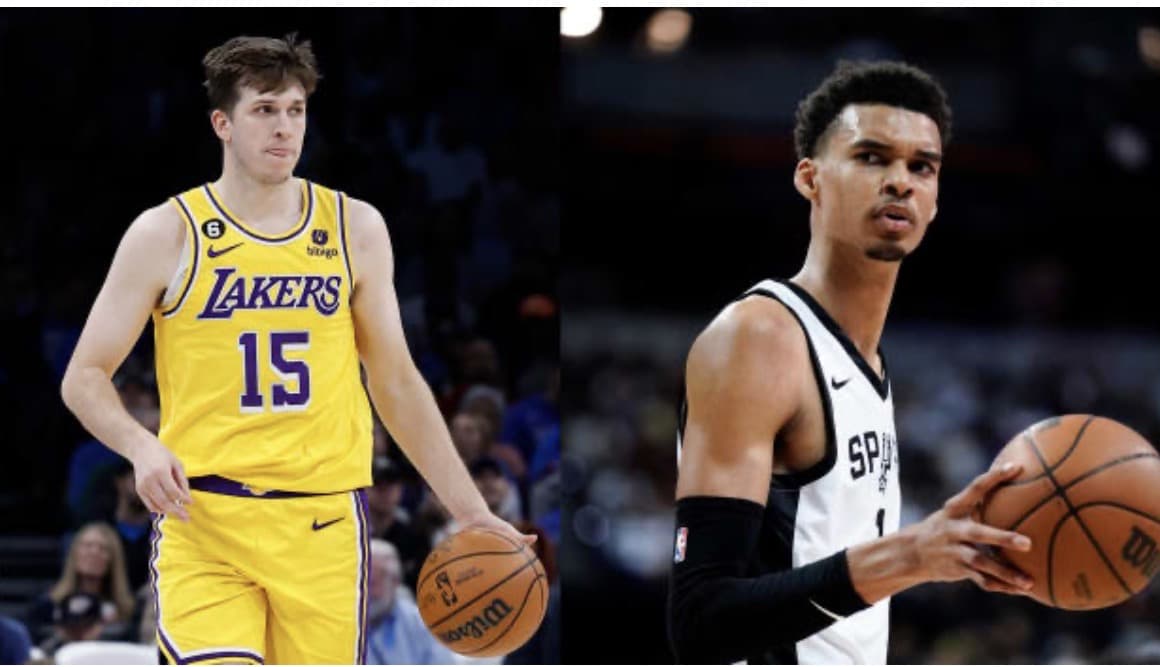
Austin Reaves and the Price of Becoming Inevitable
There’s something poetic about watching an undrafted kid tilt a franchise built on five-star résumés. Austin Reaves wasn’t supposed to shift the Lakers’ center of gravity, he was supposed to fill minutes, hit open looks, and fade back into rotation blur. Instead, he’s become the case study for how development can out-shine stardom.
He went from overlooked to unavoidable, and that’s not just a glow-up line, it’s a culture audit. In a locker room where the wall art still spells out Legends Live Here, Reeves is proof that “development” isn’t a press-conference platitude. It’s policy. He’s the hinge between what the Lakers were built on, star gravity, and what they’ve quietly learned to cultivate: reliability.
🎬 Identity Shift → The New Laker Lab
Pre-production note one: Identity Shift. The blog should make this clear, when Reeves thrives, the Lakers’ myth modernizes. He’s the counter-narrative to the headline trades. The team that once relied on celebrity now sells system fit. That’s not a downgrade. It’s an evolution.
He plays like someone allergic to panic, decelerating in traffic, dictating tempo, making “simple” look like a superpower. It’s why teammates trust him in closing sets and why coaches see him as connective tissue. His stardom feels almost accidental, but it’s manufactured the same way culture is: rep by rep, read by read.
💰 Contract = Culture Test
The money always tells on you. Reeves’ new deal didn’t change the vibe, it clarified it. The Lakers’ cap table reads like a philosophy statement now: We invest in proof of process. A front office that used to chase flash is suddenly profiting off patience.
That’s your blog hinge, pre-production note two, Contract = Culture Test. Don’t get lost in the zeroes. Get lost in the statement. When a $13-million-a-year guard feels like a bargain, it means you built something right. Visualize it with that Salary vs. Win Share chart, because this isn’t gossip, it’s infrastructure.
🧩 The Role Question
Reaves is an overqualified No. 3 who can cosplay as a No. 2 when the lights demand it. And that’s okay. Not everyone needs to be the sun; some players are orbits that keep the system stable.
Pre-production note three: Scaling Roles. His best games feel effortless because they happen inside rhythm, not rebellion. When the scouting report makes him the first name on the whiteboard, efficiency dips, not heart, just bandwidth. That nuance is the entire argument. Blog readers crave that honesty.
🤝 The Leadership Turn
Somewhere between last season’s slump and this month’s heater, Reaves stopped deferring. He’s become the quiet coaxer, the “keep your head up, big dog” guy Vince loves to reference. That’s the glue gene we haven’t seen since Fisher or Odom: accountability without volume.
Pre-production note four: Glue & Leadership. Use it as an emotional beat, the shift from storybook underdog to locker-room compass. Fans love that transformation arc more than stat lines.
📊 The Numbers That Travel
And then there’s the data that refuses to be dismissed. 68.7 true shooting. 43% assist rate. PER north of 30. This isn’t a lucky week; it’s a player writing his sustainability thesis in real time.
Pre-production note five: Numbers That Travel. The blog takeaway, “proof of scalability, not novelty.” It’s the perfect closing sentence before pivoting to what’s next: how Reeves’ rise forces L.A. to rethink the way it builds around stars, not just signs them.
Luka & Reaves: The Quiet Math of Coexistence
Basketball duos are supposed to clash before they click. But watching Luka Dončić and Austin Reeves learn to share a backcourt feels less like conflict and more like choreography. It’s jazz with a playbook, Luka bends the rhythm, and Reeves restores it before the beat drops off.
When Luka came back from injury and detonated for 44 and 12 in Memphis, it wasn’t just his dominance that stood out, it was who stabilized him. For three critical minutes in the fourth, Reeves ran the entire offense, slowing the tempo, buying Luka rest, and keeping the Lakers’ composure from leaking out.
That sequence felt like a metaphor for this whole partnership: Luka makes the weather, and Reeves builds the shelter.
Soraya’s Observation: Reaves isn’t Luka’s backup plan, he’s Luka’s balance beam. The offense breathes because one of them is always inhaling while the other exhales.
The Geometry of Trust
Luka’s game thrives on distortion, his step-backs stretch the floor like rubber bands, his vision compresses defenses like a lens. Reaves’s job is to make that distortion sustainable.
He doesn’t need to match Luka’s wattage; he just has to hold the voltage steady.
That’s what we saw against Memphis: Luka drawing doubles and making early reads, Reaves standing one pass away, pre-loading the next action before the defense even commits. It’s not just timing, it’s translation. Luka speaks chaos; Reeves subtitles it.
Soraya’s Observation: Two creators, one rhythm. Luka makes music; Reaves keeps time. This is tempo literacy in motion.
Cap Table Chemistry
This duo doesn’t just work on the floor, can it work on the spreadsheet? Reaves contract isn’t a budget miracle; it’s a cultural anchor. His mid-tier deal buys L.A. more than cap flexibility, it buys trust in development.
He’s the rare player whose value multiplies when placed next to a superstar instead of shrinking under him.
Luka’s max is the headline. Reaves consistency is the footnote that holds the story together.
And for the first time in years, the Lakers’ front office is building continuity instead of chasing celebrity fits.
Soraya’s Observation: Reaves contract is the bridge between scouting and superstardom, proof that sometimes the best spending comes from patience, not panic. There are NBA talking heads that suggest trading Reaves. It is not hard to find a local blogger or podcaster not to suggest such absurd statements!
Defense Without Drama
It’s easy to get lost in the box scores, but Reaves defensive persistence might be what allows Luka to stay explosive deep into fourth quarters.
When Reaves picks up full-court or absorbs switches, he’s quietly buying energy on Luka’s behalf. That’s the unsexy math behind superstar efficiency, the invisible stamina management that doesn’t make highlight reels but wins games.
Memphis tried to break him down with length, McDaniels at 6′10″, aggressive traps, constant bumps. Reaves didn’t fold; he redirected. He’s not the best stopper in the league, but he’s a metronome for effort.
Soraya’s Observation: Every star needs an energy accountant. Reaves audits the grid so Luka can keep cashing in.
The Leadership Layer
Reaves voice has changed this year. He’s not waiting to be invited into the huddle; he’s setting the tone of it.
You can feel it in the moments that don’t go viral, the mid-game pep talk, the quick reset after a bad turnover. Luka commands; Reaves connects.
Together, they’ve built something that looks like shared gravity, where leadership is an exchange, not a hierarchy.
This might be the most modern kind of chemistry in basketball, not dominance or deferral, but mutual fluency.
Soraya’s Observation: The Lakers didn’t just build a backcourt; they built a conversation. Luka speaks in genius. Reaves replies in solutions. In a league addicted to alpha narratives, this pairing feels refreshingly cooperative. Luka remains the force of nature, but every storm needs an atmosphere, and Austin Reeves is exactly that: calm, breathable, and essential.
When you rewatch this stretch of games, notice the space between their touches, the unhurried confidence, the shared rhythm. That’s not luck or luck of fit. That’s two basketball minds orbiting the same principle: it’s not about who dominates, but how the dominance is sustained.
Ja Morant and the Myth of Self-Awareness
I’ve covered a lot of players who’ve had to learn the hard way that talent doesn’t cancel out turbulence. Ja Morant might be the loudest example yet.
We’ve now reached the part of the story where suspension isn’t shock anymore, it’s pattern.
Missed games, muted accountability, and a fan base that’s run out of explanations.
And look, this isn’t slander. It’s sorrow.
Because at his peak, Ja plays like basketball reincarnated, fearless, creative, joyful. You feel him through the screen. But what happens when the joy starts costing everyone else? When your personal chaos becomes part of the scouting report?
He’s serving another suspension now, and if you’re listening closely around the league, trade whispers aren’t whispers anymore. That’s not punishment, that’s fatigue.
The Grizzlies believed in the redemption arc. They wrote it twice. The problem is, Ja kept improvising new endings.
Soraya’s Observation: Self-awareness is the one skill you can’t coach into somebody. You either start building it or you get benched by your own blind spots.
The Disconnect Between “I Got It” and “I’m Getting It”
Every postgame podium from Ja in the last year has had the same rhythm, nods to accountability, a soundbite about “learning,” a reset. But the action never follows the script.
And that’s what’s hardest to stomach: he keeps saying the right words, but living the wrong lessons.
For players like Ja, the game has always been the safe space, the escape from noise. But when your off-court turbulence starts rewriting your on-court availability, the game stops covering for you.
You start costing everyone else minutes, reps, and momentum.
That’s when teammates stop believing the talk. That’s when front offices stop defending the drama.
Soraya’s Observation: There’s a shelf life on “potential.” At some point, a franchise wants predictability more than personality.
Leadership Can’t Be on Layaway
The truth is, Memphis built this whole identity around him, grit, speed, swagger, belief.
But belief isn’t infinite. Every suspension chips away at that culture. Every “we’ll get him back soon” starts sounding like wishful thinking.
You can’t lead a locker room you keep disappearing from!
I've been in those locker rooms. Once the belief cracks, it spreads fast. That’s why a trade doesn’t feel far-fetched anymore, not because Memphis wants to give up, but because it can’t afford to keep waiting for clarity that never comes.
Soraya’s Observation: Memphis didn’t just lose its star. It lost its compass. You can replace points; you can’t replace gravity.
The Tragedy of Wasted Trust
Ja had the keys. The endorsements, the kids wearing his jersey, the city built around his electricity.
He had goodwill most players spend a decade earning. And he burned through it faster than he can jump.
It’s hard to watch because you know how rare this kind of talent is, and how many people vouched for him behind closed doors.
The myth of self-awareness is thinking you’ll “figure it out” when the world slows down. It never does. The lights don’t wait. The league doesn’t wait.
Memphis has waited long enough.
Soraya’s Observation: You can’t dribble your way out of consequence. The highlight reel can’t mute the silence that follows.
At some point, Ja’s next chapter will have to be less about explosion and more about reflection.
The hope is that he gets it right, even if it’s not in Memphis. Because if there’s one truth that never changes in this league, it’s this: talent gets you in the door, but trust keeps you there.
Victor Wembanyama: The Future That Arrived Early
I keep saying we were supposed to have time. Time to adjust, to rationalize, to build a narrative that made sense before Victor Wembanyama broke the rules of pacing.
We thought the learning curve would be a slow incline. Turns out, it was a trampoline.
He’s 7'6" with a wingspan that looks photoshopped, but that’s not the part that’s scary anymore. It’s the processing speed, how fast he’s solving NBA problems that were supposed to take years.
You can hear it in opposing coaches already. They talk about him the way people used to talk about Jordan — with resignation.
“Yeah, we threw two at him… didn’t matter.”
“Yeah, he’s already seeing the doubles coming.”
That’s how you know it’s real.
Soraya’s Observation: The “project” label has an expiration date. Wemby shredded his before Halloween.
The Fast-Forward Button
Five games in, he’s averaging 30 points, 14.6 rebounds, and 4.8 blocks. On a rookie contract. The Spurs are undefeated.
Those numbers read like a typo until you realize they make perfect sense.
He doesn’t play like a prospect, he plays like inevitability.
We expected the physical flashes: the blocks, the put-backs, the skyhook from outer space. What we didn’t expect was the calm.
The game speeds up for everyone else. For him, it slows down. That’s not maturity, that’s mastery.
And it’s happening inside an organization that doesn’t rush anything. The Spurs live for process. They move like a church.
Now they’ve got a deity in a rookie jersey, and he’s already rewriting the gospel.
Soraya’s Observation: Gregg Popovich didn’t build a system for this. He built a sanctuary. And Wemby walked in already glowing.
Dominance Without Polish
There’s a rawness still, missed rotations, the occasional clumsy turnover, a few post-ups that end up looking like interpretive dance. But here’s the thing: even his mistakes bend the game.
Teams are already changing their shot charts because he exists. Nobody wants to go near the paint.
He’s not blocking everything; he’s deterring everything. There’s a difference. One’s athletic. The other’s psychological.
You can feel the ripple effect, guards pull up early, bigs second-guess their drives, shooters rush their release.
It’s a league-wide anxiety attack every time he takes a step toward the rim.
Soraya’s Observation: He’s not just defending the paint; he’s defending possibility. That’s how legends start, by altering what’s reasonable.
When the Future Refuses to Wait
We all thought 2026 the emergence would happen or 2027, Wemby would make his MVP push was going to be his takeover window. Now? He’s ahead of schedule. Way ahead.
This isn’t supposed to be a championship team yet, but tell that to their net rating, their defense, their joy.
He’s made the Spurs matter again before their marketing department even had time to print new banners.
You can hear it in how other players talk about him. Nobody calls him “kid.” They call him “problem.”
You don’t get that label until your presence changes game plans. NBA pundits are calling firmly in the MVP race!
And for all the noise about his physique, the thin frame, the wear concerns, he’s outlasting contact, initiating collisions, and smiling through them.
You can’t coach that kind of composure. You can only witness it.
Soraya’s Observation: Wemby skipped the “potential” phase and went straight to “proof.” Every possession feels like prophecy.
The New Normal
The crazy part? He’s not even done evolving. His body’s still filling out. His reads are still sharpening. His touch is still expanding.
If this is his “incomplete” form, we’re in trouble. The league just got a new north star, and it’s already blinding.
We always talk about the future tense in basketball: who will take over next, who’s coming, who’s almost there.
Well, here’s the truth, the future clock just ran out.
Soraya’s Observation: He didn’t wait for the league to make space. He made the league smaller.
Wemby isn’t the next anything. He’s the first of something.
And that’s what’s terrifying, not that he’s here early, but that the rest of us are late.
The Fall of New Orleans: When Bad Math Meets Bad Timing
Man, I wanted to be wrong about this. I wanted to believe the Pelicans had figured it out, that health, development, and luck would finally sync up in the same season.
But what we’ve seen so far? This ain’t synergy. This is arithmetic gone bad. Joe Dumars and Troy Weaver stamped this decision as their first move steering the ship for New Orleans. Oh, the days of David Griffin.
They’re 0-5, they look lost, and they’re playing basketball like they owe somebody rent on every possession.
“You can’t defend, you can’t finish, you have no identity, and that travels worse than your pick going to Atlanta.”
That was straight from the pod, and I stand on it.
You can feel the cracks from the top down. It’s not just the losses; it’s the indecision.
The moves don’t make sense in sequence, they make sense in panic.
Soraya’s Observation: New Orleans keeps mistaking activity for direction. They’re not rebuilding or contending, they’re just rearranging the confusion.
The Bad Deal That Started the Dominoes
This all goes back to that 2025 Draft-night heist, when the Pelicans traded a future unprotected 2026 first-round pickto move up for Derek Queen.
That’s the kind of gamble you make if you’re one player away, not one idea away.
I said it then, and I’ll say it now, “This was bad calculus. This was Michael Scott-level management in the office buffoonery.”
You don’t mortgage your future for a project player when your present is already unstable.
Now that pick could become a top-5 selection in one of the deepest drafts in years, and guess who’s holding it?
The Atlanta Hawks.
They’re out here eating beignets made from your future.
Soraya’s Observation: Every front office has a blind spot, New Orleans’ is the illusion of “next year.” It’s been next year since 2019.
Zion’s Body, Not the Body of Work
Let’s talk about Zion.
He’s in the best shape we’ve ever seen lighter, leaner, spryer. But health without direction doesn’t fix dysfunction.
They’ve built this roster around his availability instead of his identity.
Zion’s playing well, but it’s not contagious.
The rotations are a mess, the spacing’s claustrophobic, and the energy? Nonexistent.
“You can’t defend, you can’t finish, you have no identity.”
That line hits harder now than when I first said it because it’s not about talent — it’s about translation.
They’ve got the ingredients; they just keep following the wrong recipe.
Soraya’s Observation: Zion got healthy, but the franchise didn’t. You can’t stretch the floor when your foundation’s cracked.
The Vibes Are Off, the Math Is Worse
The Pelicans’ offense ranks near the bottom of the league, 103.6 rating, 29th overall.
Their defense? 122.5 - also 29th.
That’s a full-court disaster.
“They lost 122 to 88 at home, the lowest energy game of the season.”
That’s not a bad night; that’s an existential crisis.
And it’s not just the numbers. You can see it in Willie Green’s body language, the guy looks like he’s coaching through quicksand.
When your head coach starts questioning the team’s toughness in public, the locker room’s already taken the L.
Soraya’s Observation: Coaches only talk about effort when they’ve run out of schemes.
Jordan Poole and the Leadership Black Hole
They replaced CJ McCollum and Brandon Ingram with Jordan Poole, thinking they’d found a plug-in scorer.
What they got instead is chaos wrapped in confidence.
Poole’s got a highlight reel, not a compass.
This team needed a grown-up, and they got a pyromaniac with a jump shot.
And here’s the part that hurts: this city deserves better.
The fans have been loyal through all of it, the injuries, the false starts, the “maybe this year” hope cycles.
But you can’t keep selling belief when the product keeps breaking.
Soraya’s Observation: Every rebuild hits a fork, faith or fatigue. The Pelicans are out of both.
The Bill Comes Due
That 2026 unprotected pick is the tax bill for this experiment.
And when the lottery balls start bouncing, Atlanta’s gonna collect.
New Orleans wanted to build a contender; they built a cautionary tale instead.
Bad math. Bad timing.
And a good city watching the same bad movie on repeat.
“You can’t defend, you can’t finish, you have no identity.”
Maybe that’s the franchise’s new slogan until someone decides to actually do the math right.
The Class of 2026: The Kids Who Should Storm The League
Every few years, basketball gives us a draft class that feels less like the next chapter and more like a plot twist.
You can feel it coming before the analysts say a word. Coaches start scouting high school gyms again. Brands start hovering. The AAU clips don’t look like prep ball anymore, they look like previews.
That’s what the Class of 2026 feels like: the moment the future stops knocking and just walks in.
This class isn’t built on hype. It’s built on proof. These kids have game tape that travels, from FIBA courts to summer camps to viral clips where grown men end up in thumbnails. And yet what’s most exciting about them isn’t the dominance; it’s the diversity. This isn’t five clones playing the same style. It’s a generation of specialists, leaders, playmakers, bruisers, artists, all orbiting different versions of excellence.
Soraya’s Observation: Every generation thinks it’s watching the next wave. But this one? This feels like the tide turning.
The Headliner: Darryn Peterson: The Blueprint
Every class needs a headline act, and Darryn Peterson is that with authority. The Kansas-bound guard is a blend of raw voltage and veteran IQ.
He’s “a multi-level scorer with elite physical tools,” but that doesn’t even do him justice. He’s got the craft of a 10-year vet and the confidence of a freshman who’s never been told no.
What makes him terrifying is how mature his scoring process already is. He’ll probe, pause, drag a defender half a step, and then explode. No wasted movement, no vanity dribbles, everything is applied purpose. Peterson shows traits of Kobe with the fearlessness but dedication towards his craft.
At 6'5" with a 6'10" wingspan, he defends like he’s insulted you for trying. Coaches say he’s the rare guard who can dominate both ends without compromise. That’s Kobe mentality, Derrick Rose twitch, and Anthony Edwards’ joy all mixed in one.
“He’s been punching the international game in the mouth.”
That line from the show wasn’t hyperbole, it was a warning. He’s not coming for your respect; he’s assuming he already has it.
Soraya’s Observation: Peterson plays like he’s already lived this career once. It’s not bravado — it’s memory.
The Artist: Nate Ament: Smooth is the Speed
If Peterson is the hammer, Nate Ament is the scalpel. The 6'10" Tennessee wing moves like a riddle nobody’s solved yet. For being so thin Ament is tough basketball player!
You don’t usually see someone that tall glide like a guard and read like a veteran. He’s all nuance, spacing, timing, unselfish cuts, and passing windows only he sees.
He’s got shades of Jaden McDaniels on defense and flashes of Franz Wagner on offense, but his personality feels closer to Tim Duncan: quiet, surgical, and quietly terrifying.
Right now, he’s thin, 207 pounds soaking wet. But that’s temporary. “Somebody take him to grandma’s house and get him a plate of ribs and hush puppies.” That was the pod line, and it’s gospel. Once his frame catches up to his mind, the league’s going to have a problem.
Soraya’s Observation: Patience looks boring until it blooms. Ament’s game is all timing, he’s the storm before the thunder.
The Showman: A.J. Dybansta: Bright Lights, No Dimmer
Then there’s A.J. Dybansta, the $8 million NIL prodigy from Brockton, Massachusetts, a city that births boxers and brawlers, not finesse wings.
Yet here he is at BYU, an explosive mix of power and elegance.
“A.J. Dybansta hasn’t met a shot he doesn’t like, but man, when it drops, it’s Broadway.”
That was me half-joking on the pod, but truthfully, he’s theater on hardwood. Every possession’s a performance.
The trick will be learning restraint, turning the “I can” into “I should.”
He’s 6'9", built like a safety, and plays like he’s allergic to subtlety.
Defenders bounce off him, but what you want to see is growth in his playmaking. Can he weaponize gravity the way LeBron does, draw doubles not for highlights, but for teammates?
If he figures that out, we’re not talking about an All-Star; we’re talking about a franchise. Dybansta is a tantalizing talent that will be difficult to pass up!
Soraya’s Observation: Dybansta doesn’t need to dim his light. He just needs to learn how to aim it.
The Foundation: Cameron Boozer - Old Soul, New Model
And then there’s the one who already feels NBA-ready: Cameron Boozer.
He’s the stabilizer in a class of fireworks, 6'9", 250 pounds of consistent excellence.
He doesn’t care about mixtape views. He cares about winning possessions.
“He’s a double-double waiting to happen, not flashy, just finished.”
That’s how I described him on the show, and it holds up. Boozer doesn’t play to impress, he plays to outlast.
Every box-out, every post seal, every pass off the roll, he’s a metronome of maturity. Boozer is a plethora of winning and right plays and less highlights.
He’s Al Horford with better touch and more bounce. Duke’s going to love him because he doesn’t take air out of the offense; he gives it shape.
Soraya’s Observation: Boozer’s game is the answer key, nothing fancy, just correct.
The Dark Horses: Brown Jr., Canac Jr., and Peat
Behind the headliners, the depth in this class is absurd.
Mikel Brown Jr. led the USA U-19 team in scoring over Peterson, Boozer, and Dybansta, proof that he’s not afraid of anyone’s spotlight. Louisville is treated to this kid’s toughness and not being scared of the moment!
Chris Cenac Jr. in Houston is a 6'11" hybrid who moves like he’s allergic to gravity. He’s got all the tools — the question is consistency.
And Koa Peat? That kid’s motor has its own zip code.
“He plays like every rebound owes him money.”
That’s how I said it, and I’ll stand on it. Pete doesn’t play to get noticed. He plays to end your shift.
Soraya’s Observation: These aren’t role players; they’re role definers. The next decade’s glue is already drying.
Why This Class Matters
The league’s in a weird place, aging stars, new media pressure, too much drama around not enough games.
We needed a reset. A return to the kind of hooping that’s driven by joy, not branding.
The Class of 2026 might be that correction.
They’re not waiting to be handed the keys; they’re already practicing the routes.
They’ve got humility and hunger, rare combo. They’re not just social-media stars; they’re technicians.
“They’re not waiting their turn, they’re cutting the line.”
That’s the thesis. They’re coming to the league to compete, not campaign.
Soraya’s Observation: Every so often, a draft doesn’t just fill rosters, it rewrites priorities. This one feels like one of those.
By the time these kids hit the league, half of today’s stars will be podcasting about them.
And the scary part? They won’t just inherit the game, they’ll upgrade it.
Call it evolution, call it a revival, but one thing’s certain:
The Class of 2026 isn’t chasing the future.
They are the future, and they’ve already RSVP’d for greatness.
Closing Thoughts: Keep Your Circle Tight
When you zoom out and look at the season, the stories we’ve covered, the arcs we’ve watched bend or break, it all comes down to one truth: basketball mirrors life. You can’t fake chemistry. You can’t shortcut growth. And you can’t outscore accountability.
We talked about Ja Morant and the myth of self-awareness, how talent can’t outrun consequence. Being real isn’t creating undue spectacle and drama for your franchise, because it is or was Ja Morant’s franchise! Now who knows!
We talked about Wembanyama, the future who arrived early, rewriting the learning curve in real time.
We saw New Orleans unravel under bad math and worse timing, a franchise too busy reacting to build anything worth sustaining. Troy Weaver before he came to the Pelicans, was a consultant for the Washington Wizards and has an affinity for players from the DMV area!
And we ended with the Class of 2026, a generation that might just create a ROY race with multiple options for a winner.
That’s the throughline, not hype, not headlines. Habits.
The teams that win, the players who last, the cultures that endure, they’re all built by people who know who they are.
“It’s not about who’s loudest in the locker room. It’s about who’s still there when the noise fades.”
That’s something I said during the pod, but it applies to everything players, coaches, front offices, and fans.
The league’s entering a new era of accountability. The cameras are closer, the criticism sharper, the window shorter. But if you can tune out the static and stay solid mentally, emotionally, professionally, there’s still a way to last.
Soraya’s Observation: The game always rewards truth. It just takes longer for the receipts to clear.
What Wemby represents is hope. What Ja reminds us of is fragility. What the Pelicans prove is that talent without vision is noise.
And what the 2026 class brings is possibility, that rare spark where hunger and humility coexist.
We’re in a moment where basketball feels human again. The narratives aren’t just about trophies; they’re about transformation.
So yeah, the season’s wild, the takes are flying, and everything changes by Tuesday. But our job, your job, our tribe’s job, is the same: stay grounded, stay curious, stay connected.
Because when you strip it all down, fame, stats, contracts, all that’s left is who you are when the mic cuts off.
That’s FRPC. That’s us.