By Vince Carter
UTAH JAZZ: The Optionality Gambit (or: “Hold the Line, Stack the Levers”)
The Northwest is a pressure cooker for team-building experiments, and Utah’s test tube is bubbling with one clear thesis: optionality beats comfort. If the Jazz had to print a bumper sticker for the next eighteen months, it would read: Future > Now.
The Kessler Decision: Geometry vs. Psychology
Walker Kessler is a paradox you can win with. He’s a durable rim deterrent whose lob gravity and finishing efficiency make offensive possessions shorter and cleaner, if you structure them correctly. But in a league where on-ball creators require runway to the rim, non-spacers complicate the paint map. Utah’s refusal to extend Kessler before restricted free agency isn’t a value judgment, it’s a timing play:
A modest cap hold preserves space to chase a primary wing initiator in 2026.
Then the Jazz can reach for Bird rights to keep Kessler if the market cooperates.
In plain English: add the A-tier driver first, keep the anchor second.
The bet is elegant on a spreadsheet and volatile in a locker room. Players want to feel chosen, not penciled in for later. If Kessler anchors a top-10 rim defense and flirts with 2.5+ blocks while flashing more short-roll reads, a crowded market is waiting with starter money and starter promises. Human risk meets cap logic and only one of those shows up in a CBA table.
Minutes as Currency: Keyonte, Hendricks, and the “Win by Losing” Paradox
The Jazz are balancing development reps for Keyontae George and Taylor Hendricks with the reality that Lauri Markkanen + Kessler can backdoor you into pesky wins. If the draft board is the true prize in 2026, expect careful minutes management and the occasional maintenance mystery. The aim isn’t cynicism; it’s sequencing:
Phase 1 (now): give the kids real reps with simple reads and two-option decision trees.
Phase 2 (mid-season): explore lineups that prioritize spacing around Markkanen while letting Kessler hunt lobs and offensive boards.
Phase 3 (summer 2026): deploy cap room to land the primary wing; re-sign Kessler if the path remains open.
iCarly: Streaming Before It Was Cool
Think of Utah less like a heist crew and more like Carly, Sam, and Freddie building a show in their loft, creating infrastructure before the audience arrives. The Jazz are running their own version of “iUtah”: experimenting live, figuring out the tech, and trusting that when the breakout star (their lead initiator) shows up, the cameras and lights will already be in sync.
Kessler is Freddie — the tech genius behind the scenes, anchoring everything without the flash.
Markkanen is Carly — the face of the franchise, effortlessly likable, holding the whole production together.
Keyonte George is Sam — unpredictable energy, learning timing, still raw but electric when the script hits right.
Until the next co-star walks in (2026’s potential wing initiator), they’re workshopping episodes in real time, getting reps, refining delivery, and building chemistry before syndication.
What It Looks Like on a Tuesday Night
Spacing solves: Double-drag with Markkanen popping and Kessler rolling; Keontae gets an early read.
Short-roll tutorial: If Kessler’s reads sharpen, you turn a non-spacer into a pressure-release passer at the nail.
Defensive identity: Protect the rim, finish possessions; lose the math battles only when the lottery gods request it.
Pull-quote: “Utah isn’t hedging; they’re streaming the pilot season early. The breakout hits in 2026.”
Utah: 4 Quick Levers
Double-drag where Markkanen pops and Kessler rolls—give Keontae a binary read.
Elbow splits to shift help off the strong side without sacrificing rim protection.
Short-roll school for Kessler: 0.5 seconds to decide—floater, kick, or re-screen.
Late-game library: two ATOs that don’t rely on a shot-creation star (for now).
PORTLAND TRAIL BLAZERS: Back to the Future (Jrue’s Time Machine Year)
Portland’s priorities are mentorship over wins. Scoot Henderson’s hamstring pause and Damian Lillard’s rehab leave a vacuum you don’t fill with vibes and you fill it with Jrue Holiday and the professionalism he carries like a doctor’s bag.
Jrue’s Curriculum: Defense First, Decisions Always
Holiday’s value lives in the invisible details: angles on screens, tags on cutters, live-dribble patience, and rhythm passes that feed Shaedon Sharpe early. He teaches guards how to survive playoff speed without turning possessions into coin flips. It’s an on-court grad seminar:
Scoot learns without burning the engine: cadence, early reads, late-clock bailout plans.
Sharpe gets green lights that come with a runway, not a strobe light.
Second units gain a floor for competence - fewer empty trips, cleaner shot diet.
The Frontcourt Lab: Clingan, Yang, and the Reps that Translate
Donovan Clingan brings rim protection, drop mastery, and vertical spacing; Yang Hansun (Hansen/Hansun styling depending on local copy) offers connective passing, positional craft, and short-roll creation. Removing Deandre Ayton’s touches and salary clears the deck for a developmental rotation that actually maps to Portland’s timeline. The wins are modest; the habits are major:
Earlier triggers into action - no standing on the weak side waiting for a rescue dribble.
Lob timing gets rehearsed until it’s second nature.
Communication becomes a defensive asset rather than a scouting footnote.
Back to the Future with Real Mileage
Doc Brown doesn’t just shout “1.21 gigawatts!”, he builds a plan.
He studies timelines, calibrates moments, and bets on the precise second lightning strikes. That’s Portland this season, a franchise running on careful calibration, not chaos.
Jrue Holiday is the flux capacitor in sneakers: the rare veteran who bends time for a young core. He allows Scoot Henderson and Shaedon Sharpe to live the messy rookie years without wasting them. In this metaphor, Jrue isn’t time-traveling backward to relive glory; he’s keeping the DeLorean on the road while Scoot and Sharpe learn how to drive.
In Back to the Future, Marty McFly doesn’t save the day by outmuscling anyone, he learns how decisions ripple through time. That’s the exact energy Portland’s cultivating. Every Jrue screen, every patient entry pass, every defensive switch called half a second early, those are reps that rewrite Scoot’s future tendencies. The goal isn’t a win in November 2025; it’s a cleaner read in April 2027.
If Scoot’s first two seasons were the wild mall chase, this year is the calibration montage tightening the bolts, learning the controls, and discovering what the time circuits really do. And like Doc mentoring Marty, Jrue is teaching by demonstration:
What Success Looks Like
Metric tells: turnovers trimmed, assist-to-usage ratios stabilize, transition defense doesn’t hemorrhage.
Guard development: Scoot returns to a grown-up template, not a chaos seminar.
Bigs get reads at game speed with a real pilot.
Pull-quote: “Jrue’s best passes this year are tutorials.”
Portland: 4 Signals of Progress
Turnover rate drops while assist/usage stabilizes.
Early-clock touches for Sharpe; map his confidence curve, not just makes.
Big-man footwork: Clingan’s drop angles; Yang’s short-roll skips.
Mentor minutes that correlate with fewer empty trips for bench lineups.
MINNESOTA TIMBERWOLVES: Bandwidth and the Art of Thin Margins
Minnesota is not searching for an identity; they’re stretching their bandwidth inside an apron-sensitive budget. Anthony Edwards is in acceleration mode, volume threes solved, mid-post craft rising—and the franchise is mapping out how to push the ceiling without the oxygen of surplus picks.
Roster Reframe: Randle + DiVincenzo in, KAT Out
Trading Karl-Anthony Towns for Julius Randle and Dante DiVincenzo changed the levers:
Randle: Purposeful paint touches, bully drives, second-side creation that requires help tags.
DiVincenzo: Toggle guard, defends up, shoots with volume, doesn’t hijack flow.
Gobert: Still elite rim economy; the question is offensive elasticity when the playoff chessboard compresses.
Nas Reid: Folk hero for a reason, his stretch-big scoring echoes what KAT once supplied but with bench dynamism.
The backcourt is a risk-and-agency mix: Mike Conley’s age management, Rob Dillingham’s frame and point-of-attack questions, Bones Hyland’s shot diet. On the wings, Jaden McDaniels has flashed 20+ in playoff nights; scaling that to steady 15+ without empty possessions is the needle to thread. Terrence Shannon Jr. and Jalen Clark are the needle to keep the defense threaded while NAW’s minutes are redistributed.
Cap Reality: First Apron as Neck Brace, Not Guillotine
Sliding under the second apron isn’t romance; it’s governance. Aggregation flexibility, a smaller MLE, and fewer frozen pick nightmares keep the Wolves able to patch, not overhaul. The choice was simple: trade KAT’s contract or mortgage optionality. They chose oxygen.
The Martian: Survive by Problem-Solving
It’s Matt Damon growing potatoes on Mars.
No magic portals, no shortcuts, just duct tape, stubbornness, and spreadsheets. That’s Minnesota right now: a franchise solving one problem at a time, in a cap environment that feels as hostile as Martian air.
Their potatoes? Corner threes. Transition pace. Closing lineups that unclog the paint for Anthony Edwards’ drives.
No teleporters, no luxury spending, just iterative fixes and relentless tinkering in the name of survival.
And somewhere inside that oxygen tent is Rudy Gobert, the most polarizing astronaut on the roster, the one holding the ship together while his very suit restricts movement.
Gobert: The Oxygen Tank and the Weight Belt
The numbers tell the paradox clearly. Since arriving in Minnesota (2022–2025), Gobert has delivered the exact product the Wolves paid for - elite, consistent, rim-based defense, while also handcuffing their flexibility to add the next piece.
| Season | PER | TS% | DRB% | BLK% | DWS | WS/48 | DBPM | BPM | VORP |
| 2022–23 | 18.9 | .675 | 29.8 | 3.9 | 3.5 | .174 | +0.7 | +0.7 | 1.4 |
| 2023–24 | 19.3 | .675 | 29.2 | 5.5 | 5.8 | .216 | +1.7 | +1.8 | 2.5 |
| 2024–25 | 18.3 | .687 | 23.8 | 4.1 | 4.0 | .204 | +1.3 | +1.9 | 2.4 |
Over those three seasons:
Defensive Win Shares (DWS) total: 13.3
Block Percentage (BLK%) average: ~4.5%, still top 5 among centers.
True Shooting (TS%) steady at .68+, meaning he finishes what he touches.
BPM (+1.5 to +2.0) remains that of a high-impact defensive star, even as usage hovers near 13%.
His rim deterrence is elite; opponents shoot nearly 10% worse at the rim when he’s within six feet.
His defensive presence turns mid-tier wings into overachievers and buys Anthony Edwards the freedom to gamble, slash, and rest on possessions others can’t.
Yet, that same defensive gold is wrapped in financial lead:
3 years / $109.5M fully guaranteed
Annual cap hit averaging 22% of the total team cap
Player option in 2027–28 at $38M, likely exercised if age curve declines
That’s the tension: Gobert saves them every night, but his contract traps them every summer.
The Martian Parallel: Life Support That Costs Oxygen
Like Mark Watney’s potato farm, Gobert’s impact is vital but expensive in resources. His defensive gravity gives Minnesota its identity, No. 1 or 2 in defensive rating when he’s on the floor, but his offensive footprint compresses spacing for Ant’s drives. The Wolves have to engineer every inch of their habitat to make it work:
Stagger Randle’s touches so the paint isn’t a traffic jam.
Run McDaniels and Reid as dual spacers to keep corner defenders honest.
Lean into transition where Gobert’s rim running still warps defenses without clogging halfcourt lanes.
In essence, Gobert is both life support and limiting factor, the very presence that keeps them alive also dictates how creative they must become to breathe.
Bandwith Under the Apron
Every contender eventually faces the math: the first apron is the line between “flexible” and “frozen.”
With Gobert at $36M+, Anthony Edwards’ max, and Randle’s next deal, Minnesota’s spending oxygen is thin. They’re trapped in the middle of the Martian outpost, forced to engineer playoff success with in-house tools, not free-agency lifelines.
That’s why McDaniels’ leap and Nas Reid’s chaos weapon role are more than basketball stories, they’re survival narratives. You don’t escape Mars by calling NASA; you rewire the rover you already have.
The Five Things That Decide the Ceiling
McDaniels’ scoring leap without losing the stopper role.
Randle’s bully-ball converting to playoff free throws instead of contested fades.
Reid’s usage scaling without tilting the shot diet into diet cola.
Backup rim minutes that don’t rely on teenagers being brick walls.
Conley minute management that keeps April legs spry while Dillingham grows into trust.
Pull-quote: “Minnesota’s edge lives in role clarity and closing groups that leave Ant a clear runway.”
DENVER NUGGETS Certainty Over Sizzle (The Ensemble Cut)
Denver chose certainty. They moved off Michael Porter Jr. and redistributed his volatility into a suite of reliable adults: Cameron Johnson, Bruce Brown (welcome-back), Tim Hardaway Jr., and Jonas Valančiūnas. The thesis: Jokić + Murray don’t require a third heat-check star; they need spacing, discipline, and non-Jokic minutes that don’t hemorrhage.
The Re-Architecture
Cam Johnson: lower usage, high-gravity shooting, and better defensive floor; pairs clean with Murray’s pocket passes.
Bruce Brown: connective defense, ghost screens, short-roll reads, and offensive boards that tilt a quarter.
THJ: instant spacing, movement shooting, keeps second units out of molasses.
Valančiūnas: a true backup five so Jokic doesn’t have to play 46 of 48 on a Tuesday in Charlotte.
The David Adelman era (post-Malone) lines up with this practicality. The bench no longer needs a cape. It needs a plan.
Lineup Knobs, Not Prayers
The goal is fewer 18-point cushion leaks and second-unit structures that survive Jokic breathers. With Cam/AG length, Brown’s roaming help, and JV eating innings, Denver can tailor closing fives to the opponent:
Versus jumbo wings: Murray–Brown–Cam–Gordon–Jokic.
Versus switchy guards: swap Braun for Brown if you want full-court defensive lungs.
Versus rollers: THJ forces help high, creating backline exchanges that Jokic punishes.
GameStop: Eat the Rich: Market Correction Basketball
If 2023 was the bubble, the meme-stock frenzy of “hold the line” energy, then 2025 Denver is the sober follow-up: a franchise that just cashed out of emotional stock and reinvested in fundamentals.
Two years ago, Calvin Booth told the media something that sounded boring at the time but now reads prophetic:
“We have to develop our young assets Braun, Pickett, Watson, Strawther and not chase a backup big.”
It felt conservative in a league addicted to flash. But Booth wasn’t gambling for dopamine; he was watching the market. And just like the GameStop: Eat the Rich documentary framed it, this was about power shifting back to the people who actually understand value, the front office, not the hype machine.
Fast-forward: Booth made his call. Michael Porter Jr., the meme stock of this roster, all upside, all volatility, got traded to Brooklyn for Cam Johnson and financial freedom. It was Denver’s sell button moment: realizing that the real wealth isn’t in the next moonshot, it’s in predictable assets that don’t crash your portfolio.
The Trade as Market Correction
Out: MPJ’s streak volatility, max-contract risk, and health variance.
In: Cam Johnson’s low-usage, high-gravity shooting, plus the flexibility to sign multiple mid-tier free agents like Bruce Brown (reunion), Tim Hardaway Jr., and Jonas Valančiūnas.
Result: Denver turned one “volatile ticker” into a diversified index fund.
And yes, it cost a fan favorite. But that’s how recalibration works, the same way GameStop’s chaos forced Wall Street to rethink risk exposure, Denver’s internal correction forced them to acknowledge the hidden cost of volatility: dependency.
The Shift from YOLO to ROI
Michael Malone’s firing was the final punctuation mark. The organization ripped off the Band-Aid, acknowledged its complacency, and handed the reins to David Adelman, a systems thinker who believes in repeatable process over personality cults.
This wasn’t betrayal; it was evolution.
It’s the difference between shouting “TO THE MOON!” on Reddit and learning how to read a balance sheet.
Under Adelman, Denver’s strategy looks like long-term investing:
Peyton Watson and Christian Braun finally get consistent rotation minutes.
Julian Strawther becomes a spacing specialist instead of trade filler.
Valančiūnas gives them honest backup minutes, no more Jokic exhaustion nights.
This is GameStop as basketball metaphor: the crash that teaches discipline. The chaos that forces introspection. The realization that sometimes, boring wins banners.
Shot Profile as Portfolio Management
Denver’s new roster isn’t about fireworks, it’s about shot equity.
Cam Johnson’s catch-and-shoot discipline, Bruce Brown’s connective short-rolls, and THJ’s above-the-break gravity combine to flatten variance. It’s how you stabilize non-Jokic minutes, not through talent spikes, but through statistical predictability.
The shot profile game is Denver’s new stock market:
Corner 3s are blue-chip assets.
Early-clock transition layups are high-liquidity trades.
MPJ pull-ups were speculative calls that expired.
Under new front office leadership and Adelman, the Nuggets finally stopped buying hype and started managing margins.
Narrative Reversal
This is the inverse of “Eat the Rich”, not fans rebelling against Wall Street, but a front office rebelling against their own indulgence. The Nuggets stopped chasing scarcity value (the idea that “you can’t replace MPJ”) and started chasing sustainability.
They’ve become the anti-bubble team:
Pragmatic roster.
Manageable salaries.
No illusions about ceiling volatility.
It’s not sexy, but it’s stable and stability wins playoff rounds.
Denver: 4 Second-Unit Rules
Brown + JV anchor: short-roll reads + real screens = lineup oxygen.
THJ movement to prevent stalls, don’t let five eyes stare at Murray.
Cam’s gravity leveraged with Spain actions; corner tags become predictable mistakes.
Braun/Watson minutes graded on help rules, not box score.
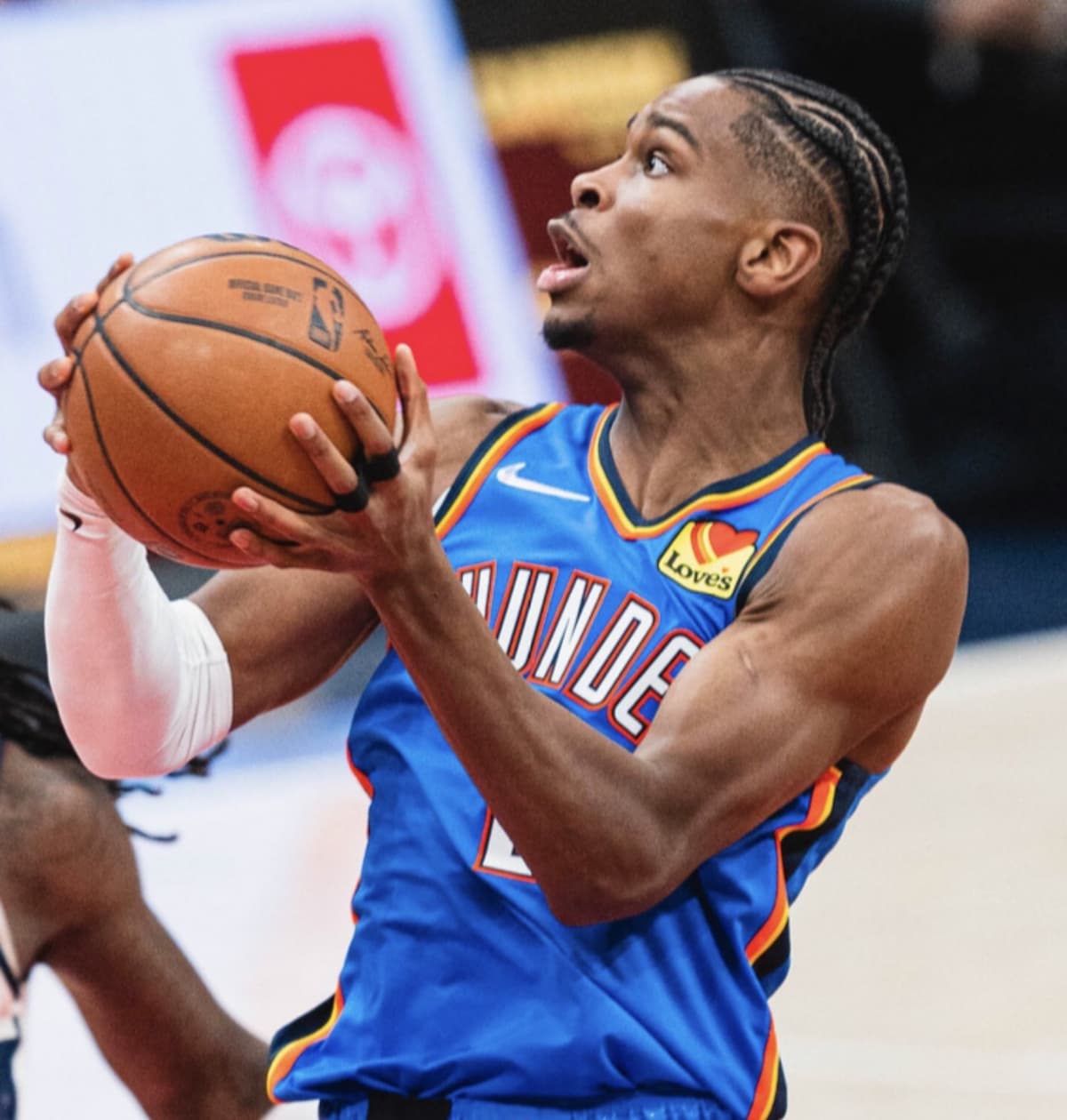
OKLAHOMA CITY THUNDER: Dynasty Math Without the Dynasty Complacency
The Thunder are living the dream in present tense. Defending champions; Shai Gilgeous-Alexander as MVP and Finals MVP; a roster that can drop 68 wins and still feel like it’s just pulling the shrink wrap off. The only team to go back-to-back since the mid-2010s Warriors is, well, the Warriors. Modern repeats are hard. OKC wants to defy the trend with depth, boring professionalism, and a boredom-proof culture.
The Boredom Trap is Real. So is the Safety Net.
Dynasties often collapse from the inside fatigue, pecking-order politics, the slow leak of details. The Thunder counter with redundancy on purpose:
Dort and Caruso eat the ugly possessions so Shai doesn’t have to.
Chet Holmgren is both a stretch big and rim deterrent—the Swiss Army 7-footer.
Hartenstein and the mid-salary wing/guard crew keep salary-slot Lego bricks ready for any window that opens.
Yes, Jalen Williams’ wrist hits the early cadence. The question becomes whether Ousmane Dieng and Isaiah Joe can hold serve on real minutes and whether Nikola Topić can task-manage an NBA pace by March. The design is there; the repetition is the test.
Creed II Meets Haikyuu!!
A sequel where the hero has already climbed the mountain and an anime where the practice arcs are thrilling because every micro-skill matters.
That’s the Oklahoma City Thunder in 2025: not reinventing, just refining. The thrill isn’t in whether they can win they’ve already proved that it’s in how precisely they build the next version of greatness.
OKC’s joy is in the micro-skills: screen angles, touch screens, empty-corner two-man actions, and those ten extra breaths Shai gets when Alex Caruso checks in to take a few defensive burdens off him.
If Creed II was about discipline after victory and Haikyuu!! was about obsession with timing and teamwork, this Thunder roster is living both every rep matters, every small improvement compounds into title equity.
Cason Wallace: The Prodigy in Supporting Role
If this were Haikyuu!!, Cason Wallace is the quiet freshman ace the player who could start anywhere else but stays in rotation because of the system’s rhythm.
In a league obsessed with highlight packages, Wallace is OKC’s fundamentalist monk:
2023–24: 82 games, .612 TS%, 2.2 STL%, 2.0 BLK% — elite defensive production on a rookie workload.
2024–25: Elevated to 43 starts, 11.5 AST%, and 3.1 STL%, showing more facilitation and perimeter chaos without losing efficiency.
Advanced metrics? +2.6 DBPM, .133 WS/48, 5.2 Win Shares — borderline All-Defense metrics in Year 2 for a player still finding his offensive identity.
He’s the connective guard archetype that playoff teams spend years hunting for already homegrown. Wallace’s impact doesn’t need volume; it shows up in opponent field-goal drop-offs, late-clock switches, and the intangible calm that lets Shai and Jalen conserve energy for the final six minutes.
He’s what Creed II’s Viktor Drago was supposed to be the next generation refining power into technique. Only Wallace already has the emotional wiring right: humility, patience, and relentless repetition.
Aaron Wiggins: The Glue Guy Who Never Overreaches
Aaron Wiggins is the seventh man, not the sixth and that’s exactly why he matters. He’s the role economy guy in an age of shot inflation.
In 2023–24, Wiggins quietly put up .664 TS% (top 10 among qualified wings) on only 12.1% usage, proving the rare efficiency that doesn’t demand oxygen. By 2024–25, when the team hit a midseason lull, his expanded 26 starts and .148 WS/48 stabilized the bench’s offensive drought. His 5.4 Win Shares were fourth on the team — above flashier names.
His catch-and-shoot footwork and baseline cuts are small-skill symphonies. In anime language, he’s that supporting senpai character and the one who quietly delivers the crucial serve or back-row save when everyone else is focused on the ace.
He’s not the momentum; he’s the rhythm. And every contender needs rhythm.
Nikola Topić: The Wild Card in the Time Skip
Every sports anime eventually has the “time skip arc”, the part where the prodigy returns from injury with new skills and perspective. That’s Nikola Topić.
He missed his entire rookie season with a knee injury, but he returns in 2025–26 fully healthy and fully integrated into a developmental ecosystem that turns high-IQ passers into rotational engines.
Topić at 6’6” and 201 pounds is the on-ball connector OKC hasn’t had since pre-injury Josh Giddey. His court vision is already elite, the question is the jumper. If that shot levels up to even league-average 35%, the Thunder suddenly have a three-creator system: Shai’s surgical scoring, Jalen’s hybrid drives, and Topić’s anticipatory passing.
He’s the Haikyuu!! newcomer whose game film looks ordinary until you realize he’s manipulating the entire tempo, a half-second faster on reads, a beat slower on fakes.
Micro-Skill Nation
What makes this era of OKC special isn’t just talent accumulation; it’s skill refinement at industrial scale.
Cason Wallace: the switch-scheme artist who turns every possession into a drill.
Aaron Wiggins: the role player whose spacing and cuts are the invisible glue of a title defense.
Nikola Topić: the brainy creator-in-waiting who adds a third control point to an already seamless offense.
Even without massive roster churn, this team is evolving like a time-lapse, everyone leveling up one niche at a time.
Shai’s isolation efficiency is gravity; Holmgren’s rim spacing is orbit; Wallace, Wiggins, and Topić are the mechanics that keep the system spinning without wobble.
From Fight Camp to Gym Class
Creed II taught that discipline after victory defines true greatness. Haikyuu!! taught that joy and struggle coexist in the grind. OKC lives in the overlap: a champion learning how to love the reps again.
There’s no dynasty curse here, no burnout. Just a locker room obsessed with craft over clout.
Pull-quote:
“Wallace starts on half the league, Wiggins stabilizes the other half, and Topić might be the next cheat code. OKC’s sequel isn’t about hunger, it’s about precision.”
The Matchup Map that Matters
Denver: Dort/Caruso on Murray, Chet dragging Jokic outside, Shai picking the weak links.
Minnesota: absorb physicality, keep spacing honest, force Gobert to guard multiple decisions.
Dallas: irritate Luka with Wallace minutes; slide Caruso to Kyrie pockets.
East elite: wing length parade, OKC survives by five-man connectivity, not star singularity.
Business as a Weapon
Presti’s staggering is poetry. Shai on supermax, Jalen about to rise, Chet looming, yet no albatross and plenty of mid-tier contracts to package without gutting the depth. It’s not hedge; it’s ammo.
Pull-quote: “OKC can lose a top-5 player for a month and still look like a 60-win machine. That’s not depth. That’s design.”
Oklahoma City: 5 Ways to Beat Boredom
Rotating emphasis nights: development targets disguised as game plans.
Caruso/Dort minutes as Shai oxygen tanks, protect the star’s legs.
Second-unit identity with two counters, not six experiments.
Chet’s growth measured in free throws and post seals, not just threes and blocks.
Calendar traps circled, Tuesday in Charlotte is a culture test.