By Vince Carter + FRPC Contributors
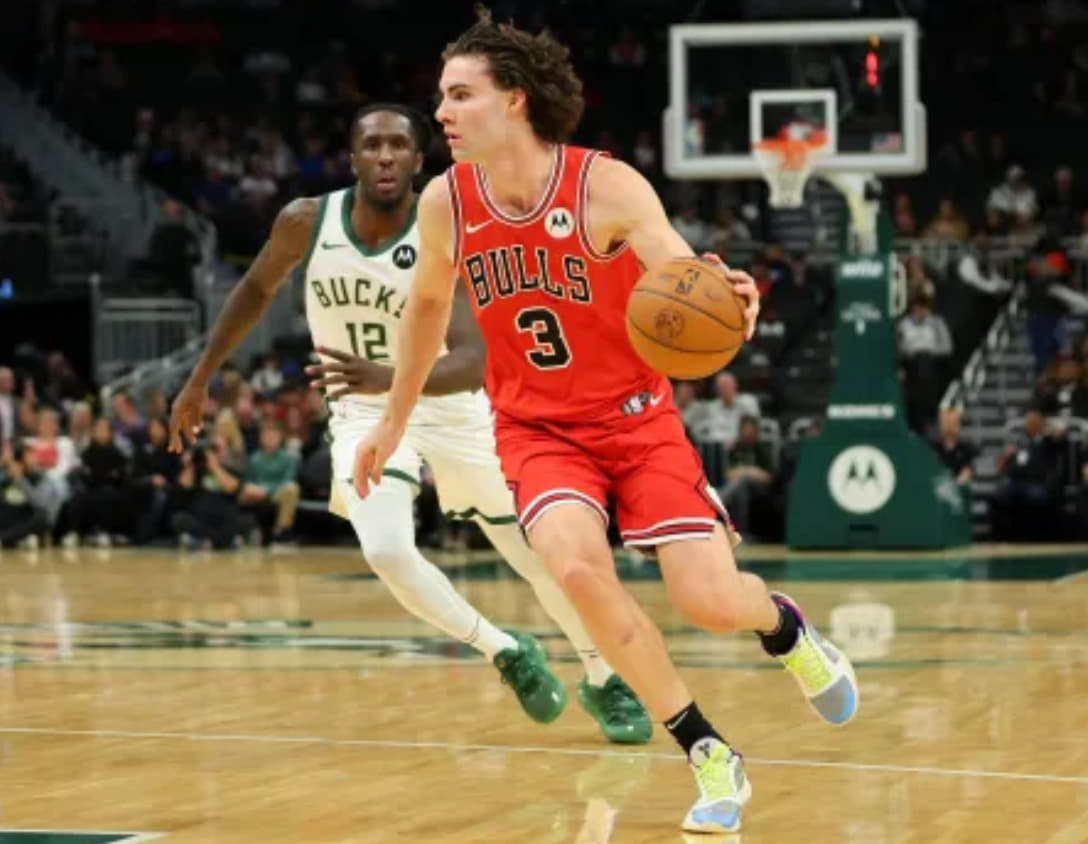
Josh Giddey’s “Problematic Value” Is the Bulls’ Rorschach Test
Chicago’s quiet standoff with Josh Giddey has stretched into late August. He’s 23, posted career highs after the OKC‑to‑Bulls pivot, and shot a surprising 37.8% from three on 4 attempts a night. Depending on your priors, that’s either a breakout worth betting on or a one‑season sugar high the cap sheet can’t afford.
The leap and the skepticism
Giddey’s year in Chicago was the cleanest version of his game: big guard boards, advantage passing, and enough spacing to keep lineups honest. The sales pitch writes itself: 6'8" initiator, career‑best assist share in the low‑30s, and a real jumper showing up on volume. The rebuttal is just as straightforward: front offices don’t pay for “maybes,” and sustainability is the whole ballgame.
Two context flags matter here:
Role clarity: in OKC, touches flowed through an MVP‑level engine; in Chicago, Giddey’s reads came earlier in the clock and from cleaner catch‑and‑shoot stations.
Shot diet: more stationary threes, fewer “make‑you‑create” possessions exactly the kind of environment where a percentage can pop for a season.
If you believe the shot is now part of his baseline, you lock him up. If you think it regresses toward low‑30s, you slow‑play negotiations.
Versatility with teeth
Coaches love him in playoff chess because he doesn’t break your matchups: he toggles across guard and wing assignments without hiding, rebounds his position, and keeps your half‑court offense connected. He’s not a rim protector and shouldn’t be graded like one, but his combination of defensive boards plus high creation volume is rare for a primary ball‑mover.
The price of patience
This is where “problematic value” lives. Chicago’s roster math tightens quickly as other deals mature, and waiting cuts both ways:
Pro‑patience: another season of data protects you from paying for variance.
Anti‑patience: every week without a deal invites a qualifying‑offer scenario, depresses trade optionality, and risks losing a connector archetype you can’t easily replace.
Reasonable frameworks floated around the league office chatter look like this:
If you buy the shot: 4 years, $100–105M keeps AAV sane while acknowledging scarcity at his size/skill.
If you’re hedging: 3 years, ~$88M with a team option, protects the downside and preserves trade value.
What Chicago should decide
The Bulls aren’t paying for star usage, they’re paying for floor‑tilt: the little edges that stack into good lineups and playoff possessions. If they see Giddey as a top‑tier connector whose jumper is now credible, they should act like it and price in small regression. If they don’t, clarity is kindness: explore value while his market still treats last season as signal, not noise.
Zach Harper’s Bigs Tiers: When Rankings Turn Into Storytelling
Every summer the NBA calendar slows, and we inevitably pivot to lists, rankings, and “tiers.” Zach Harper’s latest big-man breakdown didn’t just sort players, it told a story. His tiered approach felt like a reality show house, with a penthouse, shared rooms, and some awkward housemates bumping elbows in the kitchen. The Front Runner Podcast Collective devoted an entire segment to unpacking it, and the conversation showed why tiers matter: they shape how we talk about players, how teams value them, and even how the players see themselves.
Jokic: The Permanent Penthouse Resident
Tier 1 is a one-man penthouse. Nikola Jokic is still the league’s most unguardable offensive system, a 6’11” center who creates both spacing and flow. Denver was +12.3 in net rating with him on the floor and -1.6 without him. That’s not just value, it’s oxygen.
The podcast crew laughed about how Jokic probably cares more about FaceTiming his horses than his “placement” on Harper’s list. But his separation is impossible to deny. He’s the rare superstar who can dominate a playoff game without hunting shots, and he elevates every archetype of teammate cutters, shooters, rim runners, even defensive specialists. His penthouse isn’t up for lease.
Tier 2: Wemby, Embiid, AD
The second tier is where volatility and context rule.
Victor Wembanyama is already rewriting the position. Back-to-back historic block rates (hovering around 10%), a growing jumper (35.2% from three), and a frame that lets him close two gaps at once. The pod called him “the only contestant who wins HOH and still controls the kitchen,” a playful nod to his dominance in every facet. The only question: how fast does he force the league to redraw the map?
Joel Embiid is a 30-and-10 metronome when healthy, but the “when” looms large. He played just 19 games last season, and the FRPC hosts sounded like tired parents: proud of the talent, exhausted by the injuries. The consensus plea: just give us 60 games.
Anthony Davis is the wild card. At 31, still toggling between the four and five, still putting up Defensive Player of the Year stretches, and still maddeningly inconsistent in playoff shot creation. In Vince's house metaphor, AD is the roommate who can host a five-star dinner one night and vanish the next.
This tier underscores why tiers matter more than straight rankings. Wemby, Embiid, and AD don’t live in the same apartment, but they share a floor.
Tier 3: The Wide Middle
Here’s where Harper’s article became most interesting and where the podcast had the most fun.
Bam Adebayo: Miami’s defensive keystone, versatile enough to switch onto guards or anchor zones. With rookie Kel’el Ware joining, he finally won’t have to play 40 bruising minutes in December.
Karl-Anthony Towns: His value rehab in New York was one of last season’s quiet wins. Better health, better usage, and a steadier playoff showing gave him a fresh narrative. Still, the pod admitted: trust is fragile when it comes to KAT in late May.
Rudy Gobert: The eternal lightning rod. Advanced stats still love him, coaches still scheme around him, and yet he remains a Rorschach blot for fans. To some he’s an anchor; to others, an anchor in the wrong sense.
Alperen Şengün: Maybe the most intriguing riser. At 22, he posted 21 and 11 on 54% shooting, and Houston’s offense cratered without him. The pod gleefully leaned into the “mini-Jokic” narrative, noting how Şengün elevates shooters while holding his own on the glass. “The pawn who became HOH,” as one host put it.
Jaren Jackson Jr.: Fewer fouls, more threes, but still too few rebounds for his frame. The panel wondered if he’s destined to be a “co-star big” rather than a solo act.
Domantas Sabonis: Sacramento’s heartbeat. His rebounding and passing fuel their pace, but the lack of rim protection caps his ceiling in this exercise.
This tier is less about who’s “better” and more about preference. Do you want defensive versatility (Bam), shot-creation gravity (KAT), or connective passing (Sabonis)? Harper’s list forces you to pick your archetype.
Why These Tiers Matter
It’s easy to dismiss rankings as filler, but perception matters. Agents cite these lists in negotiations. Fans use them in debates. Voters carry them, consciously or not into All-NBA decisions. When Harper groups Mobley, Holmgren, or Sabonis into the same tier, it reframes their reputations overnight.
The FRPC hosts appreciated Harper’s conviction. “Somebody’s mom is clipping this article right now and mailing it to her son,” they joked. That’s how personal this gets. Tiers are not just lists; they’re storylines. They spark pride, irritation, even motivation.
The Big Picture
Harper’s tiers are less about where players sit today and more about how we imagine them moving. Wemby could leap into the penthouse in two years or this season as “Big Vic”, and his new ensemble cast storm into the highly competitive Western Conference. Embiid and AD could slide down if injuries persist. Şengün could drag the middle class upward.
That dynamism is the point. A ranking in August is a snapshot; a tier list is a living conversation. And as the pod made clear, sometimes the argument is more fun than the answer.
CTA: Who’s next to crash Jokic’s penthouse, Wemby by dominance, Holmgren by health and championship luster, or a wild card like Şengün? Drop your “future penthouse resident” in the comments.
Highsmith to Brooklyn, Raptors Reset Under Webster
On August 19, 2025, the NBA’s transaction wire dropped a note that could shape financial ledgers more than two playoff races in different ways. The Miami Heat shipped defensive specialist Haywood Highsmith to the Brooklyn Nets, a move that signals both teams’ shifting strategies. Meanwhile, in Toronto, GM Bobby Webster outlined the Raptors’ new agenda—balancing expensive contracts with development. Two threads, one story: the Eastern Conference’s middle class trying to find leverage in a league of haves and have-nots.
The Heat Cash Out, Nets Buy In
For Miami, moving Highsmith is less about the player and more about financial clarity. At 28, Highsmith carved out a niche as a perimeter stopper, logging 23 minutes per game last season while ranking top-15 among forwards in defensive estimated plus-minus (DEPM). But with the Heat flirting with the second apron of the luxury tax, even mid-tier salaries carry outsized weight.
Brooklyn, by contrast, sees Highsmith as a plug-and-play wing to stabilize its shaky defense. The Nets finished 21st in defensive rating last year, and pairing Highsmith with Mikal Bridges and Cam Johnson creates a switchable perimeter trio. As one Eastern scout quipped: “They basically bought a mini-Mikal at clearance prices.”
Pull Quote: “Brooklyn basically bought an off brand version of Dorian Finney-Smith at clearance prices.”
The trade underlines a philosophical divide: Miami cuts costs to preserve flexibility; Brooklyn spends to solidify identity.
Raptors’ Expensive Reset: Webster’s Task and Barnes’ New Running Mates
The Raptors aren’t in nostalgia mode anymore. Bobby Webster’s job is clear: take one of the NBA’s most expensive rosters and make it coherent around Scottie Barnes, their All-Star centerpiece. That means tough choices on contracts, finding actual spacing, and keeping the team out of the dreaded “middle.”
Names like Brandon Ingram and RJ Barrett loom large in that conversation. Ingram would give Barnes a true scoring partner and secondary playmaker, while Barrett, already in Toronto, represents the homegrown Canadian wing the team wants to invest in. The Raptors’ front office is weighing how those pieces fit together and how quickly they can assemble a supporting cast that makes sense in the modern East.
Webster’s mandate isn’t just roster-building; it’s franchise repositioning. Can he turn Toronto back into a postseason staple without overextending on contracts? Can Barnes, with the right running mates, be the guy who reopens the franchise’s contention window? That’s the Raptors’ new agenda less about chasing the past, all about building the future.
Pull Quote: “Webster’s mandate is clear: keep Barnes happy while carving a path back to relevance.”
The Raptors’ Expensive Roster Math
The financial picture still frames the challenge. Toronto’s projected 2025–26 payroll sits at $195M, roughly $25M above the first apron. That limits access to common team-building tools: no mid-level exception, restrictions on aggregating contracts in trades, and a hard stop on buyout-market flexibility.
For fans, it means that every move is magnified. High-end commitments to Barnes and Barrett, plus a potential Ingram deal, leave Webster hunting on the margins. One front-office insider described it as “running a luxury lineup with rookie-scale glue.”
Pull Quote: “Running a luxury lineup with rookie-scale glue.”
The new agenda, then, is partly survival: keep the young core happy, trim around the edges, and hope player development (Gradey Dick, Ochai Agbaji) fills gaps that the checkbook can’t.
Heat, Nets, Raptors: Different Spending Class Stories
What ties Miami’s trade and Toronto’s comments together is the Eastern Conference’s middle-class squeeze. The Cavaliers and Knicks have committed to heavy spending, while Orlando and Indiana have been shrewd but willing spenders, ascending cores. That leaves teams like Miami and Toronto deciding whether to double down on payroll or pivot to flexibility.
Miami: Preserves future cap slots, trims tax exposure, trusts its scouting to backfill wings.
Brooklyn: Buys defense today, knowing that competing is not the mission.
Toronto: Balances luxury contracts with an insistence on staying competitive, betting that their core is worth the tax.
This is the new NBA economy: every dollar carries tactical weight.
BE A FRIEND AND TELL A FRIEND!!!
Social Media and Handles:
X - Twitter Handles
Be included in the podcast!!! Drop us a line and the best replies will make the podcast!!!