By Vince Carter + FRPC Contributors
Narrative Curveball: When Finals Ratings Lie
So let me get this straight we finally get a Game 7 built on real basketball, on grit and game plans and guys bleeding for possessions… and the biggest conversation is ratings?
Come on.
This series wasn’t some glossy superstar shootout. It was a brawl. A chess match. A grindhouse flick with sneakers. And somehow, that’s seen as a downgrade? Vince nailed it—this Finals didn’t need hype, it earned tension. Indiana clawing back behind Halliburton’s busted calf and TJ McConnell’s full-court scrappiness? That’s not low drama. That’s vintage.
But because there’s no LeBron, no Steph, people tuned out like it was preseason. Joke’s on them. Game 6 was playoff cinema: dunks that screamed, turnovers that hurt, a crowd that nearly levitated. Oklahoma City and Indianapolis do not conjure up a ton of legacy fodder but the series has enticed and curated that child like belief in the purity of the game!
The irony? The best storytelling in sports is happening when nobody’s watching. These aren’t highlights, they’re emotional timestamps. And if you care about the soul of the game not the sizzle reel you saw something unforgettable.
Low viewership doesn’t mean low stakes. The narrative didn’t disappear it evolved. And now? It’s better than the one you scripted.
Game 6 Was a Statement, Not a Statline
You can’t fake desperation. And you definitely can’t fake the effort Indiana delivered in Game 6.
From the opening tip, the Pacers played like a team that needed the game to keep breathing not just to extend the series. This wasn’t about play calls or plus-minus sheets. This was a group possessed. Halliburton, nursing a calf that had no business on the floor, strapped on more compression gear than a Marvel extra and still found a way to orchestrate. His shooting line was irrelevant his presence reshaped the pace and emotional tone.
Pascal Siakam? Final boss energy. His look-away dunk off Halliburton’s pass didn’t just shake the rim it detonated any illusion that OKC was still in control. And TJ McConnell was a menace in sneakers gave them hell on both ends. Twelve points, nine boards, six assists, four steals. He’s built like a barista but moves like a Jason Bourne outtake.
Game 6 wasn’t tactical. It was primal. Indiana didn’t outplay OKC they overwhelmed them with intent. If there’s a blueprint for manufacturing belief, the Pacers just laid it out. And for the first time in these Finals, they made it crystal clear: this series is not over.
Pacers: From Punched Out to Punched In
Let’s keep it real nobody had Indiana in the Finals when the season tipped off. They were the 1–4 team folks stopped watching by Thanksgiving. Halliburton was hurt. The defense was allergic to effort. If you squinted, you saw potential. But mostly? You saw excuses waiting to happen.
Now fast-forward to Game 6, and that same squad looked like they walked out of a Wu-Tang tunnel scene. Purpose. Grit. No wasted motion. No soft switches.
Halliburton? Moving like an old soul in a 24-year-old body, wrapped in enough tape to qualify as a USPS package. But he’s setting tempo. He’s talking. He’s still the head of the snake. That pull-up three he hit mid-fourth? That wasn’t mechanics. That was message. That was “we’re not done” energy, straight off a bum leg.
And McConnell? Man, TJ came off the bench like he had beef with the universe. He’s built like your favorite barista, runs like John Wick, and plays like someone who got dared to survive every possession. Hands in passing lanes. Bodying up bigger guards. Screaming after a floater like he just hit a game-winner in July runs.
He didn’t just change pace he changed the vibe. Made OKC look shook. Made teammates stand taller. You can’t teach that kind of presence. That’s earned in dark gyms and long flights where nobody’s asking for your autograph.
This wasn’t a fluke. It was a shift. They went from punched out to punching first. And you felt it in every closeout, every hard foul, every bench eruption.
The Pacers didn’t just earn respect they took it. Loud. Proud. And unapologetically out of left field.
SGA and the Game 6 Fog
There’s no denying Shai Gilgeous-Alexander’s rise the All-NBA First Team nod, the steady poise, the deliberate tempo that turns defenders into statues. But in Game 6, none of that mattered. For maybe the first time all postseason, Shai looked... hesitant.
Not bad. Just off. Just unsteady. The pull-ups didn’t come with the same rhythm. The drives were a beat late. The decision-making, usually razor-sharp, looked like it was processing through fog. Vince said it plainly: “He got caught in between.” That’s exactly where Indiana trapped him not physically, but mentally. Shai didn’t know if he wanted to attack or reset. And that split-second delay cost him every time.
This wasn’t just schematics. It was psychology.
Carlisle didn’t over-defend Shai. He blurred his vision. He sent stunts, peeled help, shaded lanes just enough to make the right play look like a trap. And it worked. You saw it in Shai’s footwork, in his body language. He wasn’t flowing. He was second-guessing.
And here’s the wider frame: the average age of this Thunder roster is 23.3. Their basketball IQ is high. Their ceiling is sky-high. But playoff basketball is a different reality. It’s not about potential it’s about pressure. And Indiana, a team that’s been on the brink all series, played like veterans who’ve already lived through heartbreak.
OKC looked like a team that hadn’t. The execution dipped. The off-ball movement stalled. Defensive rotations got sluggish. And when your leader your tempo-setter is caught in a mental tug-of-war, it trickles down.
SGA didn’t trust the windows. Didn’t flow into second actions. The offense became disconnected from its core. And that’s where playoff reps matter most not in the highlights, but in the chaos.
None of this is fatal. It’s just the first real scar on an otherwise clean postseason run. Game 6 was a moment where raw talent met urgent desperation and talent blinked.
Shai will bounce back. He’s too smart, too skilled, too wired not to. But now he knows: the Finals ask different questions. And hesitation gets you beat.
Coaching Chess: Carlisle’s Masterstroke
What Rick Carlisle did in Game 6 wasn’t just coaching it was game control. From tip to buzzer, he didn’t adjust to OKC’s tempo; he took it away from them.
Indiana’s defensive shell wasn’t aggressive in the traditional sense it was strategic suffocation. They picked their pressure points and hit them repeatedly. First, it was Shai Gilgeous-Alexander front and center pin the white board. Carlisle’s plan was clear: cut off the easy flow. They tagged SGA early, shrunk his space, and forced the Thunder into half-court initiations that made their young guards uncomfortable. The result? Confusion! Remind me of this... Didn’t Jalen Williams score 40 points in Game5??? Daignault went away from the formula that was successful in the previous game!
Then came the real genius: how they made SGA work without overcommitting resources. Instead of trapping, Carlisle showed bodies momentarily then recovered out. It wasn’t blitzing to force turnovers. It was blitzing to force decisions. Shai got caught making reads on the move, something he normally controls.
The short rotation also mattered. Carlisle didn’t chase bench production he chased cohesion. Less Nembhard as connector, more McConnell as tempo-shifter. Less experimentation, more trust.
This wasn’t about stopping OKC. It was about rerouting everything they do best in rhythm, in space, in control. Carlisle took that from them. Piece by piece.
Game 6? That was a coaching clinic.
Halliburton the Decoy, Still Running the Show
You don’t need the ball to run the game. Tyrese Halliburton just reminded us of that on one leg, wrapped in enough compression gear to look like a cyborg, and still the most important player on the floor.
This wasn’t a box score night. You won’t frame it for the stat heads. But from the opening tip, Indiana’s energy orbited Halliburton’s gravity. He didn’t force shots. Didn’t fake being 100%. What he did was control the room and that’s a different kind of power.
There were possessions where he stood in the corner, off-ball, barely moving. And yet the defense still tilted his way. You could feel OKC’s awareness pull toward him, like they were waiting for the catch-and-fire that never came. That’s not spacing. That’s presence.
Lou Will would call that "grown-man energy." The type of control you earn from buckets and battles. Even when he wasn't touching the rock, he was quarterbacking pointing, shouting coverages, signaling switches, lifting the tempo when things slowed. He kept guys locked in.
And when he did take the shot? It was a vibe-setter. That second-half pull-up three was less about math and more about momentum. That was: “I’m still here. You’re gonna have to see me.” Bill Simmons would say it had “legend seeds” the kind of bucket people quote years later when Halliburton’s jersey is hanging in the rafters.
Indiana didn’t need Halliburton to dominate. They just needed him to exist. Loudly. Smartly. Spiritually. And that’s exactly what he did. Besides Haliburton ability to see the floor is enough of a weapon. Tyrese out here acting like Chef at Benihana’s, just feeding everybody!
In a game that was part battle, part symphony, he was the conductor even while limping, even while watching from the wing. He made OKC uncomfortable just by being there. That’s not a role. That’s aura.
And in Game 6, that aura made all the difference.
The Gospel According to McConnell – Heart Over Hype
TJ McConnell was supposed to be a trivia answer. The guy you bring up at the bar when someone says, “Name an NBA player under six feet who’s still somehow playing in the Finals.” But here he is, all 6-foot-nothing of him, turning the hardwood into a sermon.
And that Game 6? That was gospel.
This dude is built like he manages a Trader Joe’s by day and plays in a city league at night. But the moment he checks into Gainbridge Fieldhouse, it becomes a Rocky IV montage. He’s everywhere: poking passes, jumping lanes, diving on loose balls like a 90s action movie stuntman. Think John Wick, but instead of a dog, someone messed with his team’s shot at legacy.
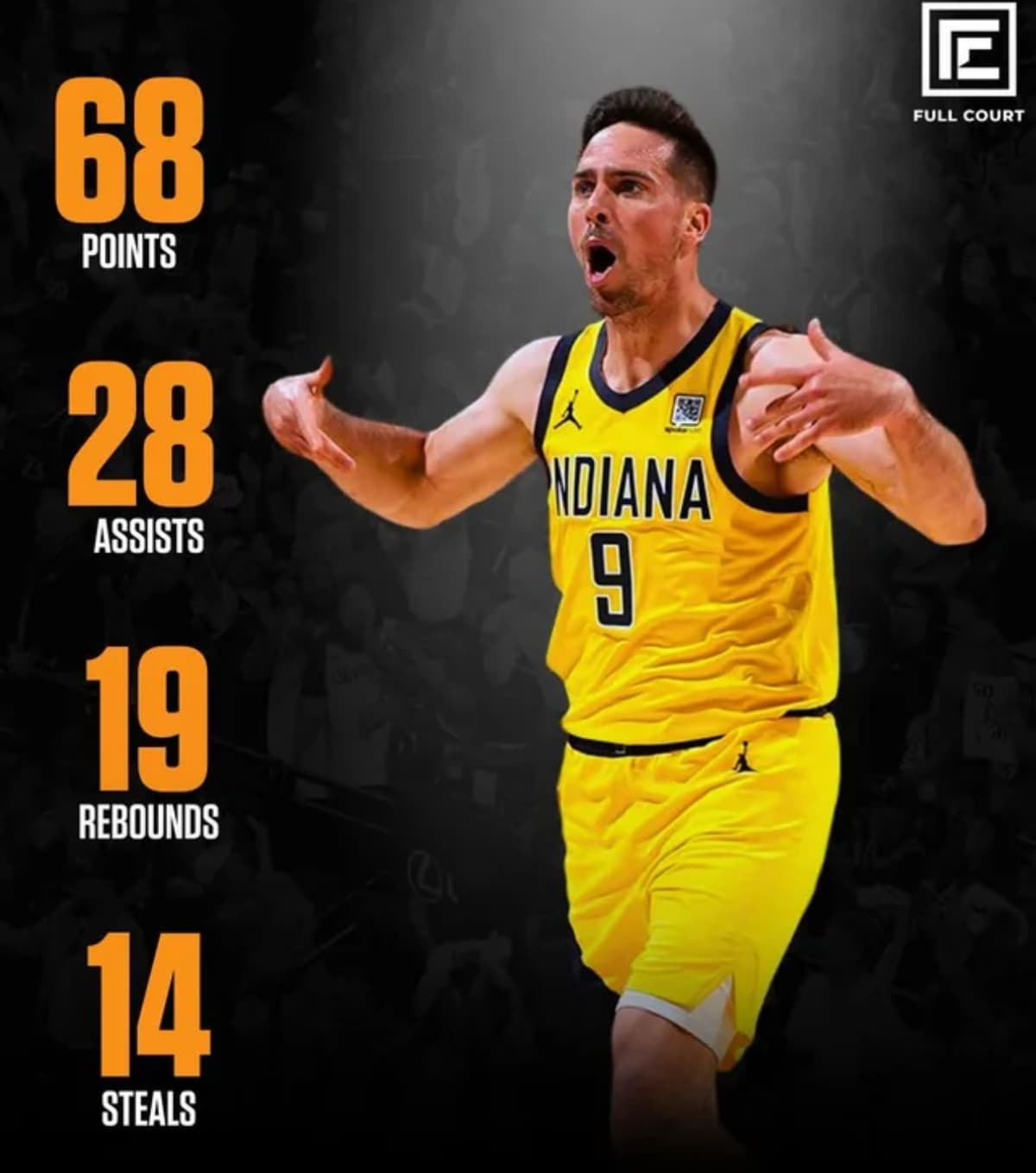
McConnell’s stat line in Game 6? 12 points, 9 boards, 6 assists, 4 steals in 24 minutes off the bench. That’s not production. That’s prophecy. He’s now the only player in NBA history to log 60+ points, 25+ assists, 15+ rebounds and 10 steals in the Finals off the bench. You hear that? NBA history. That’s not “scrappy.” That’s system-shaking.
Here’s the thing: Indiana doesn’t need flair. They don’t need iso ball. They need trust, motion, and a little Midwestern chaos. And that’s what TJ and Andrew Nembhard have given them. This isn’t defense. This is a buddy cop flick. McConnell’s the gritty vet who doesn’t play by the rules, and Nembhard’s the rising rookie who just dropped the training wheels. Together? They’ve turned SGA into a walking anxiety spiral.
And Oklahoma City? Beautiful system. Tons of talent. But it’s all scaffolded on one man’s rhythm. When SGA hits a speed bump, the whole thing veers off course like a Tesla in a thunderstorm. Meanwhile, Indiana is showing us what happens when belief becomes a tactic not a feeling.
TJ McConnell doesn’t care about your algorithm. He’s coming anyway.
Game 7 is a Mirror: The Crucible of Identity
Game 6 didn’t expose Oklahoma City’s weaknesses. It exposed their youth, their dependency, and maybe their illusionof control.
Shea Gilgeous-Alexander the metronome of OKC’s rise looked like he had finally escaped gravity this postseason. But Game 6 was his reckoning. Eight turnovers. Two assists. Blitzed into indecision. Swallowed whole by a defensive scheme that didn't even need to trap him every time just haunt his passing angles and dare him to trust teammates he didn’t seem to see anymore.
This wasn’t a loss. This was an identity crisis.
Because the truth is, OKC didn’t get beat by talent. They got beat by nerve. Indiana showed up like they knew they didn’t belong and that made them terrifying. They had nothing to protect, and everything to prove. And that’s when belief becomes a weapon. Halliburton, half-hobbled, was out there deleting social media and playing through compression gear like he was a Marvel Avenger with a job to finish. Siakam gave off quiet final boss energy. And TJ McConnell we already went to church for him.
Indiana has evolved. They’re not scrappy anymore. They’re not feel-good. They are the threat. Built on cuts, motion, and reckless courage. And courage travels.
Meanwhile, OKC? They looked trapped by the math of their own construction. You saw it their three-point attempts evaporated. Their defensive rotations lagged. Their movement? Jammed like bad reception. When you build a system around one man’s timing, one man’s poise, what happens when the meter breaks?
And that’s the thing Game 7 is not strategy. It’s soul.
It will not be won by analytics dashboards or playbook depth. It will be decided by deflections, substitutions, a single missed rotation at the wrong time. It will be won by whoever sees their reflection in the moment and doesn’t flinch.
You don’t scheme your way through Game 7. You survive it.
Because Game 7 doesn’t define a season.
It stains it or stamps it.
The Lakers B Plot – New Kings in the Kingdom
While the OKC Thunder were busy misplacing their basketball soul and the Pacers were giving us Hoosiers with high-speed Wi-Fi, something just as dramatic and way more permanent happened on the West Coast: The Lakers quietly got sold.
Not with a Woj bomb. Not with breaking glass at Crypto.com Arena. But with a little backroom power transfer so clean it might’ve been in a Succession table read.
Enter: Mark Walter.
If Jeanie Buss was the last thread connecting the Lakers to Dr. Jerry Buss’ Showtime empire, then Walter is the hedge fund samurai here to politely ask what everyone actually does for a living. He’s rich, he’s quiet, and he just became the first person in American sports history to own both an MLB and NBA franchise in the same city.
This isn’t just ownership. This is architectural realignment. The Dodgers went from tabloid team to player development factory with a 3D printer full of Cy Young winners. Now Walter gets to do the same with the Lakers — and the city won’t even notice until the spectacle is gone. And here’s the thing: LA might not be ready for “quiet competence.”
The Lakers haven’t been normal in 20 years. From Kobe vs. Shaq to LeBron vs. aging bones to Westbrook vs. modern spacing it’s been less of a dynasty and more of a The Real NBA Front Office episode. But Walter? He’s bringing in spreadsheets. He’s bringing in departments. He’s bringing in Bob Myers if Rob Pelinka so much as flinches.
And that is where the NBA plot twist gets spicy.
This offseason doesn’t just decide where Kevin Durant ends up (if anyone ever makes Phoenix a real offer). It decides whether the Lakers will still be the Lakers or become something deeper. Not just a destination, but a machine. Think Spurs with better lighting. Heat Culture in Gucci slides.
It’s not even about free agency fireworks anymore. It’s about infrastructure. About player development departments, cap whisperers, scouting alchemy. The Lakers, for once, might be stepping through the existential portal and asking the scariest question in Hollywood:
“What if we don’t chase headlines... and just build better basketball?”
Meanwhile, Jeanie Buss keeps 17% and the title of “Governor.” Which is basically like saying, “You still get to cut the ribbon at opening night and approve the popcorn flavors.” But she’s out. This is Walter’s show now.
And if the blueprint follows the Dodgers’ arc? That means fewer short-term swings, more long-term scaffolding. More Jalen Hood-Schifino types getting real runway. More “who the hell is that guy?” turning into playoff minutes.
This is the era of systems over stardom. Of Tyrese Halliburton types becoming franchise cornerstones instead of backup plans. Of teams betting on cohesion, not spectacle. And if the Lakers the freaking Lakers finally get on board?
Oh boy.
That window for impulse-built titles? Might be closing.
But hey, until then, someone check on Phoenix. KD’s probably packing right now.
The Suns, the Soap, and the Sulking Star
Let’s talk about Kevin Durant. Not “35 points on 60% shooting” KD. No, no. Let’s talk about “traded for every wing in Brooklyn and now sitting in Arizona wondering if his owner even likes basketball” KD.
Because in Phoenix? It’s full telenovela.
Matt Ishbia, proud Michigan State alum, mortgage mogul, and part-time NBA character from a rejected Ballers script, rolled into Phoenix with more ambition than bandwidth. Within a year, he’s flipped the roster like a Vegas blackjack table: Mikal? Gone. Cam Johnson? Gone. Picks? Mortgaged like a 2008 condo. For what? For vibes. For KD, Booker, and Bradley “Still Got It, I Swear” Beal.
And now? Nobody wants KD.
That’s not shade. That’s math. He’s 37, wrapped in KT Tape, and on the backend of a Hall of Fame run that might be ending in silent pout cam shots during second quarters. You know what Phoenix asked San Antonio for in a trade? Stephon Castle AND the No. 2 pick. San Antonio hung up and blocked their number like an ex who keeps texting “u up?”
Meanwhile, Durant’s watching this all unfold like a guy who walked into a room expecting champagne and found a G League front office with groupthink goggles on. Ishbia tried to stealth trade him at the deadline and KD found out. And you know he found out because every game after that, his body language screamed “Don't pass me the ball, pass me my exit strategy.”
You want to build a contender? Cool. But maybe don’t alienate one of the 15 best players in NBA history in Year 1. Maybe don’t let Rich Kleiman Durant’s business partner become your conflict resolution specialist.
Phoenix ain’t cooking. Phoenix is over-seasoned and undercooked, sitting in the back of the playoff kitchen hoping nobody notices the burnt edges.
KD wanted a ring. He got a reality show.
Somewhere, Draymond’s laughing. Loud.