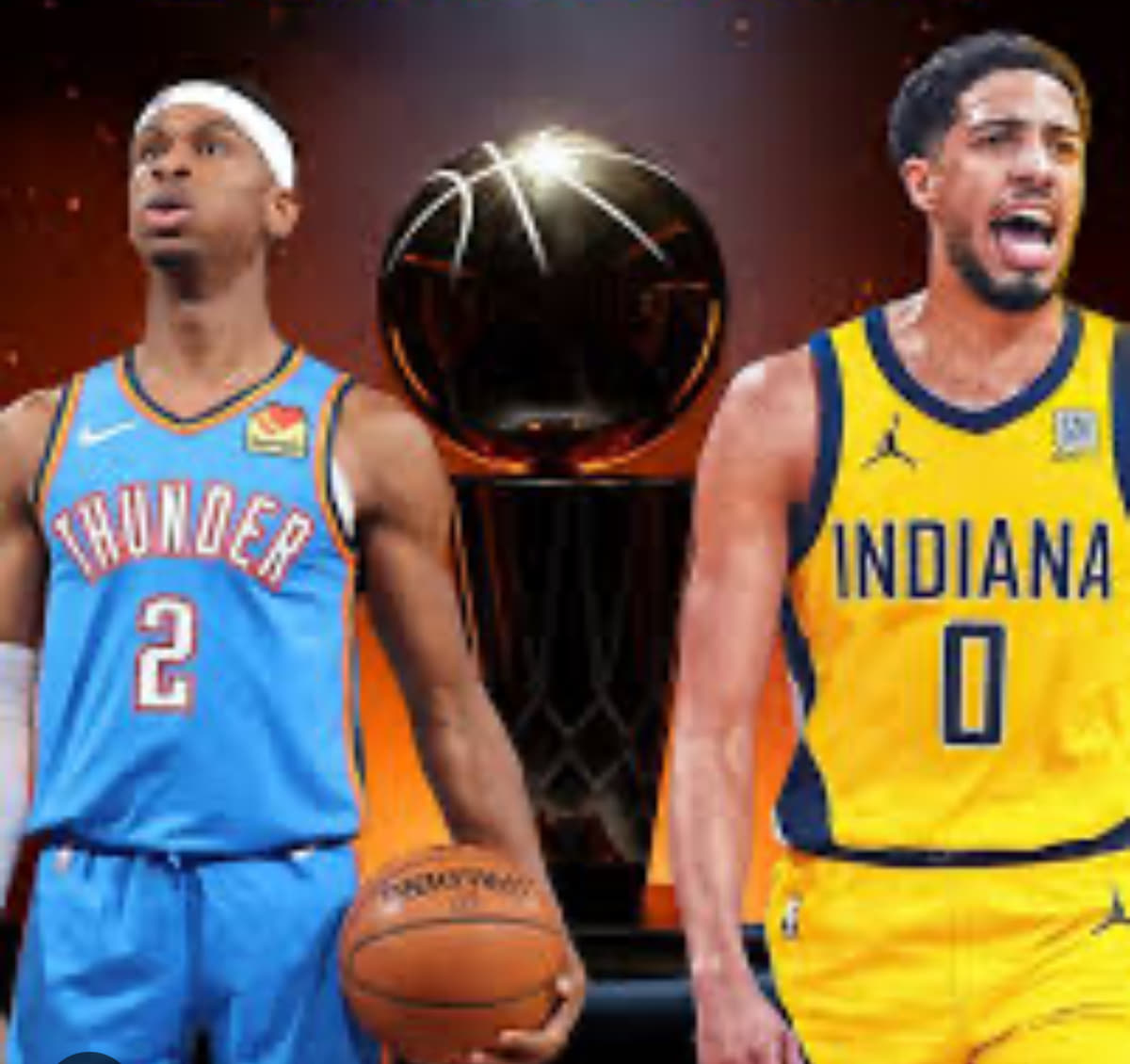
By Vince Carter
Let’s be clear from the jump this NBA Finals isn’t here for the casuals.
No LeBron. No Steph. No Tatum. No Giannis. No coastal zip codes. No endorsement darlings. Just Oklahoma City and Indiana. Two teams that haven’t sniffed a Finals in decades. Two fanbases who didn’t expect network love and built cultures without it. If you’re tuning in for legacy talk and shoe deals, this probably ain’t your series.
But if you’ve been locked in since October, this one’s a gift.
This Finals is hoop for the hoopers. It’s the payoff for anyone who’s been yelling about OKC’s defensive shell since November or Indiana’s second-unit pace manipulation post-All-Star break. You know the people who actually watch the games instead of box score surfing at midnight. The ones who saw what Sam Presti was cooking with a ten-man rotation that doesn’t chase max contracts. The ones who watched Rick Carlisle bend his roster into the funkiest passing offense in basketball, trading half-court structure for full-court rhythm.
You can’t script this for prime time. And thank God.
This isn’t a drama about superteam betrayal or redemption arcs for 30-something All-Stars. There’s no “last dance” angle here. This is about motion vs. muscle. Chaos vs. calculation. It’s about what happens when the league’s most airtight defense gets pulled into a pace war by the fastest offense left standing.
And the beauty? Nobody backed into this. OKC’s +12.8 net rating isn’t a hot streak it’s a machine humming at peak efficiency. Indiana isn’t cute or lucky they’ve been burying teams in transition and letting Tyrese Halliburton orchestrate chaos like a jazz pianist with a grudge.
So yeah, this might not hit for the timeline chasers or ESPN roundtables. But for the folks who watched Jalen Williams ghost his way into midrange space in March and saw Nesmith and Nembhard level up as real playoff defenders in May? This Finals is a feast.
And not a single superstar headline is needed. Jokic would absolutely love this series!!! It is about the basketball on the court being played and not what makes for the best headlines!!!
OKC: Built to Scale, Built to Last???
The Oklahoma City Thunder didn’t just win 68 games by accident. They built a roster that could survive any environment, and then spent 82 games proving it.
At the center of it all? Shai Gilgeous-Alexander MVP not by narrative inflation, but by surgical repetition. If you charted his season shot by shot, it’d look like a dance routine choreographed in a lab. Same spot, same form, same result. Float dribble into a gather. Rise from 14. Net doesn’t even move.
That’s how you average 39 points per 100 possessions in the playoffs without breaking the offensive shape. That’s how you shoot 73% at the rim and 47% from midrange while having the highest unassisted two-point FG% in the entire postseason field. Shai isn’t just scoring he’s bending defenders out of their shell without even shifting gears.
But what makes OKC terrifying isn’t just SGA. It’s what happens around him.
Lu Dort, Alex Caruso, Cason Wallace three of the best tag-and-recover perimeter defenders in basketball. Jalen Williams, the ghost screen savant and silent bucket in the midrange. Chet Holmgren and Isaiah Hartenstein, splitting time as weak-side deterrents and short-roll decision-makers. This team doesn’t just rotate they rotate on time and on principle. They lead the playoffs in help-side contests per game. That’s not length that’s film work.
Offensively, they aren’t running a million exotic sets. They’re running what works Veer action for Isaiah Joe, Floppy into ghost screen for Jalen, high pick-and-rolls with spacing that stretches the court wider than a U-Haul ramp. It’s not flashy, but it is devastatingly effective. Their 12.8 net rating highest since the 2017 Warriors didn’t come from volume. It came from clarity.
This is what Sam Presti built. Not a team chasing stars, but a team where almost everyone was drafted, developed, and deployed with intent. Eight of their ten main rotation players were either OKC draft picks or internal projects. And now they’re the youngest team in 45 years to reach the NBA Finals.
This isn’t a team peaking early. This is a system hitting its inflection point with Shai at the center, stacking 27-foot daggers like they’re layups.
Indiana Pacers: Fast, Furious, and Flat-Out Ignored!!!
Let’s be real: nobody expected Indiana to be here.
Not the TV guys. Not the pundit class. Not the people pretending to care about net ratings on Threads. The Pacers were background noise in every playoff matchup they’ve had. Cleveland was the feel-good defense story. New York was the big-market resurrection. And now? They’re set up as the opening act in the pre-coronation of Shai Gilgeous-Alexander.
That’s fine. Indiana likes it this way.
Because what Tyrese Haliburton and the Pacers have built isn’t cute. It’s organized chaos, and it’s carved up every defense foolish enough to underestimate it. They’re averaging 8.9 transition points per game first in the league. They get shots up in 5.1 seconds on average after a live-ball turnover. That’s not “run and gun.” That’s surgical ambush.
Haliburton doesn’t run Indiana’s offense he conducts it, live, like he’s DJing from the top of the key. Cross-matches? He finds them. Secondary help late? He punishes it. You send two at him, and suddenly you’re chasing shooters flying off of ghost screens and trail cuts. He’s logging 12.9 assists per 100 possessions, with a league-leading 36.9 AST%, and he makes it look like warmups.
What makes it dangerous is the buy-in. The whole team flows. Nesmith, Nembhard, Siakam, Turner — nobody stops the ball, nobody’s hunting their own shot in isolation. It’s pace, it’s spacing, and it’s perpetual motion. If you blink, they’ve scored.
But here's what really matters: the disrespect fuels them. Indiana has been the “oh cute, fun run” team since Round 1. Nobody’s asked what happens when they punch first. Nobody's accounting for their ability to drag structured teams into chaos and then set fire to the gaps. And if we’re being honest, that includes OKC.
Because what happens if Indiana starts hot? What happens if Halliburton hits two early threes and Turner gets downhill twice? What happens if OKC’s vaunted defense has to rotate from scramble mode for 18 seconds straight?
We don’t know yet. But the Pacers do. That’s why they’re still here.
The Floor War — Tempo, Tags, and Tactical Territory
This Finals might not have megawatt stars or legacy baggage, but it absolutely has the most intriguing tactical clash we’ve seen in years. If you love film, this series is a buffet. It’s a chess match not in the overused “coach makes a sub” way, but in how both teams physically move on the court. This is about floor geography and who owns it.
Let’s start with Oklahoma City. Defensively, they are the tightest rotation team left in the league. Everything they do is built on connectivity. They switch across three positions cleanly Caruso, Dort, and Jalen Williams don’t just survive matchups, they erase airspace. When a team runs empty corner action, OKC shrinks the strong-side like a clamp. Help arrives early, tags are automatic, and recoveries happen before the offensive player even commits.
They aren’t trying to create chaos. They’re trying to remove it. Force you into isolation. Strip away the motion. They want Indiana to play one-on-one, because that’s where Haliburton’s effectiveness dips and the help can set.
Now swing it to Indiana’s side: their game is creating messes. Misdirection, ghost screens, false motion, early pitch-aheads they weaponize every second of the clock. They’re the league’s best at turning transition into halfcourt momentum. A typical Indy possession might look like this: Haliburton catches off a drag, flows into a lefty delay, kicks to Nesmith on a 45-cut, who throws it back to a trailing Turner for a ghost pick into a slot three. If your coverage is a half-step slow at any point, they’ve already won.
This is where the game tilts: if Indiana gets cross-matches in transition like Chet guarding Siakam in space, or Wallace scrambling to contest Mathurin they’re lethal. But if OKC controls tempo and sets their defense, Indiana has to operate inside a phone booth. And that’s a problem.
Here's the micro-angle: Myles Turner in drop coverage vs. Jalen Williams in ghost action. Williams is 93rd percentile in midrange scoring. Turner can’t be late, but he also can’t hedge too far OKC will space him out and force him into no-man’s land. Conversely, on the other end, OKC is daring Turner to make decisions in real time. Do you help at the nail or stay home? Do you show and recover or commit and rotate?
Then there’s the weak side floor. OKC stacks their shooters (Joe, Wiggins) low in the corner, pulling help down and clearing the lane. Indiana has to choose: rotate and expose the skip, or sit tight and let SGA cook one-on-one from 18 feet. That’s not just a strategy issue it’s a geography dilemma. You’re choosing what part of the floor you want to die on.
Bottom line: if OKC owns the tempo and collapses Indy’s ball movement, this turns into a grinding series. If Indiana can scramble the court and force 2-on-1s across the floor, they can flip entire quarters.
This series isn’t just about who plays better it’s about who bends the court more consistently.
The Others Gonna Eat, or Get Eaten???
Every Finals has that one moment a surprise quarter from a guy who barely makes the pregame rundown. And in a series this tight, this young, it won’t be the stars that swing momentum it’ll be the third options, the X-factors, the Others.
So let’s talk about ‘em.
Let’s start with Chet Holmgren maybe the most complicated “Other” in this entire series. He’s not the number one option. Not even the second. But he might be the most delicate pressure point. He’s a 7-footer with guard instincts, rim protection timing, and a 40% three-ball that stretches Indiana’s entire defensive structure. The Pacers want to play fast, but Chet's spacing means Turner has to come out. And once he’s out? That weakside lane becomes real estate for Jalen Williams and SGA to go to work.
But Chet’s also gonna get tested. Indy’s not dumb they’re gonna put him in space, drive at his chest, drag him into cross matches. Siakam and Nembhard are gonna jab-step, shot-fake, spin-pivot him to death. That’s the deal: he’s gotta survive on an island, then come down and punish you for switching 1–5.
Now on the flip side Andrew Nembhard and Aaron Nesmith. These two are Indiana’s skeleton key.
Nembhard doesn’t have Haliburton’s flair, but he’s their second-best playmaker. He kills lazy switches, punishes late closeouts, and when he hits early, Indiana flows. In their wins? He averages 14+. In losses? He disappears. You’ll know in the first five minutes if he’s in rhythm.
Nesmith? He’s the barometer. When he locks in defensively, you feel it in the body language of the other team. He got real-time assignments against Brunson, Garland, and even OG and held up. But the real test is discipline: SGA baited five fouls out of him in one regular season game. That can’t happen now.
This series might not be decided by who drops 30 it’ll be about who keeps the defense honest, who cuts without the ball, who finishes at the rim in transition, and who doesn’t blink when the game gets tight.
Because in the Finals? You need the Others to be ready for their main character moment.
What If This Finals Is the Point?
Let’s just say it: if you’re still crying about the Finals matchup, you probably weren’t watching anyway.
No, it’s not Lakers-Celtics. Not Knicks-anybody. And no, the NBA doesn’t need to re-seed the playoffs because you didn’t recognize half of Indiana’s roster until two weeks ago. That’s not a bug that’s the fun.
This Finals is proof that basketball might be ready to matter again on the court, not in algorithm wars.
Because OKC and Indiana? They didn’t shortcut their way here. They built it. Carefully. Purposefully. With front offices that didn’t chase hype they chased cohesion.
OKC’s playbook has been patient and perfect. They flipped Paul George for Shai and a treasure chest of picks — then nailed the picks. Jalen Williams. Cason Wallace. Chet Holmgren. Isaiah Joe off the scrap heap. There’s no bloat here. No expired max contracts. Just a roster full of dudes who make sense next to each other. It’s like they’ve been playing together in a lab since 10th grade.
And Indiana? Quiet killers. That Haliburton-for-Sabonis deal doesn’t just look good now it might be the best move of the last five years. Then they slow-cooked the development: Nembhard and Nesmith went from roster filler to playoff-proof rotation guys. The Siakam deal? Perfectly timed. Added a vet, got bigger defensively, didn’t give up the farm.
Wos would say, “They didn’t jump steps they walked through every one with intention.” Amin would probably cut in like, “This is why you hire front offices with vision, not vibes.” And Shea? He’s somewhere making a PowerPoint titled ‘Nesmith Is Actually Bruce Bowen With a Podcast.’
Because this Finals with SGA’s ballet and Halliburton’s jazz is where the game breathes again. Not because of legacy talk. Not because of TV drama. But because of basketball.
And maybe that’s the bigger win. Not who lifts the trophy, but what this series represents: that basketball, when curated, coached, and committed to the right way… still works.
What the Numbers Can’t Hide... And What This Finals Leaves Behind!
Here’s the truth: the eye test and the stat sheet don’t always agree.
We’ve seen it — box score warriors who disappear when it matters. Analytics darlings who can’t guard their own shadow in a playoff switch. We’ve heard the arguments: “Metrics can be misleading.” “You gotta watch the games.”
But sometimes? The numbers scream the truth so loudly, you’d be foolish not to listen.
And that’s where we are with Oklahoma City.
You can talk about their age. Their market. Their lack of playoff scars. But when you lead the league in Net Rating, have the #1 defense, and the most repeatable shot profile in the postseason — at some point, you have to admit: this isn’t a cute story. It’s a full-on emergence.
SGA’s not just getting buckets — he’s controlling outcomes. Jalen Williams is punishing every coverage mistake. Chet’s altering drives before they even begin. This is a team that wins because it doesn’t beat itself — it forces you to.
But that doesn’t mean Indiana’s a speed bump. Not even close.
The Pacers have already outlasted the experts. Pundits picked against them in every round. And every time, they’ve imposed their style, trusted their reads, and leaned into their movement. If they win this series, it won’t be a fluke — it’ll be because their system shredded the defensive blueprint.
This Finals isn’t legacy in the traditional sense. It’s not about LeBron’s 10th run, or Steph's dynasty, or KD’s next ring. It’s something else: a legacy of how to build. Of proof that vision, patience, and basketball IQ can still outrun big-name inertia.
And for fans? This series gives us something better than buzzy matchups.
It gives us proof of concept.
That young teams, with the right reps, can skip the narrative queue.
That stars aren’t made by commercials — they’re made by pressure.
That numbers, when aligned with film, can stop whispering and start yelling.
No matter who wins, the takeaway is the same:
This is the kind of basketball that sticks with you.
Because it’s not built on hype.
It’s built to last. You didn’t come all this way for a prediction - less Blog Post!!! I have enjoyed the magical run of the Pacers, but when you run into a team that does not lack discipline and is laser focus on their assignments and defensive cues, I can’t see the Pacers pulling a rabbit out the hat this time... OKC Thunder in 5!