By Vince Carter and Maya Ruiz
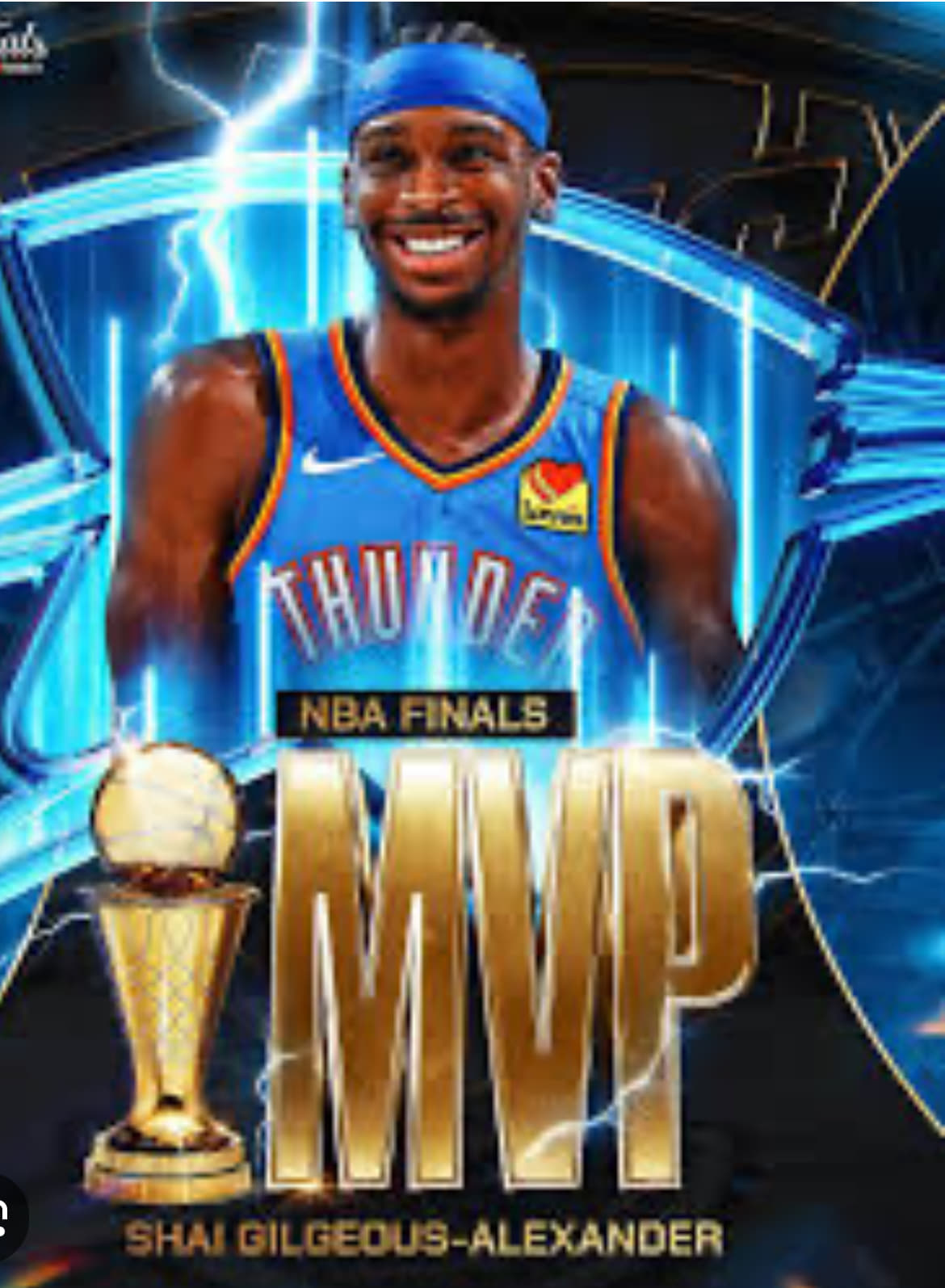
SGA might’ve lifted the Finals MVP, but this championship smells like sweat not stardust.
The Thunder just became the youngest squad in nearly half a century to win an NBA title, and they did it on a formula most execs swore was extinct: defense-first role players, bench culture, and a head coach who lets 23-year-olds fail forward in primetime. It wasn’t the cleanest Game 7. It didn’t need to be.
Because while everyone was scanning for stars, OKC went back to the hardwood. Lou Dort? He made T.J. McConnell question his passport. Chet Holmgren? Five blocks in a Finals clincher after looking overwhelmed in Game 4. Alex Caruso? Drove the bus for the second unit and crashed it straight through Indiana’s third-quarter hope.
Vince said it best on the pod: “You win with guys who don’t flinch when the lights cut out.” That’s what this Thunder squad did. They outlasted.
And yet… there’s a fog hanging over this banner. You can’t pretend Tyrese Haliburton tearing his Achilles in the second quarter didn’t shape the arc of this series. Before that, Indiana had tempo. They had angles. They had belief. The injury didn’t just take out their star it vacuumed the soul out of the Pacers’ playbook.
Still, rings aren’t awarded on sympathy. OKC seized every inch. They turned 11 turnovers in a single quarter into an 18–0 run that felt like a training montage from the 90s. “Lunch Pail Index” stuff: screen assists, contested boards, and charges drawn that didn’t make the broadcast.
Nobody had them hoisting in October. But they stacked culture, bought in early, and never deviated from the plan—even when Chet got punked in January or SGA missed time in March.
That matters. Because while we’ll always remember the injury, we can’t ignore the infrastructure. The blueprint.
They didn’t just win the chip. They reminded the league: Grit still travels. Ego doesn’t.
Third Quarter Carnage: Where the Dam Finally Broke
You could feel it coming.
The first half of Game 7 had just enough tension to keep Indiana believers on the line. Down seven at halftime, still scrapping, still bothering OKC’s passing lanes. But the third quarter? That’s where the dam broke. That’s where the Larry O’Brien Trophy started its slow roll toward the Thunder bench.
This wasn’t just a run. It was a defensive drowning. The Pacers turned the ball over eight times in the first five minutes of Q3. That’s not just sloppy that’s system failure. Five of those turnovers were live-ball. Three were straight-up pickpockets at the top of the key. The kind that don’t just flip possession, they flip oxygen.
OKC turned those mistakes into 18 unanswered points. Eighteen. Straight. Before Indiana could blink, they were down 25, their confidence gutted, their primary ball-handler on the bench with a blown Achilles, and the Thunder smelling blood like it was June in Chesapeake.
It wasn’t a highlight reel. It was a defensive wave. Caruso stunting, Dort chesting up, Jalen Williams jumping passing lanes like a caffeine-drunk cornerback. Chet Holmgren’s rotations were near-perfect, cutting off pocket passes before they even got drawn up.
Here's the thing Zach Lowe would love: spacing discipline from OKC even on the break. No wasted corner crashers. Outlet to SGA, flatten the floor, drive-and-kick to Alex Caruso... BANG. It wasn’t flashy, but it was ruthless.
Indiana was too banged up to survive a blizzard of turnovers like that. No Tyrese, no true release valve. Nembhard tried, but the reads closed too fast. Mathurin wanted it, but the handle just isn’t tight enough yet. McConnell is your primary bucket getter, you know there is a glitch in the Matrix!!! Oklahoma City squeezed the life out of the Pacers like a Boa Constrictor would!
By the time the Pacers called timeout with 4:19 left in the quarter, Vince was already calling it on the pod:
“That wasn’t a run. That was an eviction notice.”
Sometimes, the Finals hinge on a shot. This one flipped on a stretch of chaos so total it felt like the hardwood tilted. Third quarter, Game 7. That’s where OKC didn’t just win the game they took the crown.
Haliburton’s Achilles and Indiana’s Fork in the Road
You hate to say it, but the history books are ruthless.
Game 7. Tyrese Haliburton goes down, grabs his leg, and that’s it. Achilles. Done. Not just his game Indiana’s trajectory, too. In that moment, the Pacers didn’t just lose their best player. They lost the map. And the basketball gods might’ve just handed them a backdoor key to their next franchise cornerstone.
Because here’s the thing: the entire NBA changed the moment Haliburton tore that tendon. Before that? Indiana was 24 minutes away from chaos. Maybe even a ring. After? They looked like a team that needed a six-month timeout and a G-League call sheet.
But what if this is a Spurs moment? What if this is 1997 all over again? Robinson goes down, Spurs tank, get Duncan, win titles for the next 15 years. Now imagine this: Indiana fades next season (no Tyrese, no Lillard, no chance). They hang around the 6th–8th worst record range, maybe jump in the lottery. And suddenly you’re talking about A.J. Dybantsaor Cameron Boozer catching lobs from a fully healthy Haliburton in 2026.
That’s not a rebuild. That’s a reset with benefits.
Bobby Marks would call it “smart pain.” The kind of setback that forces a team to look in the mirror and say, “Do we really want to run it back with mid-tier vets and a maybe roster?”
Because here’s the other angle: Pascal Siakam. Do you extend him? Let him walk? Flip him for future picks and a young 3-and-D wing from some desperate contender trying to duck the second apron?
The Pacers have options. Dangerous ones.
And let’s not forget: Haliburton’s leadership wasn’t just vibes. It was vocal, structured, high-IQ floor general stuff. Vince even said on the pod:
“He’s a culture setter. He’s their new Reggie, with a brain wired like Steve Nash.”
That’s not hyperbole. That’s blueprint energy. And even if Tyrese doesn’t touch hardwood until 26 - 27 season he’s still that guy in Indiana’s locker room.
So what’s the fork? Path A: force contention, burn out. Path B: pull a Spurs, play the long game, get a generational wing to ride shotgun with Tyrese.
Sometimes, the timeline picks you. This might just be Indiana’s chance to rig it back in their favor.
Durant to Houston: Steal or Setup?
The Rockets landed Kevin Durant. That’s the headline. But what’s buried under the ticker crawl — in bold, all caps, triple-underlined for people who know is this:
Phoenix got fleeced. Like down-to-the-penny fleeced.
Look, I know KD is 36. I know he’s maybe a half-step slower, and maybe he looks at defense the way I look at cardio: "someone else can handle it." But he’s still a walking mid-range bucket and a top-15 all-time playoff weapon. And yet Phoenix gave him away like a last-season Timeshare.
So what did they get back?
Jalen Green – raw, redundant, streaky.
Dillon Brooks – vibes vampire, playoff pyromaniac.
Their own 2025 #10 pick back (which… thanks?).
Five second-rounders that feel more decorative than useful.
Now here’s what they didn’t get:
Cam Whitmore: baby Sprewell in transition, plays angry, still raw.
Reed Sheppard: G League microwave with a 45-degree release and no fear.
Jabari Smith Jr.: modern 4 with two-way upside, Houston’s glue guy of the future.
So here’s where we ask: What is Brian Gregory doing?
Phoenix’s new Player Personnel guy inherited a roster with three combo guards over 6’4" and still added another one. They have zero vertical rim protection. They’re a puzzle with all edges and no middle. This trade didn’t fix that — it doubled down.
If you're sitting in Phoenix, you just watched a generational scorer walk out for a couple of erratic guards and no frontcourt balance. You also didn’t even pry Jabari, the least shiny of Houston’s unicorn stable, who could’ve filled exactly the gap Ayton left.
And now… Durant’s in Houston.
Sharing the floor with Amen Thompson, Cam Whitmore, Jabari, Shingun, and FVV. That team isn’t just long — it’s loaded. Balanced. Nasty. Deep.
So let me channel my inner Wosny here:
“This trade ain’t just a miss. It’s a manifesto. A declaration from Phoenix that says, ‘We don’t know who we are anymore.’”
And from the Simmons school of thinking:
“If you swapped jerseys and told me Houston got KD plus assets… I’d believe you.”
Now we want to hear from YOU, the NBA - FRPC Audience!!!
CTA:
🗳️ What grade do YOU give the trade?
A) A – Future dynasty setup
B) B – KD still valuable, but it’s risky
C) D – Phoenix botched it
D) F – Trade malpractice
July 6th is looming! Why Jalen Green's Stay Might Be Short-Lived
Let’s be honest — Jalen Green in Phoenix is like giving a teenager a Ferrari with no GPS.
He’s exciting. He’s fast. And he’s about to crash into redundancy.
Phoenix now has four guys — Booker, Beal, Grayson Allen, and Green — all between 6'4" and 6'6", none of whom want to pass first, all of whom need the ball, and not a single one of them plays big. Green isn’t a point guard. He’s not a spot-up shooter. He’s a high-usage, vibe-heavy rhythm scorer who needs 15+ shots a game to get cooking.
That is not happening next to Devin Booker, who’s entering his "I’m not sacrificing for this anymore" era.
Now factor in the July 6th trade window — the date the KD-to-Houston deal becomes official. That’s when cap structures settle and all the contractual smoke clears. If Phoenix is serious about rebalancing this disaster of a roster, Green is the only asset they can dangle that still has theoretical upside.
Expect phone lines to heat up the second the clock strikes midnight on July 6.
The Raptors? They’re hoarding wings like vintage vinyl — maybe Jalen for one of their switchable long wings!!!
The Nets? Rebuilding, guard-needy, and they’ve worked with Phoenix before.
The Cavs? Hear me out, tiny backcourt, Green would provide much needed size!
The Hawks? Atlanta has a bunch of young 6’8” wings!
Even the Lakers could sniff around, if the Suns are willing to move him within the conference.
Here’s the bottom line: Jalen Green was never meant to stay.
He was the “something shiny” tossed in to sell the Durant trade as a “retool.” But Phoenix doesn’t need shiny. It needs structure. Size. Defense. Cohesion. Green doesn’t offer that. Not now. Not with Booker and Beal still breathing in the same backcourt.
So this isn’t a question of if Green gets moved. It’s where and how quickly they can turn him into rotation balance — a two-way wing, a rim runner, or a 3&D adult.
If Phoenix lets this July 6th window close with Jalen Green still on the roster?
That’s not mismanagement.
That’s self-sabotage.
📉 Phoenix Suns: The $200M Guard Problem
Four guards. One ball. Zero rim protection.
Welcome to the 2025 Phoenix Suns or as we call it at FRPC, The Guard Party Nobody Asked For.
Here’s the situation:
Devin Booker – $55M a year, franchise cornerstone, done sacrificing.
Bradley Beal – $50M and a full no-trade clause.
Grayson Allen – $15M, 3&D-ish, the only one who doesn’t need 15 shots.
Jalen Green - $33M, reckless drives to the basket and inconsistent defensive effort!!! “aka” Not Long For Phoenix!!!
That’s nearly $200M tied up in a single positional archetype:
Undersized scoring guards, all between 6’3” and 6’5”, all defensive liabilities, and all most effective with the ball in their hands.
Now, maybe new personnel man Brian Gregory is onto something. Maybe Phoenix is going to lean all the way into chaos. Maybe they call up Darvin Ham, offer him the job, and say:
“Do what you did with the Lakers… except go Full Guard Voltron this time.”
Laker fans are already wincing. Remember the 4-guard lineups? The wild Russell–Dennis–Reaves–D’Lo experiments that left Anthony Davis isolated and exasperated under the rim? All of Lakers Nation looking like Chris Tucker as “Smokey” flinching just hearing Darvin Hamm and affinity for guard heavy rotations!
Yeah. That might be Phoenix’s new blueprint by necessity, not design.
Zach Harper would call this “a vibes roster with no connective tissue.”
Bobby Marks would ask, “How do you flip $200M of guard money into something that rebounds?”
The problem isn’t just overlapping skillsets. It’s that none of these guards fill what Phoenix actually needs:
– A starting-caliber center
– Switchable wings
– Defensive leadership
– On-ball glue guys
Instead, they’re prepping for a 3-Point Contest roster masquerading as a playoff rotation.
This isn't a rotation. It’s a box score waiting to be meme’d.